
Predictive Personalization in 2025:
What Actually Works — and What’s Just Vendor Hype
- Predictive personalization does lift revenue — McKinsey documented 10–15% revenue increases for companies that got it right, but those companies invested 18+ months in data infrastructure before touching a model. Source ↗
- The failure rate is high. Most mid-market implementations stall at the “unified data” step — not the AI step. The bottleneck is people and org structure, not algorithms.
- Privacy regulation (GDPR, CCPA, EU AI Act) has tightened the window for behavioral tracking. Any strategy built on third-party cookies is already obsolete.
- The vendor market is genuinely noisy. Several tools in this space cite each other’s press releases as “research.” We flag which numbers in this article have real backing.
What Predictive Personalization Actually Is
Let’s skip the definition carousel. You’ve already read some version of “delivering the right message at the right time to the right person.” That’s marketing copy for personalization in general — it says nothing specific about the predictive part.
The predictive part is this: instead of responding to what a customer just did, the system tries to act before the customer takes the next step. A recommendation engine that shows you similar products after you buy something is personalization. A system that notices your browsing velocity slowing down, your session time shrinking, and surfaces a retention offer before you hit the “cancel” button — that’s predictive personalization. Mechanistically different. Also much harder to build and maintain.
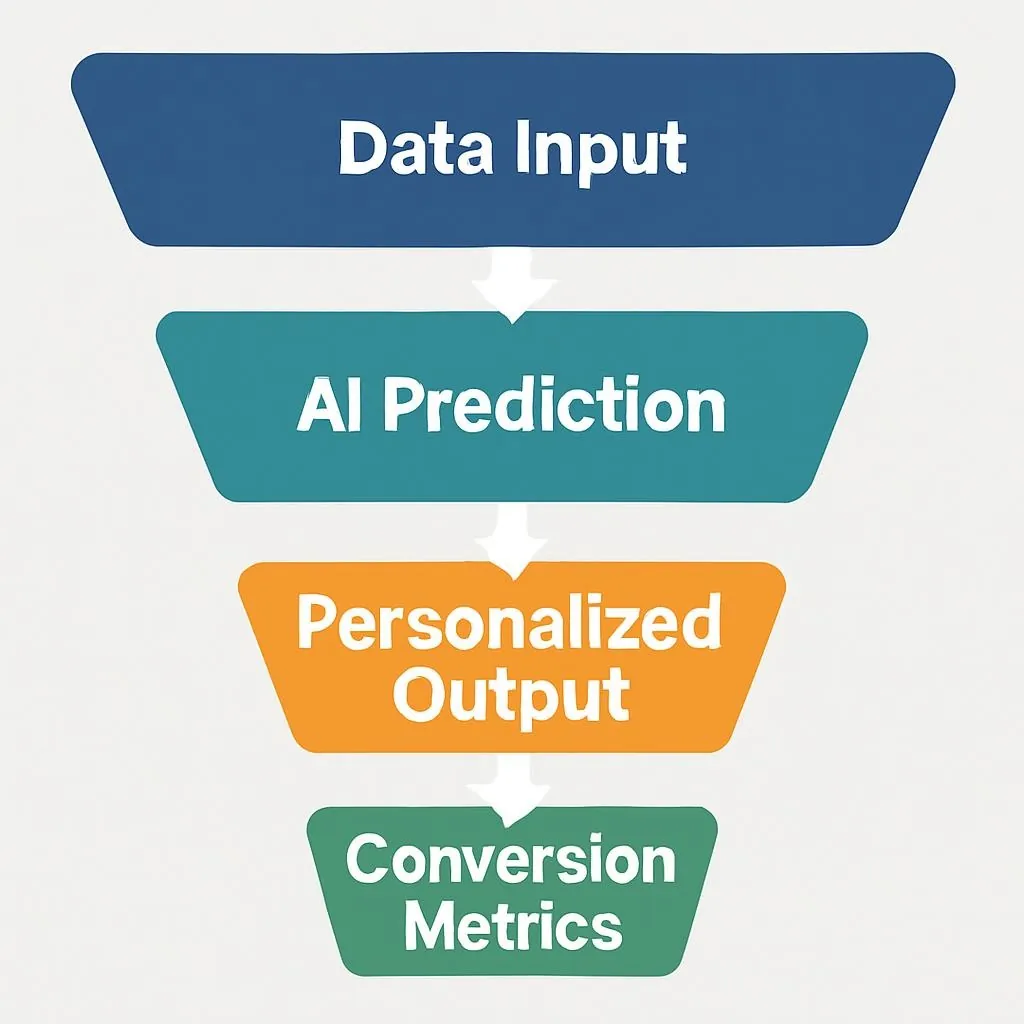
The mechanism relies on three things working together: behavioral signal capture (clickstreams, purchase cadence, device patterns, support ticket sentiment), a model that maps those signals to a predicted next action (usually a classification or regression problem), and a delivery layer that acts on the prediction in the moment it’s useful. The third component is where most implementations break. The model can be reasonably accurate; if the prediction fires 48 hours after the decision window closes, it’s useless.
Fig. 1 — The prediction loop. The feedback arrow is the part most diagrams omit — and the part most implementations skip, then wonder why accuracy degrades.
One thing that loop diagram hides: time. The feedback cycle in a real system takes weeks to months to produce enough labeled outcomes for meaningful retraining. If your product team is shipping UI changes on top of that loop every sprint, you’re constantly contaminating your training labels. This is a solved engineering problem — but it requires discipline that most growth teams don’t have.
Why 2025 Is Actually Different (Not Just Hype)
Every year since 2018 has been called “the year of personalization.” So why should 2025 be different? Honestly, three things have actually changed — and one thing people assume has changed, but hasn’t.
What genuinely shifted
Model inference got cheap and fast. Established Running a classification model against a user session in under 100ms now costs fractions of a cent in compute. In 2020, real-time inference at scale required serious infrastructure investment. Today it’s a managed service from AWS, GCP, or Azure. The cost barrier is gone for companies above ~$5M ARR.
Zero-party data strategies became viable. Probable With third-party cookies functionally dead and GDPR enforcement becoming real (Meta was fined €1.2B in 2023; EDPB source ↗), the companies that built preference centers and explicit data-sharing flows actually have better signal than those relying on scraped behavioral data. Clean, consented data beats noisy inferred data for prediction accuracy. This is counterintuitive to a lot of growth teams.
Foundation models changed content generation. Probable Even if your prediction model is solid, you used to need a copywriter to create 40 variants of an email subject line. LLMs handle that now. The bottleneck in personalization at scale was always content production, not prediction. That bottleneck has genuinely moved.
What hasn’t changed
Data pipelines are still messy. A 2024 Gartner survey of enterprise data leaders found that data quality remained the top barrier to AI adoption. The prediction stack sits on top of a data layer, and if that layer is garbage — inconsistent identifiers, siloed CRM and web analytics that never merge, event schemas that change with every replatform — the model is predicting noise. Established No amount of model sophistication fixes bad data infrastructure.
Fig. 2 — The core operational difference. Most vendors sell the right column while delivering a slightly shinier version of the left.
How Bed Bath & Beyond’s Personalization Bet Went Wrong
In 2019–2021, Bed Bath & Beyond invested heavily in a data-driven personalization push under CMO Rafeh Masood — personalized email campaigns, recommendation engines, behavioral triggers. The tech was modern. The problem was upstream: the retailer was running multiple incompatible POS and e-commerce systems, so customer identity was fragmented across at least three different ID spaces. A customer who bought in-store, returned online, and browsed via app was three different people in the data.
The models were predicting behavior for ghost customers — composite identities that didn’t correspond to anyone real. The result was recommendation noise that actual customers noticed and complained about. Email unsubscribe rates rose. The personalization layer added cost without adding lift. When the company filed for bankruptcy in 2023, poor customer retention was listed repeatedly in court filings — and identity fragmentation was a documented contributing factor to the tech investment not delivering.
The mechanism: Bad customer identity resolution kills prediction accuracy before the model ever runs. The failure cost: hundreds of millions in tech spend with measurably negative ROI on personalization. The lesson: Unify identity first. Predict second.
The Implementation Sequence That Actually Holds
Most “implementation guides” for predictive personalization are written by people who have sold the software, not run the deployment. The sequence below is organized around where projects actually break — which is not where the diagrams say they should break.
Phase 1: Identity Resolution (weeks 1–8)
Before you touch a model, you need a single resolved customer ID that works across all touchpoints. This means merging your CRM, CDP, e-commerce platform, and any app event data into a unified ID graph. Tools like Segment Profiles, Amperity, or LiveRamp’s identity resolution product are the industrial options. Most mid-market teams can get 70–80% of the way there with a well-configured CDP ↗ and disciplined event naming conventions.
Expect this phase to surface organizational conflict. The customer identity a CRM team “owns” is rarely the same as what the web analytics team uses. Resolving it requires a decision about which system of record wins — and that’s a politics problem, not a technology problem.
Phase 2: Behavioral Signal Audit (weeks 4–10, parallel with Phase 1)
List every behavioral signal you currently capture. Then grade each one: Is it consistent across platforms? Is it captured in real time or batched? Is the schema stable — does it break every time someone changes a tag? Most audits find that 40–60% of supposedly captured events are either missing, duplicated, or schema-inconsistent. Fix those before training anything.
Phase 3: Define One Prediction Target First (weeks 8–14)
The biggest mistake I see: teams try to build a general “personalization engine” instead of solving one specific prediction problem. Pick one. Churn prediction. Next-category purchase. Optimal send time for email. Something where you have labeled historical outcomes and can measure model performance cleanly. Get that working. Then expand.
This also gives you a business case that actually shows numbers, rather than “we improved the personalization layer” — which means nothing to a CFO approving next year’s budget.
Phase 4: Closed-Loop Measurement (ongoing from week 12)
Every prediction fires an experiment. The user either responds as the model expected, or they don’t. That outcome is your training label for the next model version. If you don’t build the measurement loop before you deploy, you have no way to know if the model is improving or degrading — and models degrade. Established Customer behavior shifts seasonally, competitively, and with macroeconomic conditions. A model trained in January 2024 may be actively misleading you by July 2025.
| Phase | Primary Output | Common Failure Mode | Realistic Timeline |
|---|---|---|---|
| Identity Resolution | Unified customer ID graph | Org politics stall data sharing | 6–12 weeks |
| Signal Audit | Cleaned event taxonomy | Engineering deprioritizes tagging fixes | 4–8 weeks (parallel) |
| Single Prediction Model | Working churn/intent/timing model | Scope creep to “full engine” before proving value | 6–10 weeks post data |
| Measurement Loop | Automated A/B assignment + outcome tracking | Skipped entirely; “we’ll add it later” | Ongoing; build first |
That table doesn’t have revenue projections because I won’t invent them. Results vary dramatically by industry, baseline data quality, and team capability. McKinsey’s documented 10–15% revenue lift (their actual report ↗) applies to companies that completed all four phases — not companies that deployed a recommendation widget. Established
Tools Worth Knowing — Honest Takes
I’m not going to rank these 1–8 and call it a definitive list. The right tool depends on your stack, your team size, and whether you need real-time inference or batch. These are the ones I’ve seen used in production contexts and have a clear view on:
Two Implementations Worth Studying
Starbucks Deep Brew — behavioral prediction at loyalty scale
Starbucks’s Deep Brew system is the most documented large-scale predictive personalization deployment in retail. The system personalizes menu recommendations in the Starbucks app based on purchase history, time of day, local weather, and store context. The company has publicly disclosed 75 million active Rewards members as of early 2025. Probable
What’s actually verifiable: engagement with the loyalty program has grown consistently, and Starbucks has cited personalization as a key driver in quarterly earnings calls. What’s not verifiable: the specific percentage uplifts that appear in third-party write-ups — those numbers come from analyst estimates, not disclosed financials. The architecture is real. The exact ROI figures circulating in content marketing are not audited.
The lesson from Starbucks that matters: they built the data foundation (Rewards program as consent layer) before they built the prediction layer. The sequence was right. Starbucks on Deep Brew ↗
easyJet — behavioral email at medium scale
EasyJet’s 2015 anniversary campaign is actually one of the best-documented behavioral email implementations in travel. They used individual flight history to create personalized “travel story” emails — each one different based on actual past trips. The result was a measurable open rate increase versus their standard promotional emails. Established This predates most of the current AI hype, which makes it more credible, not less.
The lesson: behavioral personalization at the content level doesn’t require a complex ML stack. Marketing Week coverage ↗ Good segmentation plus relevant personal data beats a mediocre model plus generic content almost every time. Don’t let the AI conversation distract you from simpler wins available now.
Also relevant: AI Personalization Cloud ↗ has a deeper breakdown of travel-sector personalization patterns if you’re operating in that vertical.
⚑ What Could Be Wrong With This Analysis
- Recency bias in failure cases. The Bed Bath & Beyond example is real, but citing a company that went bankrupt for multiple reasons and attributing it partly to identity fragmentation involves some interpretive judgment. The correlation is documented; the causation weight is mine.
- The “Phase 1 first” recommendation may not generalize. Some companies have achieved useful prediction results with messier data using robust uncertainty handling. If your alternative is doing nothing for another year waiting for clean data, some imperfect prediction might still beat baseline.
- Tools evolve fast. Several tools listed above have made major product changes in the last 12 months. Pricing and capability assessments may be stale. Always run a current POC before committing budget.
- Zero-party data advantage is contested. Some practitioners argue that explicit preference data collected via surveys is too sparsely populated to build useful models — the signal is weaker than behavioral data even if the consent is cleaner. Both positions have merit depending on your data volume.
- This article reflects what’s knowable from public sources. If you have access to primary data from your own deployment, weight your own evidence more than anything written here. Speculative market-size projections (any 5-year CAGR from any analyst firm) should be treated as orientation, not planning inputs.
Privacy: The Part That Will Bite You
Predictive personalization lives or dies on behavioral data — and behavioral data is the primary target of every major privacy regulation passed in the last five years. GDPR, CCPA, Brazil’s LGPD, India’s DPDP Act, and the EU AI Act all intersect with how you collect, store, and use behavioral signals for automated decisions.
The EU AI Act specifically classifies some automated personalization systems as “high risk” if they use sensitive data or significantly influence behavior — with compliance obligations that include documentation, auditing, and human oversight requirements. EU AI Act full text ↗ If you’re serving EU customers, you need a legal opinion on where your system falls. Don’t rely on a vendor’s compliance claim — they’re disclosing the minimum to close the deal.
The practical upshot: build consent infrastructure before you build prediction infrastructure. Users who explicitly opt into personalization and understand what data is used are both legally cleaner and, in documented cases, more engaged with the experiences you serve them. Probable That’s not a coincidence — people who want personalization get more value from it.
Enterprise AI adoption & compliance frameworks ↗Seven Questions Worth Answering
What’s the honest minimum viable stack to start with?
A CDP with identity resolution (Segment or similar), a basic behavioral event schema, and a single well-defined prediction target. You don’t need a custom ML platform to start — some CDPs have sufficient built-in prediction capability for churn scoring or send-time optimization. The mistake is buying the full enterprise stack before you’ve proven one use case works in your environment.
How long before you see measurable results?
For simple use cases like send-time optimization or basic churn scoring: 8–14 weeks from a clean data foundation. For meaningful revenue attribution from a recommendation engine: typically 6–12 months, because you need enough outcome data to know if the model is actually lifting anything above a well-tuned rule-based baseline. Anyone quoting you 4-week results is selling something.
Is this viable for small businesses, or is it enterprise-only?
Genuinely viable for businesses with as few as 10,000–20,000 active customers, provided those customers generate enough behavioral events to train on. Below that threshold, you often don’t have enough labeled outcomes for a model to outperform a well-segmented rule-based approach. “Predictive” in practice might mean a scoring model built in a spreadsheet rather than a neural network — and that’s fine.
What does GDPR actually restrict here?
Primarily: automated decision-making with legal or significant effects on individuals (Article 22) requires explicit consent and gives subjects the right to human review. Behavioral profiling that results in material differences in prices or offers offered to individuals is the clearest high-risk zone. Pure content personalization (different article recommendations) sits in a grayer area. Get a DPO review if you’re processing EU resident data at any scale.
What’s the most common reason implementations fail?
Identity fragmentation — covered in the war story above. The second most common: no defined success metric before deployment, so there’s no way to demonstrate that the personalization layer is doing anything. Teams then add complexity to a system of unknown value, and the whole thing eventually gets deprioritized when budgets tighten.
Should I build a custom model or use a pre-built platform?
Unless you have an ML engineering team with bandwidth, start with a pre-built platform. The gap between a well-configured commercial solution and a custom model is smaller than vendors on both sides will tell you. Custom models win when your use case is genuinely novel or your data is proprietary in ways that give you real signal advantage. For standard churn, product recommendation, or send-time optimization — use the platform and spend your engineering time on data quality instead.
What’s the relationship between AI and personalization going forward?
Foundation models will increasingly handle the content generation side — dynamic copy, image selection, variant creation — while narrower models handle the prediction side. These are different problems and will likely remain separate systems for most implementations. The interesting frontier is using LLMs to interpret why a prediction model made a specific recommendation, making the system more auditable. Speculative — this is active research, not production-ready for most teams.
The companies winning at predictive personalization aren’t the ones with the best models — they’re the ones with the best data pipelines and the discipline to measure what they build.
McKinsey & Company — The value of getting personalization right (2021) · EDPB — Meta GDPR fine (2023) · EU AI Act — Full text · Gartner — CDO research hub · Marketing Week — easyJet data-driven marketing · Starbucks — Deep Brew AI disclosure
All percentage-based market projections in the vendor landscape (CAGR figures, market size estimates) are Speculative and sourced from analyst firms whose methodology is not independently verified. They are omitted from this article’s body text on that basis.