


AI Implementation Strategy: The Framework That Separates the 19.7% That Win From Everyone Else
$547 billion burned. 80% failure rate confirmed by RAND, MIT, and Gartner. Here’s the exact six-phase playbook used by the enterprises that actually made it to production — and the three things they all did differently.
The Brutal Truth Nobody Wants to Print
Let me just say this upfront: most AI implementation guides are written by people who have never actually sat in a war room at 11 p.m. watching a $4 million pilot implode because the data team and the product team never agreed on what “clean data” meant. I have. And that experience is baked into everything in this guide.
In 2025, global enterprises pumped $684 billion into AI initiatives. By year-end, over $547 billion of that — more than 80% — had failed to generate meaningful business value. Not “disappointing returns.” Not “learning experiences.” Flat-out failure, documented and confirmed by the RAND Corporation’s meta-analysis of 65 enterprise AI projects.
For generative AI specifically, it gets worse. MIT’s Project NANDA found that 95% of GenAI pilots never made it to production deployment — with infrastructure limitations causing 64% of those collapses, and cost overruns averaging 380% above pilot projections once you try to scale.
“The failure is almost never the model. It is data readiness, workflow integration, and the complete absence of a defined outcome before the build starts.”
— Composite finding across RAND, MIT NANDA, and Gartner 2026 researchThis guide is the framework used by the organizations that actually win. Not theorized — documented. Six phases, real timelines, the exact governance decisions you need to make at each gate. Let’s get into it.
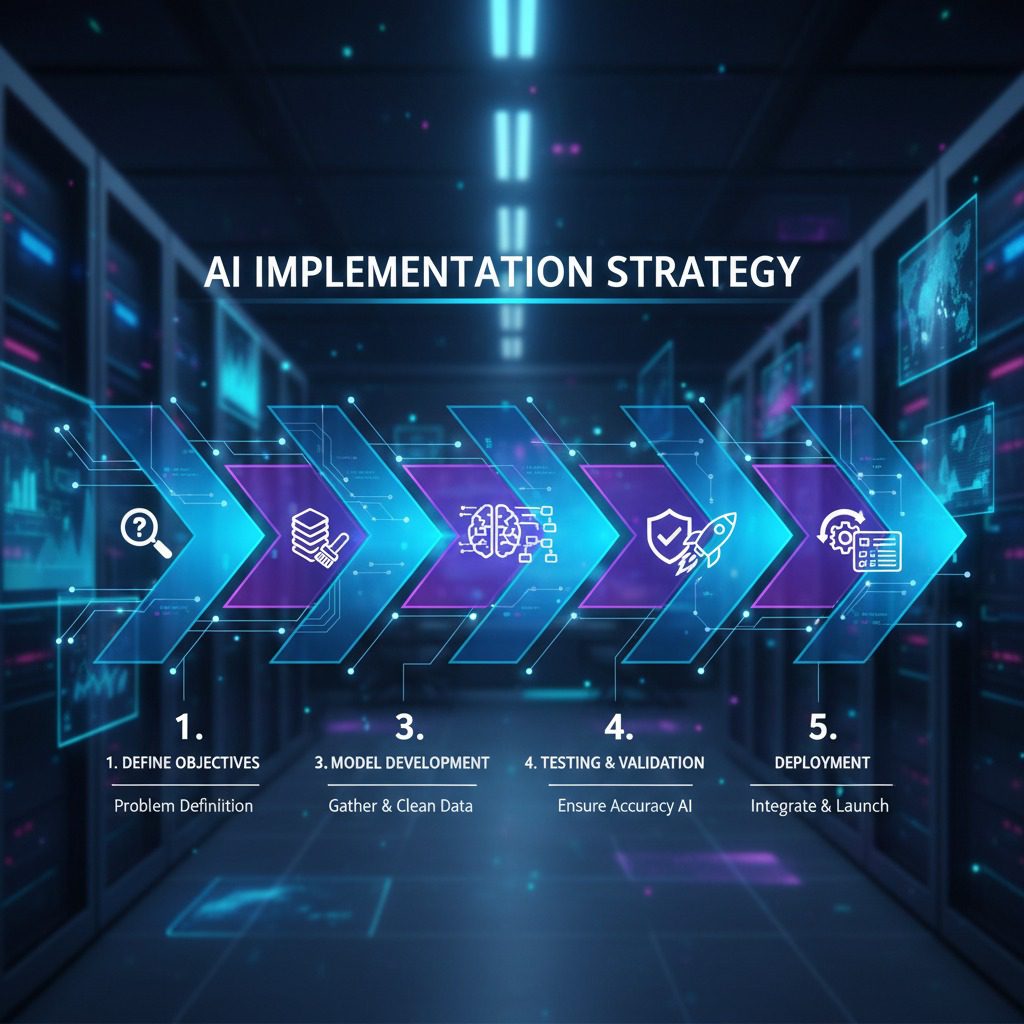
The Six-Phase Framework at a Glance
Before we go deep on each phase, here’s the full arc. Most organizations fail because they skip Phase 2 entirely and underestimate Phase 5 by a factor of three. Keep that in mind as you read.
Strategic Alignment & Executive Ownership
Define the AI vision, secure real sponsorship, stand up a steering committee with actual authority.
⏱ Weeks 1–2AI Readiness Audit
Four-dimension assessment: data, infrastructure, talent, culture. No pilot starts until reds are resolved.
⏱ Weeks 3–6Use Case Prioritization
Filter 10–15 ideas down to 3–5 evaluated candidates, then 1–2 pilots. Ruthlessly.
⏱ Weeks 7–10Pilot Execution
MVP build, limited user test, monitoring infrastructure from day one, measurable success criteria.
⏱ Weeks 11–22Production Deployment & Integration
AI-first workflow redesign, MLOps, change management as a hard project requirement.
⏱ Months 6–12Scale, Optimize & Capture Value
Center of Excellence, advanced ROI measurement, enterprise-scale governance.
⏱ Months 12–18+Phase 1: Strategic Alignment & Executive Ownership
The one move that predicts everything downstream
AI implementation is not an IT project. Repeat that. It is an organizational stress test that exposes every gap in data ownership, decision-making clarity, and cross-functional trust that has been quietly festering for years. Treat it like an IT project and you will get the 80.3% outcome. Treat it like a business transformation program with executive teeth, and your odds flip dramatically.
Here’s what “strategic alignment” actually means in 2026 — not a vision deck, not an AI committee with 14 members who meet quarterly. It means three concrete things done before anything else moves:
- A 3–5 year AI vision anchored to specific business metrics. Not “leverage AI for competitive advantage.” Something like: “Reduce customer churn from 18% to 14% within 6 months using predictive retention models” or “Automate 40% of tier-1 support inquiries by Q4.” If you cannot write the success number before you start, you are not ready to start.
- An executive sponsor who actually has decision authority. Organizations with active leadership buy-in succeed at measurably higher rates than IT-driven AI programs without business leadership engagement. This is not about a Chief AI Officer title. It is about giving an existing executive — someone who can sign off budgets, resolve cross-functional disputes, and kill projects that need to die — explicit responsibility for AI outcomes.
- A steering committee with real operating rules. Business, IT, and data leaders in the same room with documented decision rights. Who approves go/no-go at each phase gate? What triggers an immediate stop? What’s the escalation path when data and product disagree? Write it down before you need it.
Creating an AI strategy document that lives in a shared drive and is referenced at the next all-hands. Strategy that does not drive weekly operating decisions is decoration. Your steering committee should be making at least one consequential go/no-go call every two weeks during phases 2–4.
Deliverable from Phase 1: AI strategy document with SMART objectives, executive sponsor charter (named person, decision rights, accountability metrics), and steering committee operating model with defined phase gates.
Phase 2: The AI Readiness Audit
The phase 42% of companies skip — and why they regret it
Gartner’s 2026 forecast is not ambiguous: 60% of AI projects that lack AI-ready data will be abandoned before they generate value. The 42% of U.S. companies that had already abandoned most of their AI initiatives by late 2025 — up from 17% the prior year — are the proof. Every single one of them thought their data was “good enough” before they found out it wasn’t.
Your readiness audit covers four dimensions, and you need zero tolerance for optimism bias in any of them. I’ve sat in rooms where the data team said “yeah, we’re basically ready” and we spent the first six weeks of the pilot just cleaning field names. That is an $800,000 mistake you can avoid entirely with an honest audit.
Data Readiness
- Is data clean, labeled, and governed?
- Can it be accessed in real time?
- Is Model Context Protocol (MCP) architecture in place?
- Is data lineage documented and ownership assigned?
Technology Infrastructure
- Cloud/hybrid architecture readiness
- Edge computing capacity for latency-sensitive apps
- GPU/TPU/ASIC availability and cost modeling
- MLOps tooling and CI/CD pipelines
Talent & Skills
- Skills gap mapped vs. Skills Change Index
- “Agent Orchestrator” role readiness identified
- Human-in-the-loop trust framework drafted
- Training and reskilling budget allocated
Organizational Culture
- AI maturity stage formally assessed
- Workforce resistance hotspots mapped
- Change management owner assigned
- Shadow AI policy drafted
On the talent dimension specifically: with nearly 30% of work hours potentially automated by 2030, your audit needs a “Skills Reset” plan — not just a training plan. The difference matters. A training plan teaches people to use AI tools. A Skills Reset plan redesigns entire job roles around what humans will do when AI handles the routine execution layer. Writer’s 2026 Enterprise AI Adoption research shows 79% of organizations face adoption challenges, with workforce resistance among the top barriers. You need to know where your resistance will come from before you deploy anything.
Do not greenlight any pilot until your primary data domain is fully cleaned, data ownership is documented and signed off, and your use case scope is tight enough that data drift from adjacent systems cannot contaminate it. If any of those three conditions are red, the pilot launch date does not move.
Deliverable from Phase 2: Readiness assessment with red/yellow/green ratings across all four dimensions, plus a remediation plan — with named owners and hard deadlines — for every red.
Phase 3: Use Case Prioritization
Where you learn to say no — fast
Most enterprises drown in possibility here. AI can theoretically touch everything. Your job in Phase 3 is to kill 85% of those ideas with discipline and move fast on the 15% that actually justify the risk.
The filter works in three steps. This is not new — but I’ve seen dozens of organizations replace it with “vibes-based prioritization” in leadership offsites and spend six months building the wrong thing. Run the filter.
Score each of your 10–15 candidates on a 5-point scale across five dimensions: business impact (revenue, cost, risk), data readiness, technical feasibility, resource requirements, and time to value. Plot them on a Value vs. Effort matrix. Be merciless.
The 2026 shift worth noting: with 57% of corporations already deploying AI agents, prioritize use cases that can feed into multi-agent workflows in high-ROI areas — customer service orchestration, software engineering pipelines, or supply chain optimization. A single-agent use case that cannot eventually plug into a broader workflow is a dead end at scale.
If you cannot define one single measurable success metric before the pilot starts — a reduction in processing time, an error rate, a throughput number — you do not start. “Better customer experience” is not a metric. “Reduce average handle time from 8.2 minutes to 5.5 minutes” is a metric. Qualitative goals belong in marketing decks, not pilot charters.
Deliverable from Phase 3: Prioritized use case portfolio with full business cases, scoring rationale, pilot selection justification, and a pre-agreed definition of success for each pilot.
Phase 4: Pilot Execution
Contained, low-risk, designed to prove a specific thing
Choose a pilot with a time horizon of 3–4 months maximum. Early wins are not nice-to-haves. They are the political capital that funds your next phase. Without a concrete win at the 16-week mark, most steering committees start hedging, budgets get frozen, and the whole initiative stalls.
Build a cross-functional team — not a data science side project with a business stakeholder “liaison.” Put a domain expert in the room from day one. The person who knows why customers churn, which SKUs break supply chain, or why ticket escalations spike on Tuesdays. Without that domain knowledge baked in, your ML engineers will optimize for the wrong outcome and your pilot will technically “succeed” while solving the wrong problem.
Four things that determine whether your pilot produces useful signal or expensive noise:
- Build an MVP, not a feature-complete system. You’re proving value, not building software. The MVP should demonstrate one core capability in one real workflow with real users. Anything beyond that is scope creep dressed up as ambition.
- Test with real users from the target population. Not power users who love technology. Not the people who volunteered because they’re curious about AI. The median user — cautious, busy, slightly skeptical. Their feedback will be harder to hear and more important to act on.
- Deploy monitoring infrastructure on day one, not after. NVIDIA’s State of AI 2026 report found that enterprises with production monitoring in place from the start report 40% fewer model quality incidents over the first 12 months versus those that add it reactively. Build it in. This means model performance tracking, data drift detection, anomaly alerts on business KPIs, and a clear escalation path when something breaks.
- Measure against your pre-defined success criteria. Only those. Pilot scope creep kills more AI initiatives than technical failure. When someone says “while we’re at it, can we also track X?” the answer is no. Document the request, evaluate it for Phase 5, and close that conversation.
Deliverable from Phase 4: Working pilot with performance metrics, user feedback analysis, documented learnings (including failures — document those especially carefully), and a go/no-go recommendation for production with supporting evidence.
Phase 5: Production Deployment & Integration
The phase where value is either captured or vaporized
This is the hardest phase. Not technically — organizationally. The AI system is ready. The workflows are not. And the people definitely are not. Moving from pilot to production means changing how people actually do their jobs, which triggers every form of institutional resistance your culture has been quietly hoarding.
AI change management is not a soft skill add-on. It is a hard project requirement with its own workstream, timeline, budget, and owner. Fail here and it does not matter how good the model is.
What production deployment actually requires:
- Redesign workflows to be AI-first, not AI-augmented. Do not bolt the AI onto the old process. Go back to the workflow’s purpose and redesign it from scratch with AI as a native capability. This takes longer but captures 3–4x more value than augmentation approaches.
- Training tied to real workflows, not general AI awareness. “AI literacy” training without workflow context is $500/head of compliance activity that changes zero behavior. Role-specific training — “here is how you, as a credit analyst, will use this model in your Tuesday review process” — changes behavior and drives adoption.
- MLOps infrastructure for ongoing model management. JPMorgan scaled its LLM Suite to 200,000 daily users in 8 months by building model-agnostic MLOps from day one. AI benefits growing 30–40% annually in their deployment. That trajectory requires continuous model refresh, retraining pipelines, and automated performance monitoring — not a manual review every quarter.
- Performance dashboards tracking three layers: model health (drift, accuracy, latency), operational outcomes (the KPI your use case was designed to move), and business impact (revenue, cost, risk). If your dashboard only tracks model metrics, your business leaders will not trust it. If it only tracks business metrics, your engineers cannot act on it.
A production deployment with a clear workflow owner (not just a system owner), a 90-day adoption curve tracked by department, and a weekly cadence where model performance and business outcome data are reviewed together. If those three things are in place, you are in the top quartile.
Deliverable from Phase 5: Production-ready AI system with integrated workflows, MLOps infrastructure, role-specific training programs with adoption tracked by department, and performance dashboards reviewed weekly by a named business owner.
Phase 6: Scale, Optimize & Capture Value
When AI stops being a project and becomes infrastructure
By month 12, AI should not feel like an experiment. It should feel like electricity — something the organization depends on and stops thinking about consciously. Getting there requires deliberate architecture decisions, not organic growth.
Expand successful pilots through phased rollout — always phased, always with a new cohort baseline measured before expansion — and refine models using production learnings. Every 90 days at scale, your model should be better than it was because of what real users have revealed.
The Center of Excellence Model
Your AI Center of Excellence (CoE) is not a committee. It is a governance body with enforceable standards. In 2026, the enterprises that are pulling ahead have settled on a tiered tool governance model:
| Tier | Tool Type | Examples | Governance Rule |
|---|---|---|---|
| Primary | Productivity AI workspace | Microsoft 365 Copilot, Gemini for Workspace | One platform. Default for all routine work. No exceptions. |
| Secondary | Frontier reasoning model | Claude, ChatGPT Enterprise | For high-cognition workflows. Approved use cases only. |
| Specialist | Domain-specific tools | Code assistants, legal AI, finance models | CoE approval gate required. Reviewed quarterly. |
The ROI numbers at scale are real — but only if you get there. LinesNCircles’ 2026 Enterprise AI ROI analysis shows firms that reach production-scale processes report an average ROI of 1.7x, with cost savings of 26–31% across supply chain, finance, and customer operations. In manufacturing, predictive maintenance AI has delivered a 40% reduction in maintenance costs at scale. Those numbers are not available at pilot stage. They require Phase 6.
Deliverable from Phase 6: Enterprise-scale AI operations, CoE governance model with tool approval framework, continuous optimization cadence, and board-level ROI reporting across direct, operational, and strategic value dimensions.
The Governance Layer: Running Beneath Every Phase
Three deployment models — one decision you cannot avoid
At some point — usually around the Phase 3 to Phase 4 transition — your leadership team will face a foundational architecture decision that locks your cost structure and data control posture for 3–5 years. Most organizations make it by accident. Make it on purpose.
| Model | Best For | The Real Risk | 2026 Fit |
|---|---|---|---|
| BUY | Standardized use cases, fast deployment, predictable cost baseline | Long-term vendor dependency; usage costs compound aggressively at scale | Good for non-differentiating workflows (HR, finance admin, IT support) |
| BUILD | Competitive differentiation, strict regulatory requirements, proprietary data | Significant upfront investment; ongoing operational and talent cost | Justified only when the use case is core to competitive advantage |
| HYBRID | Flexibility across use cases, control over sensitive data workflows | Requires architectural discipline and strong governance to prevent sprawl | The 2026 default for enterprises with 5+ active AI use cases |
The 2026 emerging standard: a “Router” architecture where simple, high-volume tasks route to fast, cheap Small Language Models (SLMs), and complex reasoning tasks route to Frontier LLMs. This gives you the cost efficiency of commodity models and the capability ceiling of premium ones — without paying frontier prices for everything.
The EU AI Act — August 2026 is Not Optional
If you operate in or serve the EU, August 2026 is a hard compliance deadline. High-risk AI systems must have full technical documentation, human oversight protocols, and CE marking in place. “We’re working on it” is not a legal position. Your governance framework needs:
- Ethical AI guidelines covering bias detection protocols and transparency requirements
- Human oversight mechanisms for every high-risk classification in scope
- Risk management documentation covering technical, operational, and reputational exposure
- GDPR alignment review for every system that processes personal data
- Incident response procedures tested before August, not after
Shadow AI: The Problem You Cannot Afford to Ignore
Here’s something most strategy guides skip: as of 2026, a significant portion of AI use inside enterprises is completely unmanaged personal AI account usage on company work. ChatGPT free tier, consumer Claude, Gemini personal — employees using these tools for work without IT visibility, without data governance, and without any organizational control over what proprietary information is being fed into third-party models.
Ban unmanaged personal AI accounts for company work. Then enforce it. Discovery requires network-level monitoring, browser-level visibility, employee surveys with structured incentives, and IAM integration. If you cannot see it, you cannot govern it. And if something goes wrong — a data leak, a hallucinated regulatory filing, a client confidentiality breach — “we had no idea our employees were using that” is not a defense that protects the organization.
The 90-Day Recovery Plan
For organizations already behind — this is how you stop the bleeding
If you are reading this after burning budget on one or more failed pilots, here is the reality: you are not uniquely unlucky. You followed the same default path that 80.3% of enterprises take. The recovery is not complicated, but it requires doing something most leadership teams hate — slowing down to go faster.
- Pick one data domain and clean it completely
- Document data ownership, lineage, and access rights
- Identify the top 3 data quality issues blocking your last pilot
- Assign a named data owner with authority to enforce standards
- Assign AI responsibility to a named executive — not a committee
- Define decision rights at every phase gate in writing
- Document the escalation path when data and product disagree
- Kill any projects without a measurable success metric
- Select one use case with the tightest possible scope
- Define one success metric, measurable within 90 days of go-live
- No new platforms, no new CAIO titles — just execution
- When the number moves, you have your scaling lever
When that single metric moves — even partially — you have the organizational proof of concept you need. Not for the technology. For the decision-making discipline and the data infrastructure. Those are what actually scale.
Measuring What Actually Matters
Four layers of AI value — most organizations track only one
Standard ROI measurement is insufficient for AI programs. Too many organizations track cost savings and call it done. The full value picture requires four layers, tracked simultaneously:
- Usage metrics. Daily, weekly, monthly active users by role and department. If adoption is below 60% of target population at 90 days post-launch, you have a change management problem, not a technology problem.
- Depth metrics. Feature utilization rates, workflow integration intensity, number of AI-assisted decisions per user per week. Adoption without depth is not behavioral change — it’s compliance theater.
- Breadth metrics. Cross-departmental adoption, number of workflows with AI embedded, percentage of processes that would be materially degraded if AI were removed tomorrow.
- Strategic agility metrics. Time to deploy new AI capabilities, cost to add use cases, speed of model iteration cycles. These predict your competitive position 18–24 months out.
The board-level metric that matters most in 2026: Percentage of employees operating at “AI Embedded” or “AI-Native” maturity — meaning AI is integrated into their daily workflow, not used occasionally when they remember. Most enterprises sit between Stage 2 (AI Exploring) and Stage 3 (AI Scaling). The gap between Stage 3 and Stage 5 (AI-Native) is exactly where competitive advantage is currently being built and lost.
The Bottom Line
AI implementation in 2026 is not a technology problem. It has not been a technology problem for at least three years. The models are good enough. The infrastructure exists. The tools are mature enough to deploy at scale.
The 80.3% failure rate is a leadership and process gap, full stop. The 19.7% that succeed consistently do three things the majority refuses to do: they clean data before training models instead of during or after, they establish decision-making clarity before allocating budgets, and they scope use cases so tightly that failure is unambiguous and success is undeniable.
Follow the six-phase framework above with the discipline it demands. Not the parts that feel comfortable. All of it — especially the Phase 2 audit nobody wants to do and the Phase 5 change management work everyone underresources. Or don’t, and by this time next year, you will have a very expensive new data point to contribute to the 80.3% statistic.
For more on AI readiness frameworks, see our AI Readiness Assessment Guide. On governance and compliance, read our Enterprise AI Governance Playbook. For use case ROI modeling tools, visit our AI ROI Calculator.
- RAND Corporation meta-analysis — “80% AI Failure Rate 2026: How RAND and Gartner Expose the AI Productivity Gap” (mybusinessfuture.com, April 2026)
- DataNorth.ai — “How to Create an AI Strategy for Your Business (2026 Update)” (datanorth.ai, April 2026)
- Beam.ai — “Why 42% of AI Projects Show 0 ROI” (beam.ai, April 2026)
- Growexx — “AI Implementation Roadmap: Complete 2026 Strategy Guide” (growexx.com, April 2026)
- SR Analytics — “Why 95% of AI Projects Fail and How Data Fixes It” (MIT NANDA findings) (sranalytics.io, February 2026)
- Sombra Inc — “Guide: AI Deployment Strategy for Executives in 2026” (sombrainc.com, March 2026)
- NVIDIA State of AI 2026 Report — Enterprise AI Monitoring & Production Quality
- LinesNCircles 2026 Enterprise AI ROI Analysis — Production-scale outcomes across 2,400+ initiatives
- Gartner 2026 Forecast — AI Data Readiness and Abandonment Rates
- Writer 2026 Enterprise AI Adoption Research — Workforce Resistance and Adoption Challenges