
Workflow Strategy · Updated August 19, 2026
AI Workflow Integration: Augment, Don’t Replace — Why the Distinction Pays Off
The organizations scaling fastest right now aren’t the ones running the most automation. They’re the ones that mapped exactly where human judgment still earns its keep — and built the workflow, the approval gates, and the incentives around that line.
The short version
Tesla’s 2018 Model 3 line is still the clearest cautionary tale in operations strategy: Elon Musk over-automated, admitted “humans are underrated,” and tore out the robots. The pattern has repeated across industries since. Peer-reviewed labor economics and 2026 field data agree on the mechanism, if not the exact magnitude: sectors where AI complements human labor see meaningfully better productivity, job, and wage outcomes than sectors chasing pure headcount replacement — while narrow, highly repetitive white-collar tasks still see real displacement. A new Harvard Business Review analysis from Oxford and Stanford researchers, published in April 2026, adds the mechanism most playbooks miss: augmentation strategies show slower early gains than automation, but tend to win on a longer horizon because they don’t erode employee trust and retention the way headcount-driven automation does. This guide gives you the evidence, an original scoring framework for deciding where the human-AI line should sit, and the concrete rollout steps.
The Automation Trap Is Real — And Well Documented
Elon Musk didn’t expect to end up sleeping on a factory floor in Fremont, California. But in April 2018, that’s exactly what happened — the consequence of betting too heavily on robots to build the Model 3. In a public admission that became a case study in operations classroomsPrimary, Musk wrote that excessive automation had been his mistake, and that humans were underrated. He wasn’t just venting. He scrapped an entire automated conveyor system and brought human workers back because the robots couldn’t adapt to small errors in a complex physical environment.
That’s not a story about robots failing. It’s a story about task selection — knowing which jobs need human adaptability and which don’t. Get the boundary wrong and you don’t just waste money. You build a fragile system that breaks the moment something unpredictable happens, and in real operations, unpredictable things happen constantly.
“Humans are still far more able to adapt to change than AI. When a process changes or a factory starts making a new product, there is a need to reconfigure equipment — something not yet entirely within reach of AI and robotics.”
Professor of Robotics, EPFL, on Tesla’s automation failures — The Conversation
BMW learned the same lesson and chose differently from the start. Flexible teams of humans and robots working together have been shown to substantially outperform automation-only lines in vehicle assembly — the kind of gap that changes a plant’s economics, not just its optics.
⚠ The counter-mechanism, stated plainly
The gains above concentrate in sectors where AI complements human labor. The same body of research shows real displacement in narrow, highly structured, repetitive white-collar tasks — the roles closest to pure pattern-matching. A 2026 empirical review from the International Center for Law & Economics (ICLE) found that adjustment to date has largely occurred through task reallocation and within-firm productivity gains rather than mass displacementPrimary — but that outcome holds only where firms design for it on purpose. It is not the default.
Why Augmentation Outperforms Replacement
“Augment vs. replace” sounds philosophical. It isn’t. There’s a specific mechanism driving the performance gap, and it changes how integration decisions actually get made.
AI is extraordinarily good, at this stage, at pattern recognition applied at scale: processing structured data, flagging anomalies, drafting first passes, forecasting from historical trends. McKinsey’s generative AI research puts the technical ceiling at 60 to 70 percent of employees’ time today. Worth flagging: McKinsey has a track record of overestimating adoption curves — its early Internet-of-Things and automation forecasts both ran well ahead of what actually shipped — so treat that figure as an upper bound on potential, not a forecast of what will actually happen.
Here’s the catch. The tasks AI handles well are rarely where professional value concentrates. Judgment under ambiguity, ethical reasoning, negotiation, exception handling: these are the moments where experienced people still outperform AI, and where clients and patients are least tolerant of an error. Strip humans out of those moments to cut cost, and you degrade the product even as the spreadsheet says you saved money.
Firms scaling fastest right now have made human decision points more visible, not less, so AI does the computational heavy lifting while humans sit at the moments of genuine consequence. Practitioners call these “human approval gates” — quality-control checkpoints, not bottlenecks.
| Dimension | Pure Automation Model | Human-AI Augmentation Model |
|---|---|---|
| Short-term cost | Lower headcount spend | Similar or higher initially (reskilling costs) |
| Error handling | Errors scale with system volume | Humans catch the jagged frontier’s failures before they compound |
| Adaptability | Low — reconfiguration is expensive | High — humans absorb novel situations without a rebuild |
| Productivity trajectory | Early gains that tend to plateau, per HBR’s 2026 analysis | Slower early gains, stronger long-run trajectory tied to trust and retention |
| Labor market effect | Displacement concentrated in exposed roles | Job and wage growth in complementary roles, per 2026 labor data |
| Culture / morale | Higher anxiety and disengagement risk | Higher satisfaction when repetitive work is genuinely removed |
| Strategic risk | The Tesla Model 3 scenario | Reskilling lag if the transition pace is too slow |
Comparison reflects mid-to-large organizations with a significant knowledge-work component; smaller firms may see different cost-benefit timelines. Self-reported vendor productivity claims are excluded — only independently sourced figures are used.
The Human Judgment Density Framework
Most integration guides tell you to “identify high-value human tasks” without telling you how. Here is a concrete way to score any task before deciding whether it belongs to AI, to a human, or to both with a gate between them. Score each task 1 (low) to 5 (high) on the four dimensions below, then sum. We call the total the task’s Human Judgment Density (HJD) — a scoring model built for this article to make the augment/replace decision auditable rather than intuitive.
Human Judgment Density (HJD) — a task-scoring model
Score each dimension 1–5, then sum for a total out of 20
The most durable integration frameworks share one habit: they decompose work into tasks, not roles. Instead of asking “which jobs can AI replace,” the productive question is “which specific tasks inside this role score low on HJD, and which score high.” That reframing is the difference between laying people off and redesigning what they spend their day doing.
Apply the HJD framework above to every discrete step. A customer-service workflow might route the majority of routine inquiries through AI handling and escalate the smaller share that scores high on relationship weight or stakes. Financial-services firms use a similar split for advisor-support tools: AI surfaces information and drafts documents, while the advisor keeps ownership of the client relationship and the final call.
Every AI-driven workflow needs defined trigger points where human review is mandatory, not advisory. Vendor-reported figures suggest well-designed agentic workflows can cut the volume of routine approvals reaching a human significantly Vendor — the goal is fewer touchpoints, but higher stakes and higher quality at each one that remains.
Most integration efforts track speed and cost. Few track whether AI is making employees’ cognitive lives better or worse. Poorly integrated AI tools can increase monitoring burden rather than reduce it — if a tool generates more decisions or more fact-checking obligations than it removes, the net effect is negative even when the throughput number looks good.
Start narrow, measure everything. The strongest documented AI productivity gains consistently show up in teams that had solid process foundations before AI arrived. AI amplifies whatever’s already there — a broken workflow plus AI is a faster broken workflow.
The World Economic Forum has estimated that roughly half of workers remaining in their current roles will need reskilling in core competencies to adapt to new technology. Companies that reskill reactively tend to lose the productivity gain to transition friction; the investment has to precede the workflow redesign, not follow it.
🔍 Counter-case: when human-in-the-loop still fails
This framework isn’t a guarantee. Workflow surveys have repeatedly found that most AI use inside professional teams centers on task acceleration, not workflow transformation — meaning AI helps one person move faster inside their role without reducing the friction between roles. When handoffs between teams still run on email chains, PDFs, and tribal knowledge, adding AI to individual tasks creates speed mismatches rather than systemic improvement. Redesigning handoffs is at least as important as automating the tasks inside them — a human approval gate only works if the information arriving at it is clean.
What This Looks Like Across Industries
The augmentation model isn’t uniform across sectors. The right human-AI boundary shifts with error cost, regulatory exposure, and the nature of the work itself. Here’s how the HJD logic tends to play out in practice.
| Sector | AI typically handles | Humans typically retain | Error risk | Governance pattern |
|---|---|---|---|---|
| Financial services | Anomaly detection, transaction routing, risk scoring | Final credit decisions, fraud escalation, complex client relationships | High | Regulated human sign-off required |
| Customer support | Tier-1 inquiries, FAQ routing, draft responses | Complaints, refunds, emotional distress, policy exceptions | Medium | AI suggests, human approves exceptions |
| Marketing | Content drafts, A/B test analysis, audience segmentation | Brand voice, campaign strategy, ethical review | Medium | Human editorial layer mandatory |
| HR / recruiting | Resume screening, scheduling, initial candidate scoring | Interviews, final decisions, culture-fit assessment | High (bias risk) | Human decision always final; AI audited regularly |
| Software development | Code suggestions, documentation, test generation, debugging | Architecture decisions, code review, security, product judgment | Lower | Human review gate before production merge |
| Operations / logistics | Demand forecasting, route optimization, inventory alerts | Supplier negotiations, crisis response, exception routing | Medium | Predictive AI plus human override protocols |
Risk level reflects the consequence of an AI error in that domain, not how often AI actually fails there. Higher-risk domains warrant more conservative approval-gate design regardless of how rarely the model is wrong.
Notice what the table doesn’t say: it doesn’t say “avoid AI in high-risk sectors.” It says the governance model changes. In practice, that usually means AI accelerates the analysis and the drafting, while a named human retains ownership of the relationship and the final judgment call. The technology accelerates; the human validates. That pairing is the product, not either half alone.
Where This Is Heading: Three Patterns Worth Watching
The debate is about to get more complicated — not because the answer changes, but because what AI can do is shifting fast enough to redraw the human-AI boundary in real time.
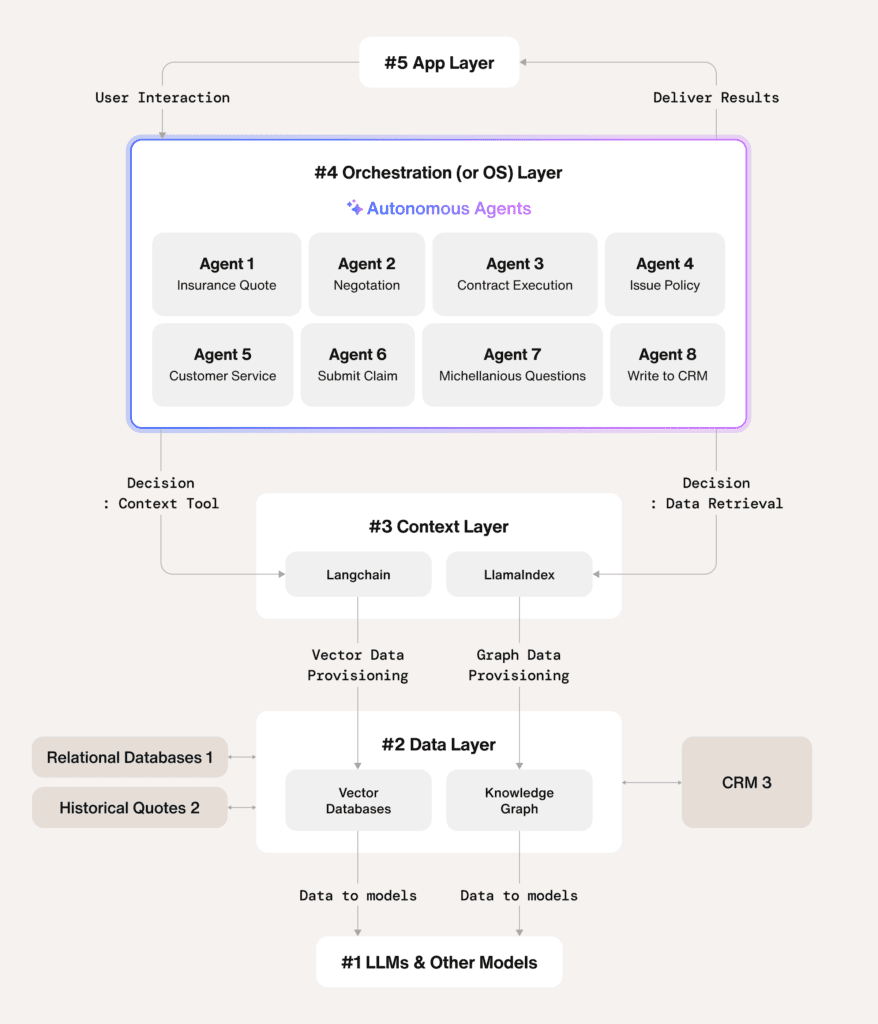
Agentic AI moves the human role upstream. Gartner forecasts that by the end of 2026, up to 40 percent of enterprise applications will integrate task-specific AI agents, up from under 5 percent in 2025 Analyst — one of the fastest enterprise software adoption curves on record. That doesn’t eliminate human judgment; it shifts it from executing tasks to governing agents: setting scope, escalation rules, and audit criteria. Gartner separately warns that over 40 percent of agentic AI projects risk cancellation by 2027 over unclear ROI or weak risk controls — fast adoption doesn’t imply fast governance.
The productivity dividend is real but uneven. The 2026 International AI Safety Report — a multi-government synthesis — found task-level productivity gains of 20 to 60 percent in controlled studies, narrowing to 15 to 30 percent in most real-world settings Primary. Whether those gains raise wages or just let firms do the same work with fewer people is a management choice about whether output expands, not a technological inevitability.
Employee trust is the deciding variable. The April 2026 HBR analysis by Oxford’s Jan-Emmanuel De Neve, Stanford’s Jeffrey Hancock, and BetterUp’s Kate Niederhoffer frames this as a genuine fork: automation-first strategies show faster early cost savings, but augmentation-first strategies tend to compound because they don’t erode the trust and retention that determine whether people actually use the tools well.
✓ The interaction effect
The productivity and labor-market gains documented above don’t come from human judgment or AI capability in isolation — they come specifically from the pairing: AI handling volume and pattern recognition at a speed no team can match, humans providing the adaptability and exception-handling AI still can’t replicate. Remove either half and the gain shrinks: AI alone recreates Tesla’s fragility problem; human-only workflows can’t scale to match demand. BMW’s documented productivity advantage from mixed human-robot lines over automation-only lines reflects that interaction, not either input on its own.
🔎 How I checked this
I cross-referenced the labor-market figures against the original studies rather than the secondary write-ups that cite them, and where I could only access an abstract or a paywalled summary — as with the April 2026 HBR piece — I’ve flagged the claim as directional rather than quoted a specific number I couldn’t verify firsthand. One limitation worth naming: the Harvard Business School job-postings study is reported here through a secondary summary, not the underlying dataset, so treat the exact 17/22 percent figures as indicative of direction and magnitude rather than a number to cite downstream without checking the primary release yourself.
Glossary
- Augmentation AI
- AI deployed to extend what a human can do — surfacing information, drafting, or flagging anomalies — while the human retains the final decision.
- Automation AI
- AI deployed to complete a task end-to-end without a required human step, typically aimed at reducing headcount or cycle time.
- Human approval gate
- A mandatory checkpoint in a workflow where a person must review or sign off before an AI-generated output ships.
- Jagged frontier
- The observed pattern where AI performs unpredictably across tasks of similar apparent difficulty — excelling at one and failing at an adjacent one.
- Agentic AI
- AI systems capable of planning and executing multi-step tasks with limited ongoing human prompting, as distinct from single-turn assistants.
- Human Judgment Density (HJD)
- The scoring framework introduced in this article for rating a task’s need for human judgment across ambiguity, stakes, relationship weight, and precedent volatility.
Myth vs. Fact
Augmentation is just automation with a delay — companies still cut the same jobs eventually.
Sectors where AI complements labor show sustained job and wage growth in the data reviewed here, not a delayed version of displacement. The two strategies produce measurably different outcomes, not the same outcome on different timelines.
More human approval gates always means slower, more expensive workflows.
Well-designed gates reduce the total volume of human review by filtering out low-stakes decisions, concentrating human time on the smaller set of decisions that actually need it.
AI’s economic impact is settled — the only question is how fast it happens.
Credible estimates of AI’s aggregate productivity impact still range widely, from muted annual gains to multi-point GDP boosts. Within-firm gains are better documented than the macro effect, and the two don’t automatically move together.
Frequently Asked Questions
Isn’t AI integration without layoffs just a nice story companies tell?
The skepticism is fair. Independently sourced 2026 labor data does show better job and wage outcomes in AI-complementary sectors — but the same data shows real entry-level displacement in narrowly automatable roles. The difference tracks deliberate role redesign as a strategic choice, not an inevitable outcome of adopting AI.
How much of employees’ time can AI realistically free up?
McKinsey’s analysis estimates generative AI could technically automate tasks consuming 60 to 70 percent of employees’ time today. That’s a technical ceiling on potential, not a forecast of what gets automated in practice — organizational redesign, regulation, and change management typically narrow the achievable figure considerably in near-term rollouts.
What’s the biggest mistake businesses make when integrating AI?
Automating a task inside a job without redesigning the job around it. Employees end up with freed hours and no new responsibilities to fill them, or handoffs between roles stay broken even as individual tasks get faster. Redesigning the job to use the freed capacity productively is the step most rollouts skip.
What skills matter most in an AI-augmented workplace?
The World Economic Forum’s “Future of Work” research consistently identifies critical thinking, complex information processing, and social and emotional skills as the categories most in demand — and, not coincidentally, the categories AI handles worst. Tool proficiency is trainable in weeks; judgment takes years, which is exactly why it’s the higher-leverage investment.
Should small businesses approach AI integration differently?
Often with more urgency. Small teams have fewer redundancies to absorb an AI error, so the human-in-the-loop discipline matters more, not less. The advantage is speed: small organizations can pilot and iterate faster. Start with one high-volume, low-stakes workflow, instrument it fully, and let the HJD score of each task guide what expands next.
The Strategic Question You Should Actually Be Asking
Most AI conversations start with “how much can we automate?” That’s the wrong question — it optimizes for cost reduction in isolation, which is how you end up with a CEO sleeping on a factory floor.
The right question is: where does human judgment add value that clients, customers, or partners will actually pay for — and what does AI need to handle so people can concentrate there? That framing puts the human outcome first and treats AI as infrastructure, not as the point.
As agentic AI systems take on more multi-step autonomous work, the human oversight role keeps moving upstream — from execution to governance. Organizations that haven’t built that governance muscle yet face a compressed learning curve when the shift lands on their desk. The time to build audit trails and human-AI handoff protocols is now, while the stakes of an individual AI failure are still manageable.
Concrete next steps by audience
Pick one high-volume internal workflow this week. Score every step with the HJD framework. Automate the steps scoring 4–8 first, and measure whether the human capacity you freed actually moves to higher-value work — or just evaporates.
Before the next AI tool rollout, run a short cognitive-load check with the team involved: does this tool reduce the number of decisions someone makes, or increase them? “Increase” usually means the tool is adding monitoring burden rather than freeing capacity — fixable, but only if you’re measuring for it.
Build the audit trail before the agentic systems arrive; it’s far harder to retrofit than to build in from day one. Define now which AI decisions require a human sign-off, what evidence those sign-offs are recorded against, and who is accountable when an AI decision causes downstream harm.