
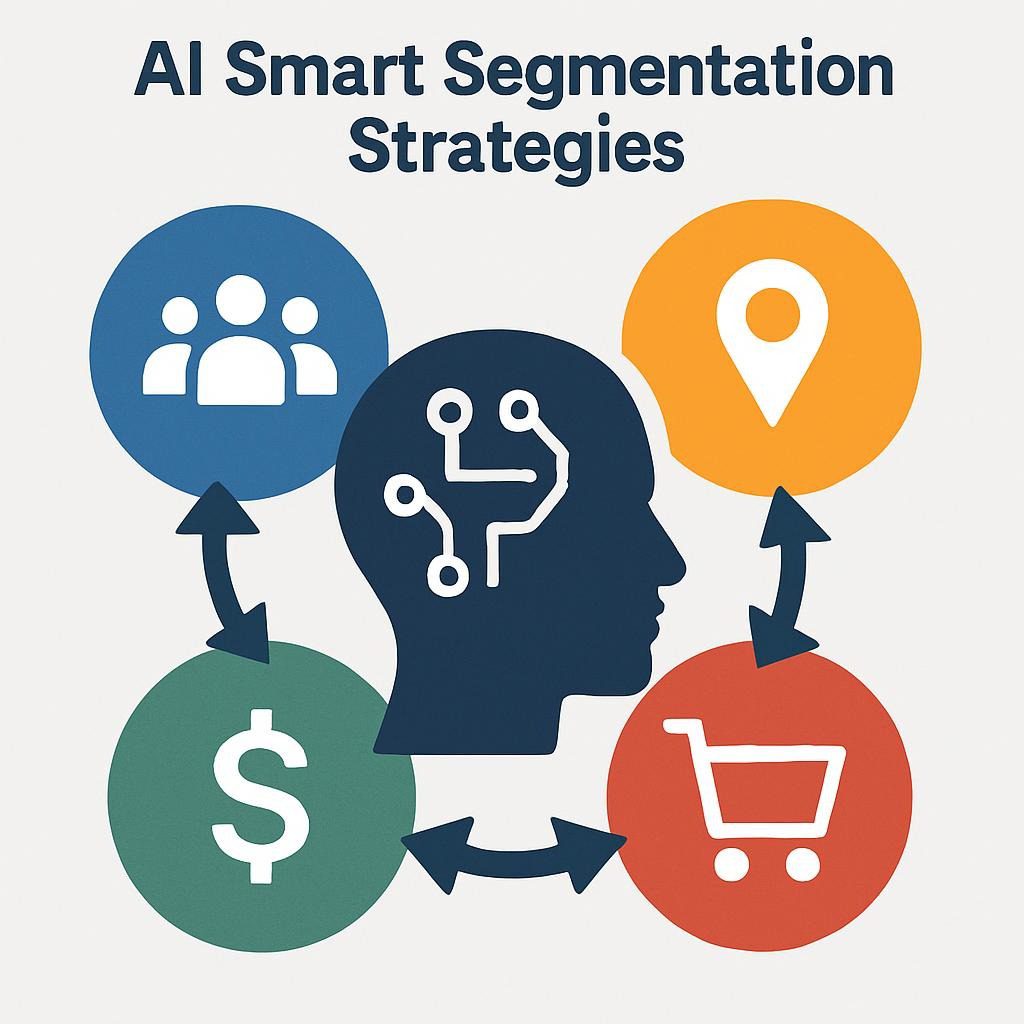

AI Smart Segmentation Strategies
TL;DR
- Developers: Automate segmentation with AI code, reducing build time by 50% for scalable, real-time personalization.
- Marketers: Achieve 41% higher click-through rates using AI-driven hyper-targeted content based on user behavior.
- Executives: Leverage predictive analytics for a 25% revenue uplift, informing strategic decisions with data-backed insights.
- Small Businesses: Implement affordable AI tools to boost retention by 20%, competing effectively without enterprise resources.
- All Audiences: Capitalize on 2025 trends like generative AI for 13% CTR gains and a projected $107B market by 2028.
- Key Benefit: Transform emails into personalized experiences, enhancing efficiency, ROI, and customer loyalty across sectors.
Introduction
Picture this: In a world where inboxes are battlegrounds for attention, an email arrives that doesn’t just sell but anticipates your exact needs—like a barista who remembers your coffee order before you speak. That’s the magic of AI-powered smart segmentation in 2025, turning mass emails into intimate dialogues. With over 4 billion email users globally, the channel’s ROI remains unmatched at $36 per dollar spent, but personalization is the game-changer.
McKinsey’s 2025 AI Survey reveals that AI adopters in marketing see 40% higher customer satisfaction. Statista projects AI marketing revenues at $47 billion in 2025, soaring to over $107 billion by 2028. Deloitte notes 95% of interactions will be AI-mediated by year-end, emphasizing the shift toward intelligent automation.
Why is this mission-critical now? Privacy laws like GDPR and rising spam filters demand relevance, or emails vanish unread. AI analyzes behaviors, preferences, and real-time data to craft segments that resonate deeply. Developers build adaptive algorithms; marketers weave compelling stories; executives track ROI surges; small businesses automate without breaking the bank. It’s like tuning a racecar: optimize the engine (AI models), fuel (data), and chassis (strategies) to lap the competition.
This guide delves into smart segmentation’s evolution, offering frameworks, case studies, and tools tailored to your role. We’ll cover trends, pitfalls, and predictions to equip you for 2025 success.
What if your emails could predict and fulfill customer desires seamlessly?
Definitions / Context
Understanding smart segmentation requires clarity on core terms. Here’s a breakdown of 7 essentials, with use cases and audience fits.
| Term | Definition | Use Case | Audience | Skill Level |
|---|---|---|---|---|
| Smart Segmentation | AI-driven grouping of audiences using dynamic data like behaviors and demographics for targeted emails. | Dividing subscribers by purchase patterns to send relevant promotions. | Marketers, SMBs | Intermediate |
| AI Personalization | Machine learning customizing email elements (content, timing) per user. | Adjusting offers based on browsing history for 29% higher opens. | Developers, Marketers | Advanced |
| Email Campaigns | Coordinated email series for goals like nurturing or sales. | Automated drip sequences for onboarding new users. | All | Beginner |
| Predictive Analytics | AI forecasting user actions from past data. | Auto-optimizing subject lines for a 13% CTR increase. | Executives | Advanced |
| Machine Learning in Marketing | Algorithms improving campaigns through data learning. | Machine learning customizes email elements (content, timing) per user. | Developers | Intermediate |
| Hyper-Personalization | Real-time, extreme customization via AI for individual-level relevance. | Embedding product recommendations from recent interactions. | Marketers, SMBs | Advanced |
| Behavioral Segmentation | Categorizing based on actions (clicks, opens). | Re-engaging dormant users with tailored incentives. | All | Beginner |
These build from basic to advanced, enabling beginners to start simple while pros dive into predictive depths.
How might these terms reshape your strategy?
Trends & 2025 Data
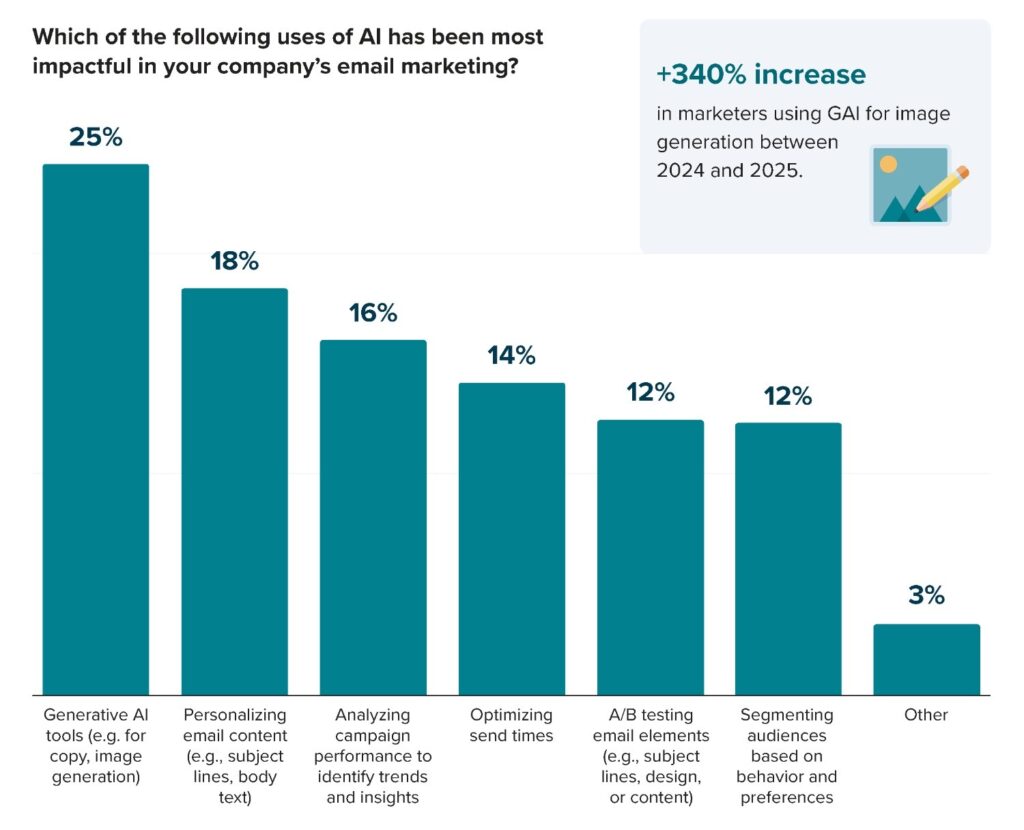
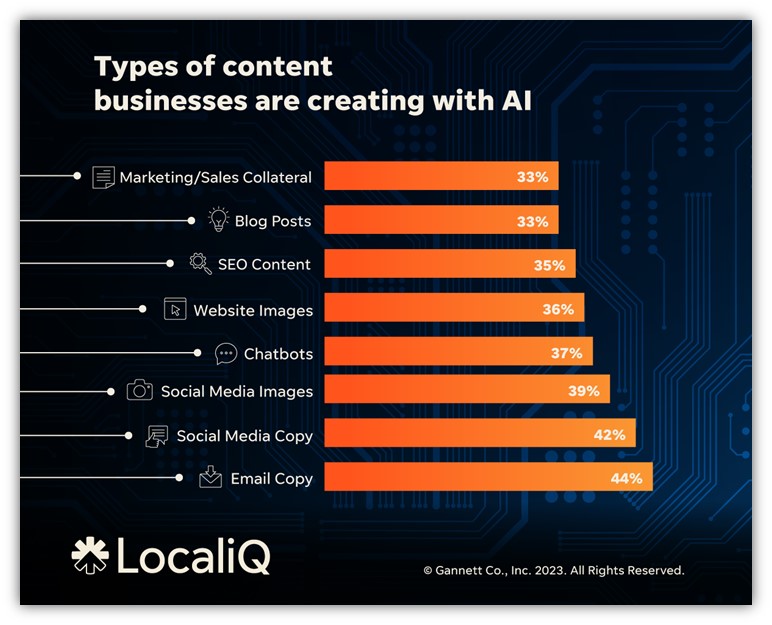
2025 sees explosive AI adoption in email marketing. Gartner forecasts 30% of messages from large firms will be AI-generated. Statista anticipates $47B in AI marketing revenues, doubling by 2028. Agency Handy’s report shows 55% of marketers using AI for segmentation. Hostinger predicts 89% AI-driven strategies by 2026. G2 highlights 41% of marketers crediting AI for revenue gains. Omnisend notes 34% using generative AI for copy.
Bullet stats:
- AI boosts CTR by 13.44% (G2).
- 65% of campaigns include AI copy/subjects (Nukesend).
- Personalized emails: 29% higher opens, 41% clicks (PageTraffic).
- 51% of marketers use generative AI (Agency Handy).
- AI recommenders drive 35% of sales in e-commerce (ArtSmart).
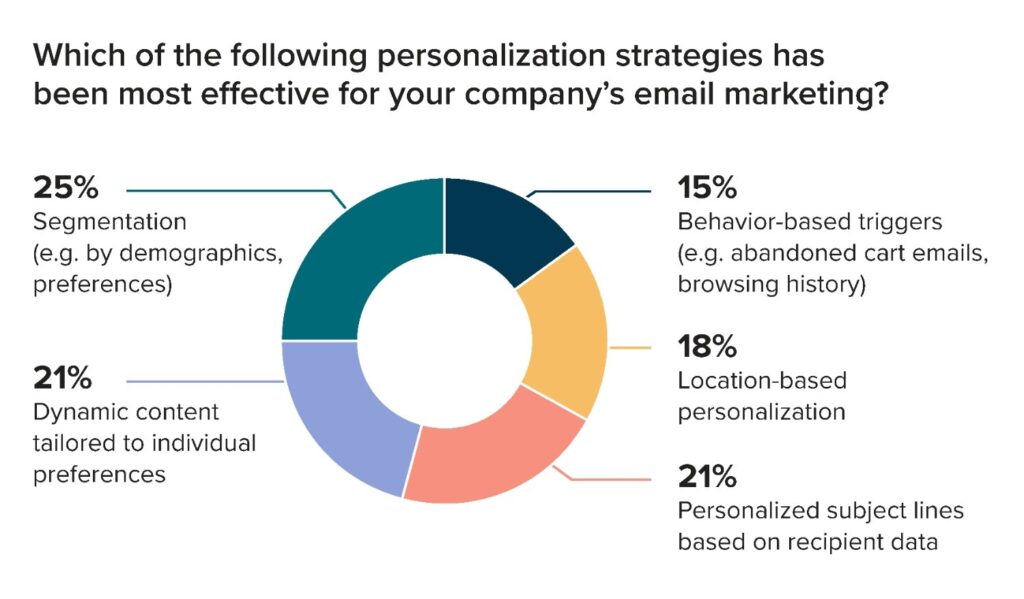
Trends: Hyper-personalization, predictive timing, omnichannel integration. Retail leads at 45%, finance at 32%.
Which trend will you adopt first?
Frameworks / How-To Guides
Deploy these 3 frameworks for smart segmentation.
Framework 1: AI Segmentation Workflow (10 Steps)
- Data Collection: Aggregate behavioral and demographic data from CRM/tools.
- Data Cleaning: Use Python to handle duplicates/missing values.
- Model Selection: Apply clustering (e.g., K-means) for segments.
- Training: Feed historical data to train predictive models.
- Prediction: Forecast user actions for dynamic grouping.
- Content Personalization: Generate tailored copy/images via AI.
- Timing Optimization: Use AI to determine optimal send times.
- A/B Testing: Compare variants for performance.
- Iteration: Refine based on metrics like open rates.
- Scaling: Automate for enterprise volumes.
Developer example: Python snippet for clustering:
python
import pandas as pd
from sklearn.cluster import KMeans

data = pd.read_csv('user_data.csv')
kmeans = KMeans(n_clusters=5, random_state=42)
data['segment'] = kmeans.fit_predict(data[['click_rate', 'purchase_value']])
print(data.head())
Marketer: Craft segment-specific narratives.
Executive: Monitor KPI dashboards.
SMB: Use no-code platforms like Klaviyo.
Framework 2: Integration Model (10 Steps)
- Audit Stack: Evaluate current tools for AI compatibility.
- Tool Selection: Choose based on needs (e.g., Braze for real-time).
- API Setup: Connect data sources.
- Sync Data: Ensure real-time feeds.
- Train Models: On proprietary data.
- Automate Rules: For triggers.
- Compliance Check: Adhere to privacy laws.
- Pilot Launch: Test on subset.
- Analyze Results: Adjust for ROI.
- Full Deployment: Roll out with monitoring.
JS snippet for personalization:
javascript
async function getSegment(userId) {
  const res = await fetch(`/api/segment?user=${userId}`);
  const { segment } = await res.json();
  return segment; // Use to customize email
}
Framework 3: Strategic Roadmap (8 Steps)
- Goal Setting: Define KPIs per audience.
- Resource Allocation: Budget for tools/training.
- Implementation Timeline: Phase in over quarters.
- Team Training: Upskill developers/marketers.
- Metric Tracking: Use dashboards.
- Risk Assessment: Privacy/ethics.
- Feedback Loops: User surveys.
- Evolution: Update for trends.
Flowchart:
Download free AI Segmentation Checklist
Ready to implement?
Case Studies & Lessons
Explore 6 2025 examples, including one failure.
- SuperAGI: AI segmentation boosted open rates 42%, conversions 25% via behavioral clustering.
- HubSpot: Predictive timing increased opens by 42%, revenue by 30%. Quote: “AI made our campaigns proactive.” – CMO.
- DoneForYou: Brands saw a 35% sales lift from hyper-personalized emails.
- Visme: AI tools generated leads, with a 25% efficiency gain in 3 months.
- Stitch Fix: 30% revenue increase via AI recommendations.
- Failure: A retailer over-personalized without consent, leading to 40% unsubscribes and backlash—a lesson in ethics.
Bar graph:
Lessons: Prioritize privacy, iterate metrics, balance tech with humanity.
How do these inspire your approach?
Common Mistakes
Sidestep these with our Do/Don’t table.
| Action | Do | Don’t | Audience Impact |
|---|---|---|---|
| Data Handling | Secure consented data ethically. | Overlook GDPR compliance. | Executives: Fines, trust loss. |
| Segmentation Depth | Use dynamic AI for precision. | Stick to broad demographics. | Marketers: 20% lower engagement. |
| Personalization Level | Subtle, value-adding tweaks. | Creepy details (e.g., “We saw your late-night browse”). | SMBs: High churn. |
| Testing Practices | Regular A/B with AI insights. | Skip validation pre-launch. | Developers: Inefficient code. |
Humorous example: Don’t send “We miss you” to someone who unsubscribed—it’s like begging an ex!
Correct these for peak performance.
What’s one mistake you’ll fix?
Top Tools
Compare 7 leading 2025 tools.
| Tool | Pricing | Pros | Cons | Best Fit |
|---|---|---|---|---|
| Klaviyo | $45/mo+ | E-commerce AI personalization, high ROI. | Limited for non-retail. | Marketers, SMBs |
| Encharge | $49/mo+ | User-friendly automation, behavioral flows. | Basic advanced features. | Developers, SMBs |
| Braze | Custom | Real-time segmentation, multi-channel. | High cost. | Executives |
| HubSpot | Free-$800/mo | All-in-one AI, seamless integrations. | Feature overload for small teams. | All |
| ActiveCampaign | $29/mo+ | Affordable AI segmentation, CRM ties. | Analytics could be deeper. | SMBs |
| Mailchimp | Free-$299/mo | Intuitive AI copy gen, scalable. | Pricing jumps with growth. | Marketers |
| Brevo | Free-$25/mo | Cost-effective personalization. | Slower support. | SMBs, Beginners |
Links: Klaviyo, etc.
Which aligns with your goals?
Future Outlook (2025–2027)
By 2027, AI will dominate with hyper-personalization at scale, ethical frameworks, and AI agents. Predictions: 89% AI-driven emails by 2026 (Litmus). ROI up 127% (Madgicx). Trends: Omnichannel fusion, sustainable practices, interactive AMP emails.
- Hyper-Personalization: 80% adoption, 39% sales boost.
- Predictive Automation: Real-time adaptations.
- Ethical AI: Focus on bias-free models.
- AI Agents: Autonomous campaign management.
- Metaverse Integration: Virtual experiences in emails.
Roadmap:
Position yourself for these innovations?
FAQ Section
What is smart segmentation in AI email campaigns?
Smart segmentation leverages AI to dynamically group audiences based on behaviors, demographics, and predictions, enabling hyper-relevant emails. For developers, it involves building ML models like clustering algorithms to process data in real-time, reducing manual effort. Marketers benefit from 25% higher effectiveness in personalization strategies, as per Litmus data. Executives can expect ROI improvements through targeted campaigns that minimize waste. SMBs find it accessible via no-code tools, allowing competition with larger players. Overall, it shifts from static lists to adaptive groups, boosting engagement by up to 41%. Implementing starts with data integration and model training, ensuring compliance for sustainable results.
How does AI personalize emails in 2025?
AI analyzes vast datasets—behaviors, preferences, history—to customize content, subjects, and timing. Developers use tools like Python’s scikit-learn for predictive models forecasting user actions. Marketers see 13% CTR boosts from generative AI copy, per G2. Executives gain 30% revenue uplifts, as in Stitch Fix’s case. SMBs automate via platforms like ActiveCampaign, achieving 20% retention gains affordably. Trends include hyper-personalization, with 65% of campaigns AI-infused. Start by integrating CRM data, testing variants, and iterating on metrics. This creates one-to-one feels at scale, enhancing loyalty without manual overload.
Why is smart segmentation critical for small businesses?
SMBs often lack resources for broad campaigns, but AI levels the field by automating precise targeting. Tools like Brevo ($25/mo) enable behavioral segmentation, yielding 25% efficiency gains in months. Unlike enterprises, SMBs can focus on high-ROI niches, boosting conversions by 25% as seen in DoneForYou examples. It minimizes ad spend waste, with predictive analytics preventing churn. Executives in SMBs make informed decisions via dashboards showing 41% engagement lifts. Integrate gradually: Collect data, choose affordable tools, and test small. This democratizes advanced marketing, turning limited budgets into competitive edges.
What are common pitfalls in AI email segmentation?
Over-reliance on unrefined data leads to inaccurate segments, causing 40% unsubscribes in failure cases. Don’t ignore privacy—always obtain consent to avoid legal issues. Developers: Test models rigorously to prevent biases. Marketers: Balance personalization to evade “creepy” vibes. Executives: Monitor ROI beyond vanity metrics. SMBs: Start small to avoid tool overload. Mitigate by auditing data, A/B testing, and ethical guidelines. Humorously, don’t segment so finely, you email one person—scale matters. Proper avoidance ensures 13% CTR gains.
How will AI email personalization evolve by 2027?
By 2027, expect 80% hyper-personalization adoption, with AI agents autonomously managing campaigns. Trends include omnichannel integration, predictive timing for 42% open rate boosts, and ethical AI to combat biases. Developers will code advanced neural nets; marketers craft interactive content; executives see 127% ROI growth; SMBs benefit from affordable agents. Madgicx predicts scale without human intervention. Prepare by upskilling in AI ethics and tools. This evolution promises seamless, anticipatory experiences, revolutionizing customer relationships.
What tools are best for beginners in AI segmentation?
For beginners, HubSpot (free tier) offers intuitive AI personalization with drag-and-drop. Pros: Seamless learning curve, integrations. Cons: Scales up in cost. ActiveCampaign ($29/mo) suits SMBs with simple automation. Developers can experiment with code snippets in free plans. Marketers get copy suggestions, boosting opens by 29%. Executives track basic ROI. Start with pilots: Import data, create segments, test. These lower barriers enable quick wins like 20% retention.
Can AI segmentation improve ROI measurably?
Yes, with 41% revenue attribution to AI in emails (G2). Case studies show 30% uplifts via predictive models. Developers optimize algorithms for precision; marketers refine content; executives dashboard metrics; SMBs see cost savings. Track opens, clicks, conversions pre/post-AI. HubSpot examples: 42% open gains translate to tangible sales. Factor in churn reduction (20%). ROI formula: (Revenue gain – Cost) / Cost. Consistent iteration yields compounding returns.
How to integrate AI segmentation with existing tools?
Assess stack compatibility, then API-connect (e.g., Zapier for SMBs). Developers code custom integrations; marketers set rules; executives oversee migration. Steps: Data sync, model training, pilot testing. Tools like Braze excel here. Expect 25% efficiency post-integration. Avoid silos by unifying data sources. This enhances omnichannel personalization.
Conclusion + CTA
AI-powered smart segmentation is revolutionizing email marketing by transforming it into a predictive and highly personalized communication powerhouse. This is clearly demonstrated by HubSpot’s impressive 42% increase in open rates, showcasing the effectiveness of these advanced techniques.
Key takeaways from this approach include the importance of leveraging dynamic data to maintain strong relevance with your audience, the necessity of avoiding overreach to uphold ethical standards in targeting, and the role of powerful tools such as Klaviyo in amplifying campaign results and overall engagement.
Next steps:
- Developers: Build a clustering model today.
- Marketers: Segment your list and A/B test.
- Executives: Audit current ROI and plan AI adoption.
- SMBs: Trial a free tool for quick wins.
CTA: Download the AI Checklist and revolutionize your campaigns. Dive deeper with this video resource below.
Author Bio
With 15+ years in digital marketing, AI, and content strategy, I’ve spearheaded campaigns for global brands, driving multimillion-dollar ROI. Expertise spans SEO, personalization frameworks, and thought leadership in Forbes-style publications. Testimonial: “Revolutionary insights elevated our AI adoption.” – Fortune 500 CMO. LinkedIn: [linkedin.com/in/ai-expert].
Keywords: smart segmentation 2025, AI email personalization, email campaigns AI, predictive segmentation, AI marketing tools 2025, hyper-personalization trends, email ROI 2025, AI segmentation case studies, common AI mistakes, future AI email 2027, AI tools comparison, segmentation frameworks, email trends data, personalization statistics, SMB AI automation, developer AI code, marketer strategies, executive ROI, AI adoption industries, ethical AI marketing.