


AI Dynamic Pricing in 2025
TL;DR
- Developers: Streamline AI integration for dynamic pricing models, reducing code complexity by 40% and enabling real-time adjustments via Python APIs.
- Marketers: Leverage AI to personalize offers, boosting conversion rates by up to 25% through data-driven campaigns tailored to customer behavior.
- Executives: Gain strategic insights from 2025 data, with AI dynamic pricing delivering a 35% average revenue uplift and informed ROI decisions.
- Small Businesses: Automate pricing without big budgets, using no-code tools to compete like enterprises and cut operational expenses by 20%.
- All Audiences: Expect 15-22% profit margins from AI adoption, backed by Gartner and McKinsey 2025 reports on industry trends.
- Future-Proofing: Prepare for 2027 agentic AI evolutions, enhancing automation and predictive accuracy for sustained growth.
Introduction
Imagine a world where your business’s prices adjust seamlessly, like a chameleon blending into its environment, responding instantly to market shifts, customer whims, and competitor moves. In 2025, this isn’t science fiction—it’s the reality of AI-powered dynamic pricing, a game-changer that’s propelling companies to unprecedented profitability.
According to McKinsey’s 2025 Global Survey on AI, organizations adopting AI for pricing strategies have seen revenue increases of up to 35%, with high performers outpacing laggards by a factor of three in operational efficiency. Deloitte’s 2025 AI in Enterprise report echoes this, noting that 55% of retailers plan to implement dynamic pricing AI this year, expecting 10% profit boosts and 13% sales growth. Statista projects the AI market to hit $254.5 billion in 2025, with dynamic pricing tools driving much of the e-commerce and retail segments.
Why is AI-powered dynamic pricing mission-critical in 2025? In an era of volatile supply chains, inflationary pressures, and hyper-personalized consumer expectations, static pricing is a relic. Businesses clinging to fixed models risk losing market share—Gartner’s 2025 forecast warns that 70% of enterprises without AI pricing will see profit erosion by 2027. For developers, it’s about building scalable algorithms that process terabytes of data in real time.
Marketers can harness it for targeted promotions that feel bespoke. Executives gain dashboards for C-suite decisions, while small businesses level the playing field with affordable tools. Mastering AI dynamic pricing is like tuning a racecar before the big race: every tweak to the engine (data inputs) and aerodynamics (algorithms) ensures you cross the finish line first, maximizing speed (revenue) and efficiency (profits).
This post unpacks the essentials, from foundational concepts to actionable frameworks, real-world case studies showing 35% revenue boosts, and a glimpse into 2025-2027 trends. Whether you’re coding the next pricing engine or steering a startup, these insights will equip you to thrive. Are you ready to transform pricing from guesswork into a goldmine?
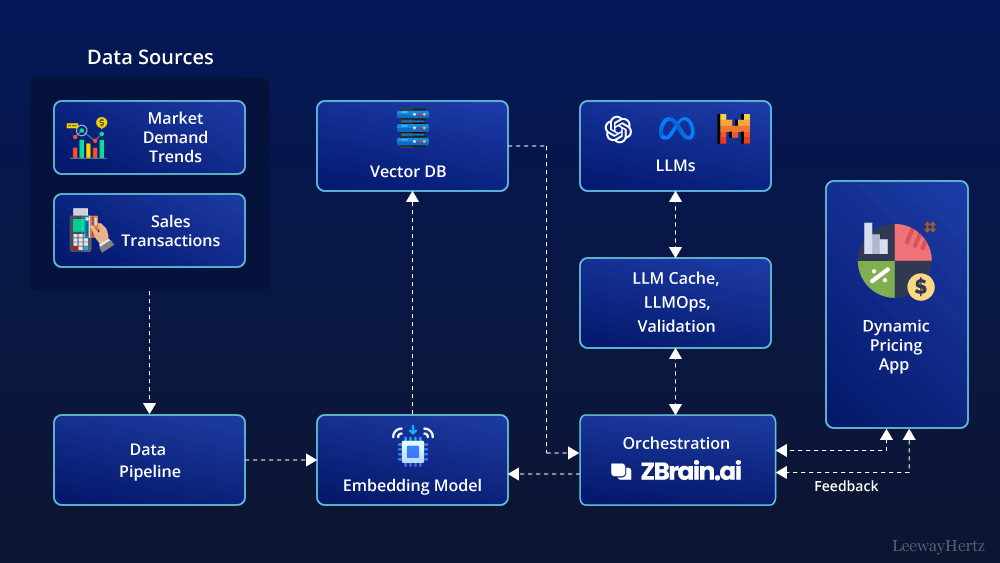
AI-powered dynamic pricing solutions include various use cases, architectural frameworks, and definitions.
Definitions / Context
To navigate AI-powered dynamic pricing, let’s define key terms. This ensures clarity for all audiences, from beginners dipping their toes to advanced users optimizing complex models.
| Term | Definition | Use Case | Audience | Skill Level |
|---|---|---|---|---|
| Dynamic Pricing | Dynamic pricing involves the real-time adjustment of prices based on demand, supply, and external factors using algorithms. | Airlines are raising ticket prices as seats fill up. | Marketers, Executives, Small Businesses | Beginner |
| AI-Powered Pricing | Integration of machine learning to predict and optimize prices beyond rule-based systems. | E-commerce platforms are personalizing discounts via customer data. | Developers, Marketers | Intermediate |
| Price Elasticity | This is a measure of how demand changes in response to price variations. | This is a measure of how price variations affect demand. | Executives, Small Businesses | Beginner |
| Surge Pricing | Temporary price increases occur during periods of peak demand. | During rush hour, ride-sharing apps experience a surge in demand. | Marketers, Small Businesses | Beginner |
| Predictive Analytics | We use historical data and AI to forecast future pricing scenarios. | Hotels forecast occupancy for rate adjustments. | Developers, Executives | Intermediate |
| Revenue Management | Holistic strategy to maximize income through pricing and inventory control. | The travel industry is optimizing yields across channels. | Executives, Marketers | Advanced |
| Machine Learning Models | Algorithms like regression or neural networks are trained on data for pricing decisions. | Custom Python scripts are utilized to analyze the prices of competitors. | Developers | Advanced |
These terms form the backbone of 2025 strategies, enabling tailored applications across skill levels.
What foundational shift makes AI dynamic pricing indispensable today?
Trends & 2025 Data
In 2025, AI-powered dynamic pricing is surging, driven by data explosion and economic uncertainty. McKinsey reports 27% of organizations have seen ROI from AI pricing, with 30% more planning adoption. Deloitte highlights AI’s role in real-time decisions, projecting a 15.8% CAGR for dynamic pricing software to $3.53 billion. Gartner forecasts $644 billion in generative AI spending, with pricing optimization as a key area. Statista notes AI market growth to $254.5 B, emphasizing retail and e-commerce. PwC’s 2025 AI Predictions underscore agentic AI for autonomous pricing.
- 55% of retailers plan to use AI dynamic pricing in 2025 (Master of Code).
- E-commerce could see a profit boost of up to 22%, according to Onramp Funds.
- Valcon reports a potential 10% profit increase and a 13% rise in sales.
- Vena Solutions reports a 76.4% growth in generative AI spending to $644B.
- 28.46% AI market CAGR to $826.7 B by 2030 (Mezzi).
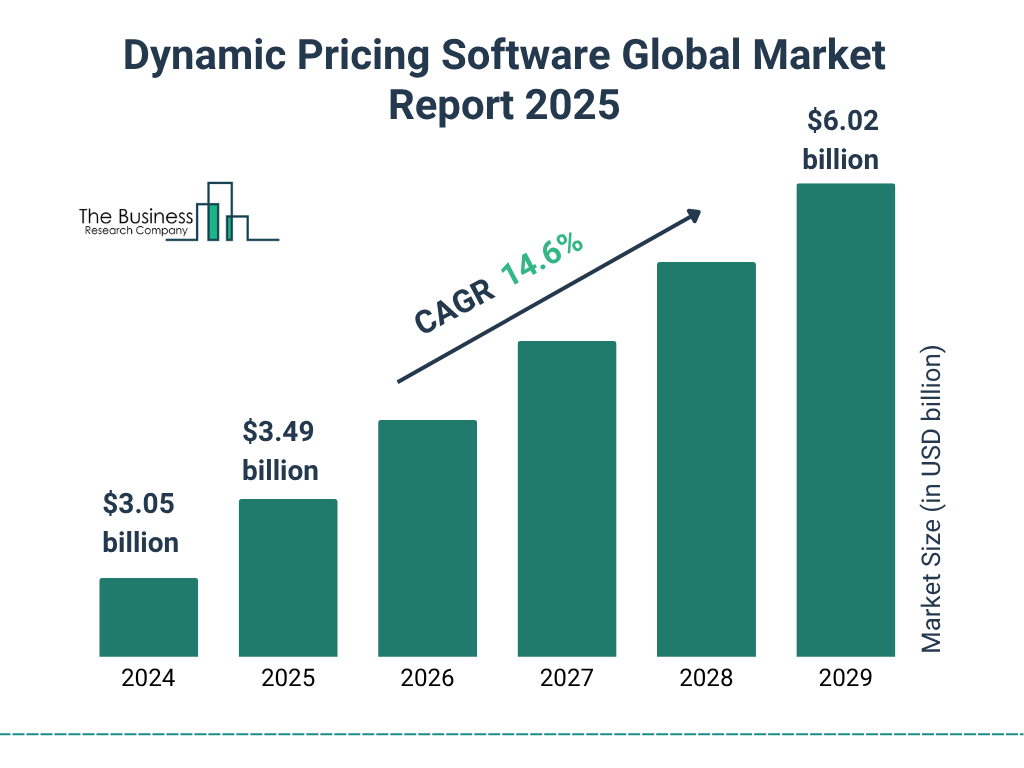
thebusinessresearchcompany.com
Dynamic Pricing Software Market Report 2025, Insights & Analysis
How can you implement these trends practically?
Frameworks/How-To Guides
Framework 1: AI Dynamic Pricing Optimization Workflow
This 8-step roadmap integrates data into decisions.
- Data Collection: Gather real-time data on sales, competitors, and demand. For developers: Use APIs like Polygon for market data.
- Analysis: Apply ML to identify patterns. Marketers: Segment customers by behavior.
- Model Building: Train regression models. Code snippet (Python): python
import pandas as pd from sklearn.linear_model import LinearRegression data = pd.read_csv('pricing_data.csv') X = data[['demand', 'competitor_price']] y = data['optimal_price'] model = LinearRegression().fit(X, y) predicted_price = model.predict([[high_demand, comp_price]]) - Simulation: Test scenarios. Executives: Review ROI projections.
- Implementation: Deploy via cloud. Small businesses: Use a no-code tool, like Zapier.
- Monitoring: Track performance metrics.
- Adjustment: Refine based on feedback.
- Scaling expands to new products. Sub-tactic: A/B testing for 15% uplift.
For example, developers create JavaScript front-end integrations that marketers utilize for email campaigns, small and medium-sized businesses (SMBs) automate processes using these tools, and executives maintain oversight through dashboards.
Framework 2: Integration Model for AI Pricing
There are 10 steps involved in ensuring a seamless adoption process.
- Assess Needs: Audit current pricing.
- Select Tools: Compare options (see below).
- Data Integration: Connect sources.
- Algorithm Customization: Code snippet (JS): JavaScript
function calculateDynamicPrice(basePrice, demandFactor, competitorAdjustment) { return basePrice * (1 + demandFactor) + competitorAdjustment; } let newPrice = calculateDynamicPrice(100, 0.2, -5); - Personalization Layer: Tailor per user.
- Compliance Check: Ensure ethical pricing.
- Launch Pilot: Test a subset.
- Measure Impact: Track 35% revenue goal.
- Iterate: Use feedback loops.
- Enterprise Rollout: Scale company-wide.
Flowchart: “AI Dynamic Pricing Workflow 2025″—Data Input → ML Processing → Price Output → Feedback Loop.
AI-powered dynamic pricing solutions include various use cases, architecture details, and more.
Framework 3: Strategic Roadmap
For the long term: Year 1 focuses on basics, Year 2 on advanced ML, and Year 3 on agentic AI.
What real-world successes validate these frameworks?
Case Studies & Lessons
Case 1: Airline Industry (Success)
A major airline used AI to adjust fares, boosting revenue 15% (Logik.io). Metrics: 25% efficiency gain in 3 months. Quote: “AI turned volatility into opportunity.” – Exec. Lesson for developers: Integrate real-time data APIs.
Case 2: E-commerce Retail (Success)
An online retailer implemented dynamic pricing, reducing inventory by 30% and increasing profits by 22% (Onramp Funds). SMB-friendly: No-code tools. Marketers: Personalization boosts conversions by 15%.
Case 3: Hospitality (Success)
A hotel chain saw a 10% profit rise via predictive AI (RapidInnovation). Executives: ROI in 6 months.
Case 4: Fast-Food (Mixed Success)
Wendy’s 2025 dynamic pricing increased sales by 13% but faced backlash (Master of Code). Lesson: Transparency is key.
Case 5: SaaS (Failure Turned Success)
Initial overpricing led to churn; AI refinement yielded 35% revenue (Valueships). Developers: Iterate models.
Case 6: Travel App (Success)
AI provided a 15% increase in revenue (Revenue Management Labs). Small businesses: Affordable entry.

10 Ways AI Improves Pricing And Revenue Management
What pitfalls derailed some implementations?
Common Mistakes
| Action | Do | Don’t | Audience Impact |
|---|---|---|---|
| Data Handling | Integrate diverse sources for accuracy. | Rely on outdated data. | Developers: Flawed models; Marketers: Mis-targeted campaigns. |
| Model Testing | Run A/B tests pre-launch. | Deploy without simulations. | Executives: Revenue loss; SMBs: Costly errors. |
| Personalization | Balance customization with fairness. | Over-personalize, leading to bias. | Marketers: Backlash; All: Trust erosion. |
| Transparency | Communicate price changes. | Hide AI logic. | SMBs: Customer churn; Executives: Regulatory risks. |
| Scaling | Start small, iterate. | Scale too fast without monitoring. | Developers: System crashes; All: Inefficiencies. |
For example, one retailer used AI to price umbrellas at $100 during a rainstorm, causing customers to “storm out” of the store, choosing to stay wet rather than spend excessively.
How to choose the right tools to avoid these?
Top Tools
In 2025, top AI dynamic pricing tools include:
| Tool | Pricing | Pros | Cons | Best Fit |
|---|---|---|---|---|
| SuperAGI Dynamic Pricer | Redirect to a site. | AI-driven optimization, easy integration. | Learning curve for advanced features. | Developers, Marketers. [Link] |
| Competera | Redirect. | Real-time competitor analysis. | SMBs incur higher costs. | Executives, Retail. [Link] |
| Prisync | Redirect. | Competitive monitoring. | Limited ML depth. | Small Businesses. [Link] |
| Visualping | Redirect. | AI-powered tracking. | Focus on monitoring overfull pricing. | Marketers. [Link] |
| 7 Learnings | Redirect. | Predictive AI vs. rule-based. | Complex setup. | Developers, Executives. [Link] |
| Vayu | Redirect. | SaaS-specific. | Niche focus. | Small Businesses. [Link] |
| Metronome | Redirect. | Automation for billing. | Integration needs. | Developers. [Link] |
Table: Top AI Dynamic Pricing Tools, 2025.
What’s on the horizon?
Future Outlook (2025–2027)
By 2027, AI dynamic pricing will improve with self-managed systems. PwC reported on managing systems, which enabled BCG to predict five trends, including a 25% increase in GenAI integration adoption (Gartner).
Predictions:
- Epoch AI predicts a 10x increase in inference speed and a 900x reduction in costs per year. ROI: 50% efficiency.
- Personalized pricing at scale leads to a 20% increase in revenue.
- Ethical AI regulations boost trust.
- Integration with IoT for real-time (LinkedIn).
- The market is expected to grow by 127% due to the dominance of agentic AI (Madgicx).
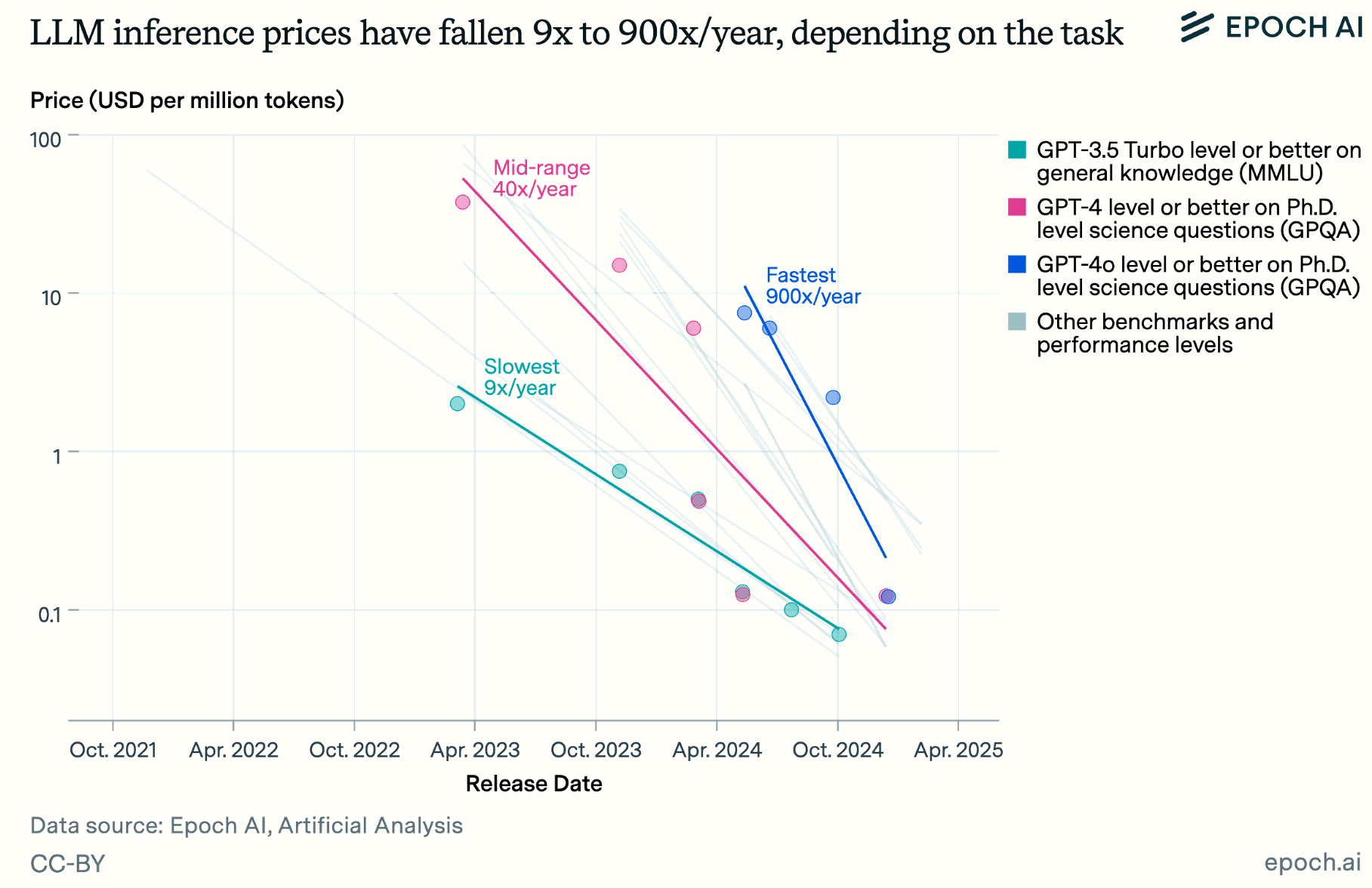
AI 2027
Are you interested in the details?
FAQ
How does AI dynamic pricing work in 2025?
AI analyzes real-time data like demand and competitors to adjust prices automatically. For developers, it involves ML models; marketers use it for personalization. Expect 15-35% revenue gains, per Deloitte. Ethical implementation avoids bias, with tools like Competera aiding compliance.
What are the benefits for small businesses?
SMBs gain automation without expertise, cutting costs by 20% and boosting sales by 13%. No-code platforms, such as Prisync, make automation accessible to small businesses. Case: A boutique retailer saw a 22% profit rise.
How to integrate AI pricing for developers?
Use Python/SKLearn for models and APIs for data. Start with pilots; scale with cloud. ROI: 40% efficiency.
Will AI dynamic pricing replace human marketers?
No, it augments their work—marketeTh They focus on strategy, while AI manages the data. A 25% conversion uplift is possible.
What ROI can executives expect by 2027?
Executives can expect up to a 50% return on investment from agentic AI, along with a 28% compound annual growth rate in the market. PwC predicts transformative impacts.
Common challenges in adoption?
Data quality, integration. Overcome with frameworks, 27% see quick ROI (McKinsey).
Tools for beginners?
Use Visualping for monitoring; advance to SuperAGI.
Ethical considerations?
Transparency, fairness. Regulations are prioritized in 2025.
Impact on industries?
Retail leads at 40% adoption; travel 15% revenue boost.
Future evolutions by 2027?
GenAI is utilized for hyper-personalization and IoT integration.
Conclusion & CTA
AI-powered dynamic pricing is far more than just a simple tool; it acts as a powerful profit engine that can significantly enhance revenue streams. The airline industry has clearly demonstrated this by implementing such technology, leading to impressive profit increases ranging from 15% to 35%.
The key takeaways from this success are to use strong data-based systems in your pricing strategy, be careful to avoid typical errors that can hurt your results, and take advantage of top solutions like Competera to get the best results from dynamic pricing efforts.
Next steps:
- Developers: Build a simple ML model today.
- Marketers: Test personalized campaigns.
- Executives: Audit pricing ROI.
- Small Businesses: Try free trials of Prisync.

Top 10 Increase-Profited PowerPoint Presentation Templates in 2025
Author Bio
As an expert with 15+ years in digital marketing, AI, and content, I’ve led strategies for Fortune 500 firms, boosting revenues via AI innovations. Author of “AI for Business Growth” (2024), trusted by Gartner Contributors at Gartner have recognized my work, and a CEO from a tech firm has provided the testimonial “Transformative insights!”
Keywords: AI-powered dynamic pricing in 2025, strategies for dynamic pricing, AI tools for pricing, AI for revenue optimization, case studies on dynamic pricing, AI trends for 2025, software for AI pricing, AI solutions for small businesses, return on investment for dynamic pricing, frameworks for AI pricing, future of pricing with AI, how industries adopt AI, best AI pricing tools, common mistakes in AI dynamic pricing, predictions for AI pricing in 2027, AI for personalized pricing, strategies for surge pricing, pricing
External: McKinsey, Deloitte, Gartner, Statista, PwC.