

AI Inventory Control in 2025: What the Research Says — And Where Implementations Go Wrong
McKinsey’s distributor operations survey, Gartner’s 509-leader study, and Amazon’s own operational data converge on a clear picture. The ROI from AI inventory control is real and substantial. So is the failure rate. Both things are true. Here’s how to land on the right side of that divide.
Start with the number that should reset your expectations before anything else. In May 2025, Gartner surveyed 579 supply chain practitioners and published a finding that every vendor deck conveniently leaves out: by 2028, 60% of supply chain digital adoption efforts will fail to deliver their promised value. Not fail catastrophically. Just fail to deliver what was promised — productivity gains that stayed at the individual level and never translated to the team or the operation.
That stat sits next to this one from the same research community: McKinsey’s November 2024 distributor operations report documented reductions of 20 to 30 percent in inventory levels, 5 to 20 percent in logistics costs, and 5 to 15 percent in procurement spend for distributors that successfully embed AI in operations. That’s a wide range, but it’s sourced to a real study with named methodology.
Both figures are true. The question isn’t whether AI inventory control works. It’s whether your implementation will be in the 40% that delivers, or the 60% that doesn’t.
Those last two numbers together are the problem in miniature. Almost everyone is exploring AI for inventory. Almost no one has moved past exploration into a structured, value-based implementation. The gap between “we’re piloting something” and “we’ve reduced carrying costs by 25%” is where most supply chain organizations are stuck right now, often because the pilot was built on data that wasn’t ready for it.
What Good AI Inventory Control Actually Delivers
Before getting to the failure modes — and they’re instructive — it’s worth establishing what verified, documented success looks like. Not self-reported vendor claims. Actual named cases with traceable data.
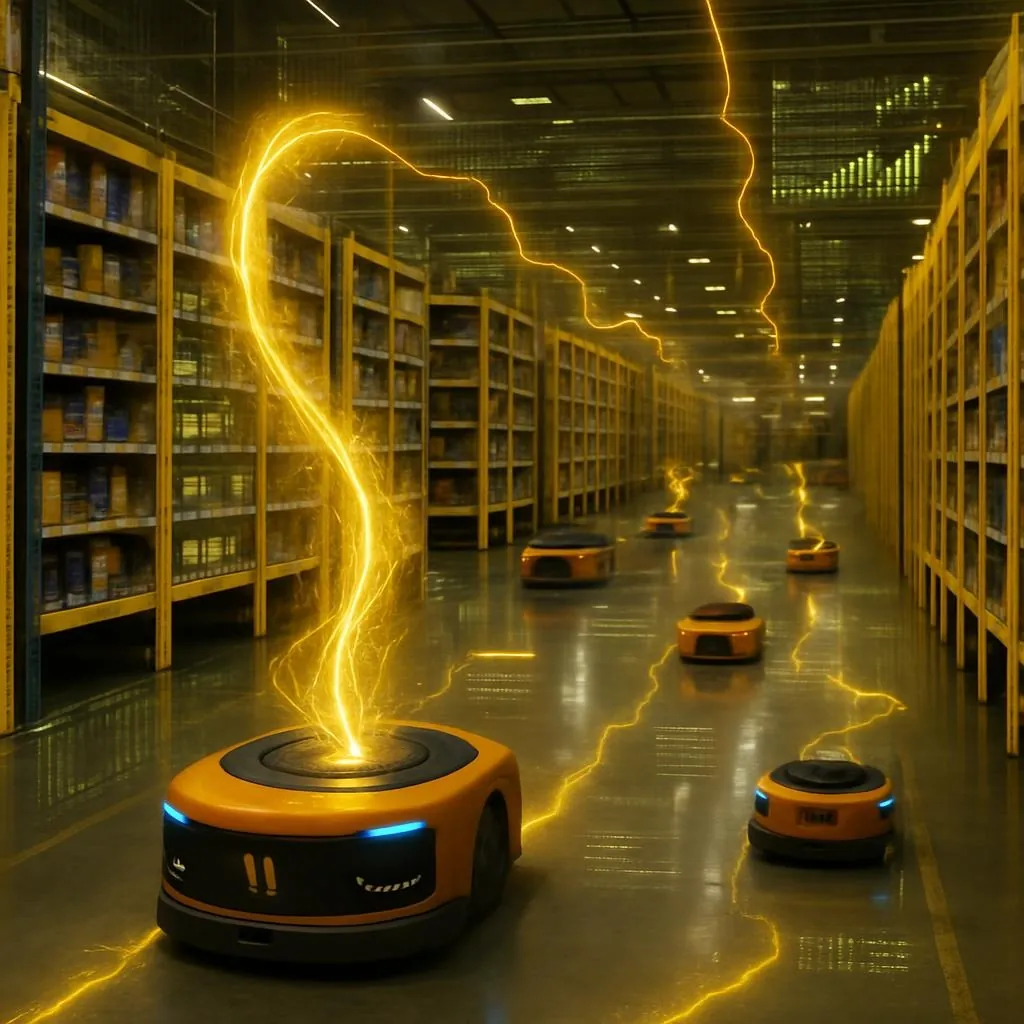
Amazon’s Sequoia system — its current-generation AI, robotics, and computer vision platform — represents the most publicly documented large-scale AI inventory deployment in existence. According to Amazon’s own operational reporting, Sequoia enables the company to identify and store inventory up to 75% faster at fulfillment centers. The system uses mobile robots to transport inventory to ergonomically positioned workstations, reducing physical strain while accelerating throughput.
The broader robotics program — which began with Amazon’s $775 million acquisition of Kiva Systems in 2012 and now encompasses over 1 million deployed robots — continuously self-optimizes: tracking high- and low-velocity SKUs and positioning the highest-turnover products closest to pick-and-pack stations. With Kiva-era technology, the same daily pick volume that required two 75-person shifts in a conventional warehouse could be handled with 25 people per shift. The 2024 launch of Amazon’s Shreveport facility represents the current state of the art.
Walmart’s AI inventory story has two distinct chapters. The demand forecasting layer — which connects ML predictions directly to replenishment systems for what Walmart calls “hands-free” forecasting — aims to eliminate the manual intervention between AI-generated insight and physical restocking. For perishables and fresh produce, the system adjusts forecasts multiple times per day to reduce spoilage.
The computer vision layer adds a real-time shelf monitoring capability: ceiling-mounted cameras scan continuously for stockouts, misplaced items, and planogram violations. This matters particularly for omnichannel fulfillment — when a customer places an online order that gets fulfilled from a store, an undetected shelf gap produces a canceled order or a substitution. Academic analysis of Walmart’s publicly reported results shows consistent directional improvements across stockout rates, inventory carrying costs, and forecast error — though Walmart does not publish specific percentage outcomes publicly. The 30 million fewer driving miles attributed to route optimization is sourced to IHL Group research, not Walmart.
This is the case study that supply chain leaders in distribution should actually be reading — not the Amazon and Walmart stories, which operate at a scale most organizations will never approach. McKinsey’s November 2024 report documents an unnamed major building products distributor that built an AI-enabled supply chain control tower to manage inventory levels across its warehouse footprint. The system identifies potential inventory issues proactively, facilitates cross-functional collaboration, and includes a generative AI chatbot that provides live answers from real-time data.
The outcome: fill rate improvement of 5 to 8 percent. That may sound modest compared to the headline numbers in vendor marketing materials, but fill rate in building products distribution is directly tied to contractor retention. A 5-point fill rate improvement is a material competitive differentiator in a market where contractors choose distributors based on reliability.
“AI doesn’t replace human judgment in supply chain — it amplifies it. Advanced AI running on poor data doesn’t solve problems faster. It creates faster decisions that may be wrong.”
SupplyChainToday.com synthesis of practitioner experience, January 2026Why 60% Fail: The Data Problem Nobody Talks About in the Sales Cycle
Here’s the part of the conversation that gets skipped when a vendor is presenting their platform. Gartner’s finding that 60% of supply chain digital efforts will fail to deliver promised value isn’t primarily a technology problem. It’s a data problem — and a learning and development problem layered on top of it.
Salesforce’s 2024 State of Data and Analytics report found that 76% of business leaders believe AI has made being data-driven more important than ever — but only 36% of those same leaders trust the accuracy of their company’s data. That’s a 27-percentage-point decline in data trust in a single year. The implication for inventory AI is direct: an ML model trained on inconsistent historical data, duplicate SKU records, or siloed warehouse management systems doesn’t produce worse forecasts than a spreadsheet. It produces confident-looking wrong forecasts. And confident wrong forecasts are more dangerous than obvious uncertainty.
Consider what happens at a mid-size distributor that deploys AI demand forecasting before auditing its ERP data. The model ingests five years of transaction history — but the first two years predate a systems migration that changed product codes. The AI treats discontinued SKUs and their replacements as separate products. It reads seasonal patterns that were actually data migration artifacts. It generates reorder recommendations that, on paper, look precise to two decimal places.
The cost asymmetry: the implementation took six months and $200,000 in licensing and integration fees. Identifying and correcting the data foundation problem takes another three to four months and delays the ROI timeline by a full year. This pattern is documented across industries — Improving’s analysis of AI project failures finds that once business users see inconsistent or biased outputs, adoption drops — and regaining confidence is far harder than building it the first time.
The lesson: A data readiness audit isn’t a preliminary step before the real work starts. It is the real work. Budget for it accordingly.
Gartner’s research surfaced the second failure mode: individual productivity gains not translating to team or frontline level. This is the supply chain version of the same downstream disorder that appears in software engineering — one person’s workflow gets faster, but the bottleneck just moves one step downstream. A planner with an AI forecasting dashboard can make better decisions in less time. But if the warehouse management system, the supplier portal, and the transportation management system aren’t integrated, the speed gain stays trapped at the desktop. The additional Gartner finding — that 58% of supply chain leaders identify rapid tech advancement as a major future challenge — reflects exactly this integration debt.
What the Leading Organizations Are Doing Differently
Gartner’s February 2024 survey of 818 supply chain practitioners found that top-performing supply chain organizations invest in AI/ML to optimize their processes at more than twice the rate of low-performing peers. That gap matters — but the more interesting question is what specifically those leaders are doing. The McKinsey distributor operations research provides three clear differentiators.
A 90-Day Implementation Framework Grounded in What Works
McKinsey’s distributor research offers the clearest practitioner-level framework I’ve seen in the primary literature. Three implementation priorities, explicitly stated: prioritize immediate value from a single use case, build a structured value-based road map, and make AI self-funding by reinvesting returns from the first use case into the next. Here’s what that looks like in practice.
The single most common cause of underperforming AI projects is poor or incomplete data. Before any vendor demo, audit your SKU master data for duplicates, your historical transaction data for migration artifacts, and your stock-on-hand records for accuracy against physical counts. Document gaps explicitly.
In supply chain terms: current fill rate, current stockout frequency by category, average inventory turns, current carrying cost as % of inventory value, and forecast accuracy vs. actual (if you have it). These are your before numbers. Without them, you cannot calculate ROI — and you cannot tell whether your AI implementation is working or just generating impressive-looking dashboards.
Per McKinsey’s guidance: pick one or two low-risk, high-value use cases deliverable within three to four months. Demand forecasting for your top 20% of SKUs by volume is the canonical starting point — highest data quality, highest ROI visibility, most tractable scope. Do not start with the hardest problem. Start with the problem that will generate buy-in.
Apply AI forecasting to your pilot SKU set. Run the AI recommendation alongside your existing process (not instead of it) for at least two weeks before you trust it to drive replenishment decisions. This parallel running period is where you catch the data quality issues you missed in Phase 1.
Gartner’s research identifies exactly this as the failure point: AI insight that never reaches the execution layer. Before expanding to more SKUs, confirm that the AI forecast is connected to your replenishment triggers — not just visible in a dashboard. An insight that requires manual transfer to the WMS has cut its potential value in half.
Gartner’s May 2025 finding on the L&D gap is worth taking seriously: individual productivity gains from AI don’t translate to team-level gains without structured learning investment. Warehouse floor staff need to understand why the system is making recommendations, not just what it’s telling them to do. Otherwise, they override it — and they’re not always wrong to.
Compare fill rate, stockout frequency, and carrying cost against your Phase 1 baselines. This is the self-funding mechanism McKinsey describes: use the documented savings from the pilot to justify and fund the next use case. If you can’t show ROI from the pilot, expanding scope will amplify the problems rather than amortize them.
McKinsey’s framework calls for a one-to-two-year value-based road map with quantifiable impacts at each stage. The sequence that tends to work: demand forecasting → replenishment automation → dynamic safety stock → supplier collaboration. Each step builds on the data and integration work from the previous one. Jumping to agentic autonomous ordering before you’ve validated your forecast accuracy is how you end up in Gartner’s 60%.
Gartner’s March 2026 prediction — that 60% of supply chain disruptions will be resolved without human intervention by 2031 — is plausible. Getting there requires data quality and governance frameworks capable of supporting autonomous decisions. Prioritize investments in data quality and governance before you hand execution authority to an AI system. Gartner says so explicitly, and the failure mode when you don’t is a fully automated bad decision.
The Tool Landscape: What Category Matters More Than Which Vendor
Rather than naming individual platforms — which change pricing and capabilities faster than any article can track — here’s the category map that matters for supply chain leaders evaluating options. The category determines your integration complexity and data requirements. The vendor you pick within it is secondary to getting the category right for your current maturity stage.
| Capability | What it does | Right for you if | Not ready if |
|---|---|---|---|
| AI demand forecasting | ML-based demand prediction incorporating sales history, seasonality, promotions, external signals | You have 18+ months of clean transaction history and a defined pilot SKU set | Your historical data spans a systems migration or major SKU restructure |
| Replenishment automation | Connects forecast outputs directly to purchase order triggers, eliminating manual transfer | Your AI forecast has been running in parallel for at least 60 days with validated accuracy | You’ve just deployed forecasting — validate first, automate second |
| Supply chain control tower | Cross-functional visibility layer; real-time inventory status, exception alerts, cross-location optimization | You have multiple warehouses and need coordinated inventory visibility across them | You’re a single-location operation — a control tower is overhead without network complexity |
| Computer vision / shelf monitoring | Camera-based real-time shelf gap detection, planogram compliance, misplacement identification | You operate physical retail or distribution with high SKU density and meaningful stockout costs | High capex; justify against your actual stockout-driven revenue loss, not a vendor’s estimated savings |
| Digital twin / simulation | Virtual model of warehouse operations; used to optimize labor, equipment, and layout without physical experimentation | You’re planning a significant warehouse reconfiguration or network expansion | You need short-term ROI — digital twin delivers strategic insight, not immediate operational savings |
What Three Data Sources Say Together
Read together, McKinsey’s distributor operations research (November 2024), Gartner’s twin findings on the 60% failure rate and the 60% autonomous disruption resolution prediction (2025–2026), and the Salesforce data-trust collapse (2024) point toward a divergence that will become pronounced by 2027–2028.
Organizations that use 2025 and 2026 to build data governance foundations and validated forecasting capability will be positioned to adopt agentic autonomous inventory systems when they mature — because the preconditions (data quality, integration depth, organizational trust in AI outputs) will already be in place. Organizations that deploy AI tooling without those foundations will be managing the fallout from Gartner’s 60% prediction: implementations that absorbed budget and attention but delivered individual-level productivity gains that never reached the operation.
The supply chain leaders best positioned in 2028 are the ones who treated the 2025–2026 window as an infrastructure period, not an adoption race. The companies trying to catch up then will be paying data remediation costs while their competitors are already running autonomous replenishment. That gap closes very slowly.
Assessing your organization’s AI inventory readiness?
We work with supply chain and logistics leaders to audit data foundations, define pilot use cases, and build implementation road maps grounded in your actual operational baseline — not vendor assumptions. No generic frameworks.
AI inventory control delivers real, documented returns — 20 to 30 percent inventory reductions, 5 to 20 percent logistics cost cuts, and fill rate improvements that translate directly into customer retention. The math works. The question is whether your data foundation and implementation discipline are sufficient to land in the 40% that captures it, rather than the 60% that spends the budget and waits.
Primary Sources
- McKinsey (Nov 2024). “Harnessing the power of AI in distribution operations.” Distributor operations survey, n=40; supplementary survey December 2022, n=74. mckinsey.com
- McKinsey (May 2024). “The state of AI in early 2024.” n=1,491 respondents, 101 nations. Supply chain and inventory management revenue finding. mckinsey.com
- McKinsey (2021). “Succeeding in the AI supply-chain revolution.” Early adopter benchmark: 15% logistics cost improvement, 35% inventory improvement, 65% service level improvement. mckinsey.com
- Gartner (May 2025). “Gartner Predicts 60% of Supply Chain Digital Adoption Efforts Will Fail to Deliver Promised Value by 2028.” Survey n=579 practitioners, October 2024. gartner.com
- Gartner (March 2026). “Gartner Predicts 60% of Supply Chain Disruptions Will Be Resolved Without Human Intervention by 2031.” Survey n=509 supply chain leaders, October 2025. gartner.com
- Gartner (February 2024). “Gartner Says Top Supply Chain Organizations are Using AI to Optimize Processes at More Than Twice the Rate of Low Performing Peers.” Survey n=818, August–October 2023. gartner.com
- Amazon (2024–2025). Sequoia system and robotics operational data. aboutamazon.com
- Salesforce (2024). State of Data and Analytics: 76% of leaders believe AI made data-driven operation more important; 36% trust their company’s data accuracy. salesforce.com
- IHL Group (December 2023). Retailers using AI saw 8% annual profit growth in 2023 and 2024. Cited via: ArtisLedge ML retail case study synthesis
- SupplyChainToday.com (January 2026). “Why Data Is the Real Bottleneck in Supply Chain AI.” Practitioner synthesis of data readiness requirements. supplychaintoday.com
Programmatic Recovered $13.6B. AI Didn’t Do It.
Elastic AI: How Scalable Machine Learning Architectures Are Redefining Enterprise Efficiency
Predictive Precision: AI Inventory Forecasting Success Stories That Revolutionized Retail Operations
Dynamic Stock Solutions: AI Inventory Automation Strategies That Transformed E-Commerce Profitability
Tailored Buyer Experiences: 10 AI Strategies Revolutionizing Retail Personalization in 2025
Optimizing Stock Levels: AI-Powered Inventory Management Case Studies That Slashed Overstock by 40%