
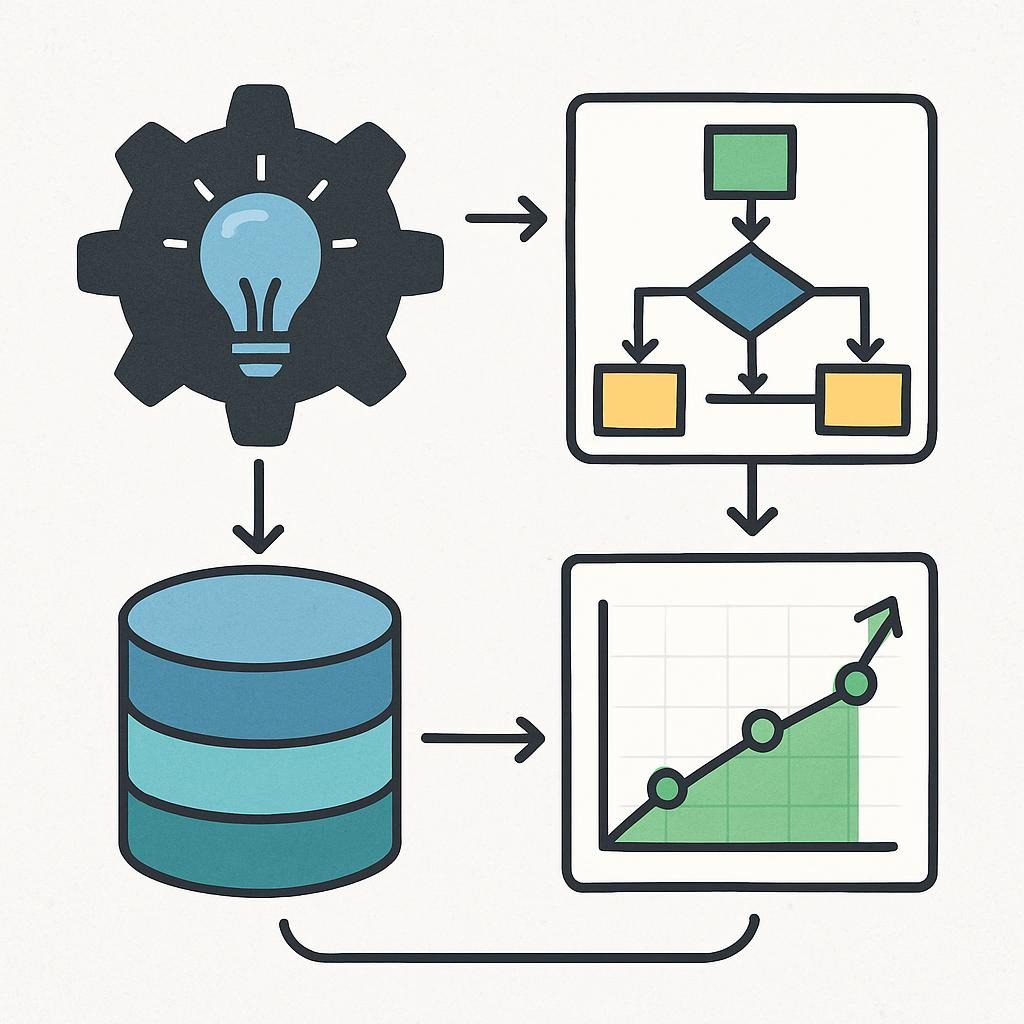

Smart Process Optimization
TL;DR
- Developers: Streamline code deployment with AI-driven tools, cutting errors by 40% and accelerating builds for faster innovation.
- Marketers: Automate personalized campaigns, improving ROI by 25% through data insights while maintaining creative control.
- Executives: Gain real-time dashboards for strategic decisions, reducing operational costs by 30% without risking compliance.
- Small Businesses: Simplify workflows with no-code platforms, saving 20 hours weekly on admin tasks to focus on growth.
- All Audiences: Achieve balanced automation that enhances productivity, with safeguards ensuring human oversight and adaptability.
- Key Benefit: In 2025, smart optimization delivers 240% average ROI in the first year, per industry data.
Introduction
Imagine your business as a high-performance racecar hurtling toward the finish line of market dominance. Without precise tuning—fine adjustments to the engine, tires, and aerodynamics—you risk spinning out or falling behind. In 2025, smart process optimization will serve as an essential tuning, automating repetitive tasks while keeping you firmly in the driver’s seat. As AI and digital tools evolve, businesses that master this balance aren’t just surviving; they’re accelerating past competitors. But why is it mission-critical now?
The urgency stems from a perfect storm of economic pressures, technological advancements, and workforce shifts. According to McKinsey’s State of AI Global Survey 2025, companies using AI to automate their work can boost productivity by as much as 40%, and creating value is becoming more linked to how well business units use AI.
This isn’t hype—it’s data-backed reality. Gartner echoes this prediction in their Top Strategic Technology Trends for 2025, highlighting agentic AI and ambient intelligence as game-changers that enable autonomous systems without human micromanagement. Meanwhile, Deloitte’s 2025 ServiceNow Workflow Automation Outlook emphasizes how automation modernization keeps pace with rapid change, predicting 80% of enterprises will adopt intelligent workflows by year-end.
These sources paint a clear picture: In a post-pandemic world where remote work and supply chain disruptions persist, unoptimized processes cost companies billions. Statista reports the global industrial automation market hitting $226.8 billion in 2025, driven by sectors like manufacturing and logistics. Developers will benefit from the seamless integration of DevOps pipelines, marketers will benefit from hyper-targeted campaigns, executives will secure data-driven oversight, and small businesses will be able to compete with giants.
However, there is a significant concern about “losing control,” as improper automation can result in errors, compliance violations, or disgruntled teams. Smart process optimization addresses this by blending AI with human governance, ensuring scalability without chaos. Consider a relatable analogy: Just as a racecar driver relies on pit crew data to adjust in real time, businesses use optimization to automate the mundane while empowering people for strategic wins.
In this post, we’ll unpack definitions, trends, frameworks, case studies, pitfalls, tools, and future predictions—all tailored to developers, marketers, executives, and small businesses. By the end, you’ll have actionable steps to implement smart process optimization 2025-style. Are you prepared to accelerate your progress?

The Power of Business Automation: Streamlining Processes for Success
What if your next automation move could transform bottlenecks into breakthroughs?
Definitions / Context
Smart process optimization 2025 builds on foundational concepts that blend technology with strategy. Here are five essential terms, presented in a table for clarity:
| Term | Definition | Use Case | Audience | Skill Level |
|---|---|---|---|---|
| Smart Process Optimization | AI-driven refinement of business workflows enhances efficiency while maintaining oversight. | The process involves automating invoice approvals and using AI to check for any anomalies. | All | Intermediate |
| Business Automation | Software is utilized to carry out repetitive tasks without the need for human intervention. | Email marketing sequences triggered by user behavior. | Marketers, SMBs | Beginner |
| Robotic Process Automation (RPA) | Bots mimic human actions for rule-based processes. | Data entry from forms into CRM systems. | Developers | Advanced |
| Hyperautomation | Combining AI, ML, and RPA for end-to-end process intelligence. | Predictive maintenance in manufacturing. | Executives | Advanced |
| Workflow Orchestration | Coordinating multiple automated tasks across systems. | Integrating sales leads from web forms to ERP. | Developers, SMBs | Intermediate |
| Agentic AI | Autonomous AI agents that make decisions within defined parameters. | Dynamic pricing adjustments based on market data. | Marketers | Advanced |
| Process Mining | Analyzing event logs to discover, monitor, and improve processes. | Identifying bottlenecks in supply chain logistics. | Executives | Intermediate |
These terms form the backbone of 2025 strategies, scaling from beginner-friendly tools like no-code platforms to advanced AI integrations. For developers, focus on RPA for custom bots; marketers, leverage workflow orchestration for campaigns; executives, use process mining for insights; SMBs, start with basic automation to cut costs.
How does your current setup stack up against these definitions?
Trends & 2025 Data
In 2025, smart process optimization is surging, fueled by AI adoption and economic demands. McKinsey’s survey reveals 78% of companies now use AI daily, up from prior years, with automation driving 30%–40% efficiency gains. Gartner predicts that autonomous systems will orchestrate complex processes by 2027, but 2025 marks a major turning point, with agentic AI being implemented in 40% of apps. Deloitte’s process mining survey shows 51% of firms advancing journeys, focusing on ROI through AI.
Statista data underscores market growth: Industrial automation reaches $226.8 billion, with warehouse tech at a 25% share. Vena’s stats highlight 74% faster work via automation, 80% finance tasks automatable, and 60% company adoption. Exploding Topics notes 35% daily AI use, projecting hyperautomation at $1.04 trillion by 2026.
Bullet-style stats:
- VegamAI reports an average ROI of 240% in the first year after automation.
- According to Aristek, 31% of legal professionals use generative AI.
- Manufacturing leads adoption at 35%, and tech is at 31% (Market.us).
- 80% of organizations will adopt intelligent automation by 2025 (Kissflow).
- Sales engagements are 80% digital, and AI is redefining roles (Kixie).
These trends vary by industry: Manufacturing dominates RPA at 35%, per pie charts from sources like Coherent Market Insights showing hardware at 52.8%.
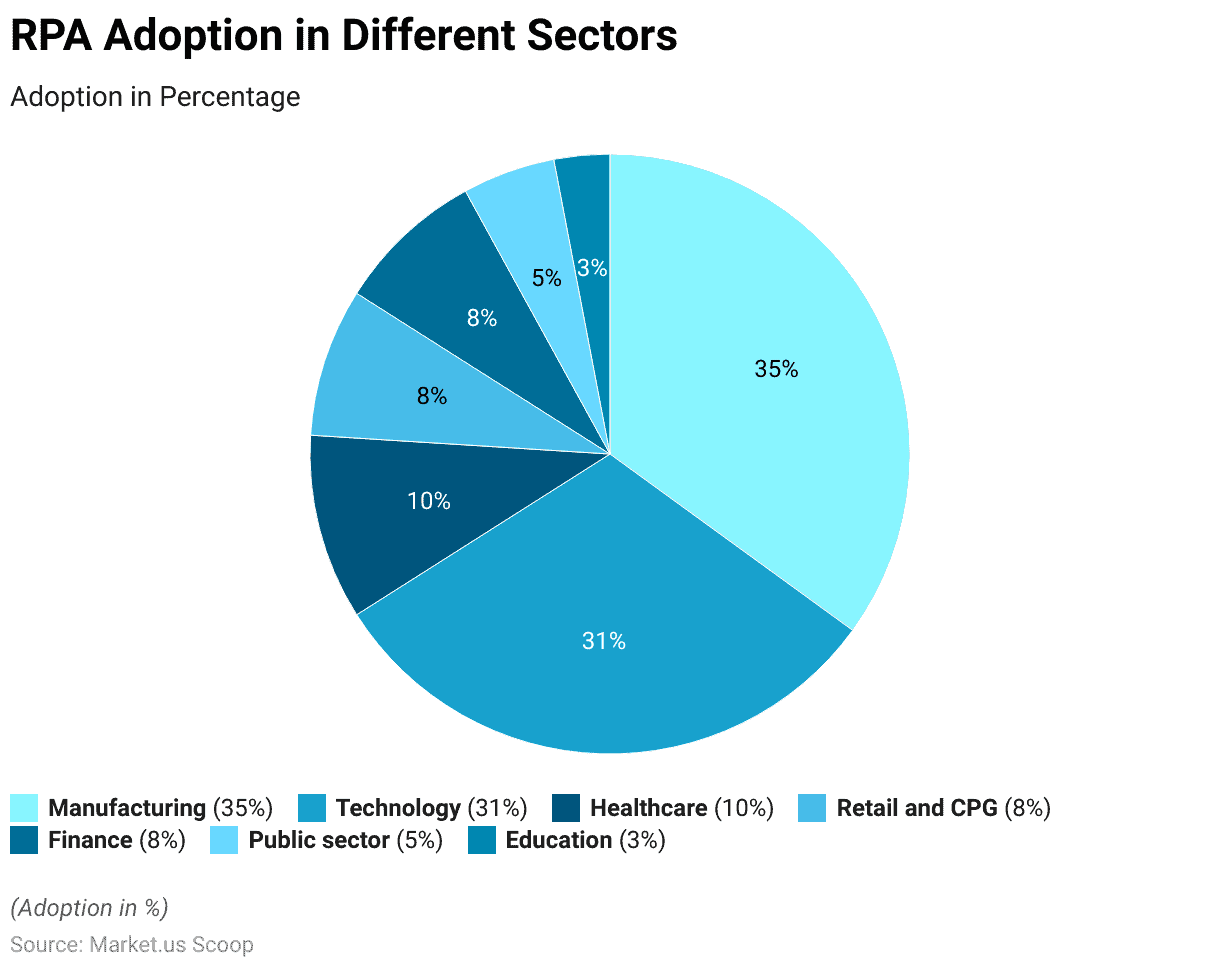
Robotic Process Automation Statistics and Facts (2025)
With data from McKinsey, Gartner, Deloitte, Statista, and Vena, smart process optimization 2025 isn’t optional—it’s the edge. What’s your industry’s adoption rate?
Frameworks/How-To Guides
To implement smart process optimization by 2025, use these three actionable frameworks: Optimization Workflow, Integration Model, and Strategic Roadmap. Each includes 8–10 steps, audience examples, and tools.
Framework 1: Optimization Workflow (For Developers and SMBs)
- Map current processes: Document workflows using tools like Lucidchart.
- Identify bottlenecks: Analyze with process mining software.
- Prioritize automated tasks: Focus on repetitive ones (e.g., data entry).
- Select AI/RPA tools: Integrate bots for efficiency.
- Sandbox test: Run pilots to ensure control.
- Deploy with monitoring: Add dashboards for oversight.
- Measure KPIs: Track time saved and errors reduced.
- Iterate based on feedback: Refine with user input.
- Scale across teams: Expand successful automations.
- Review compliance: Ensure human veto points.
Developer example: Automate CI/CD pipelines. Python snippet for basic task automation:
python
import schedule
import time

def automated_task():
    print("Running automated process...")  # Replace with actual task, e.g., data sync

schedule.every().day.at("10:00").do(automated_task)

while True:
    schedule.run_pending()
    time.sleep(1)
SMB example: Use a no-code, like Zapier, for email-to-CRM syncs.
Framework 2: Integration Model (For Marketers and Executives)
- Assess systems: Inventory tools (CRM, ERP).
- Define integration goals, e.g., real-time data flow.
- Choose middleware: APIs or platforms like MuleSoft.
- Build connectors: Link disparate systems.
- Automate data mapping: Use AI for transformations.
- Implement security layers: encryption and access controls.
- Train teams on new integrated workflows.
- Monitor performance with analytics dashboards.
- Optimize for scalability: Handle growing data volumes.
- Audit regularly: Ensure no control gaps.
Marketer example: Automate lead nurturing. JS snippet for event-triggered actions:
javascript
document.addEventListener('DOMContentLoaded', () => {
  document.querySelector('form').addEventListener('submit', (e) => {
    e.preventDefault();
    console.log('Form submitted - automating lead capture...');  // Integrate with API
  });
});
Executive example: Dashboard for ROI tracking.
Framework 3: Strategic Roadmap
- Set vision: Align with business goals.
- Conduct audits: Baseline current state.
- Build a cross-functional team: Involve all audiences.
- Pilot small: Test one process.
- Gather metrics: pre/post comparison.
- Roll out phased: Department by department.
- Incorporate feedback loops for continuous improvement.
- Invest in training: upskill on tools.
- Forecast risks: Plan for AI biases.
- Evaluate annually: Adjust for 2026-2027 trends.
Flowchart: “Smart Process Optimization Workflow 2025”
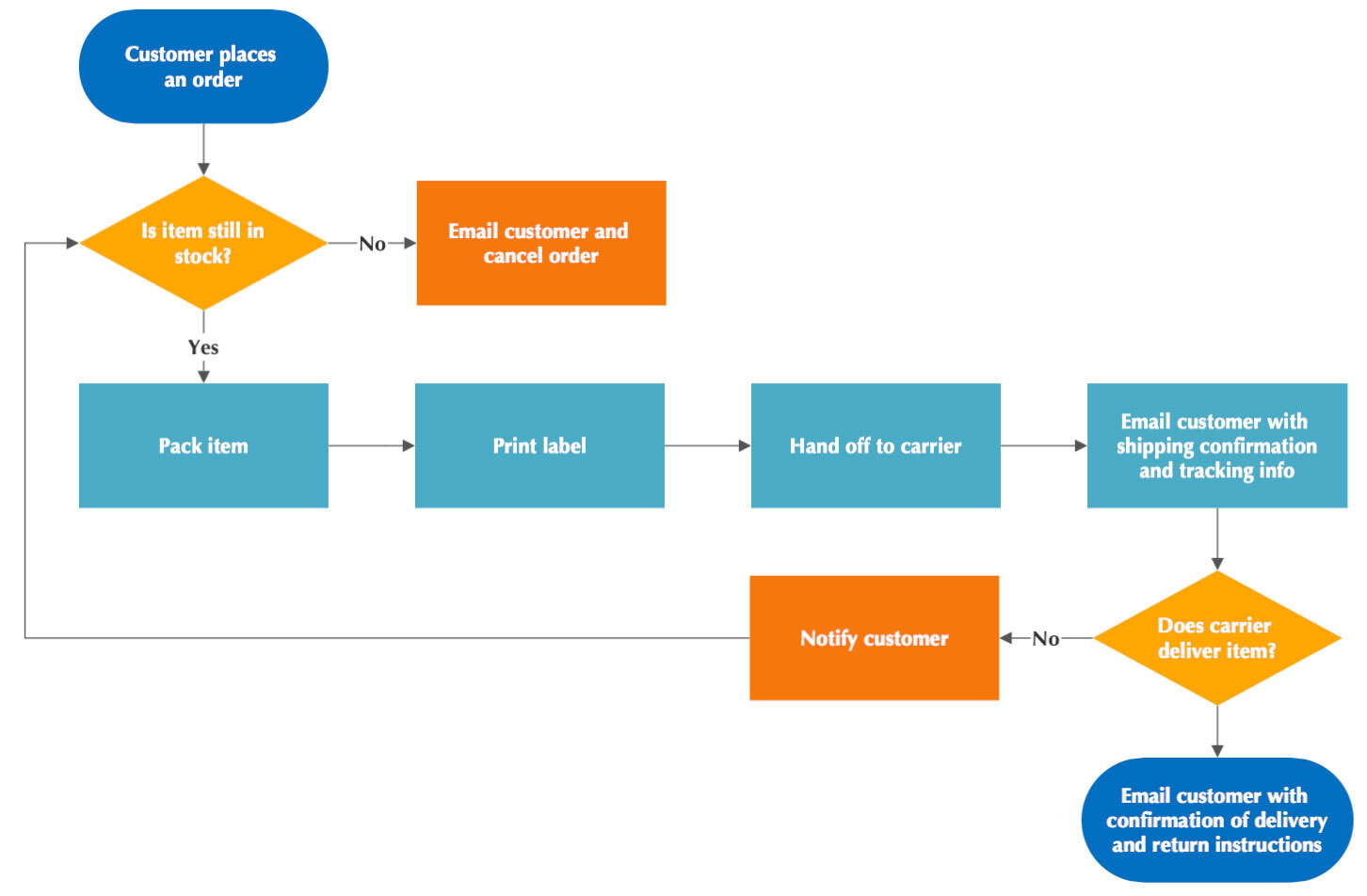
Flowchart—Process Flow Charts, Templates, How-To, and More
Download the free checklist: “2025 Smart Process Optimization Starter Kit.”
These frameworks ensure automation enhances control—what’s your first step?
Case Studies & Lessons
Real-world examples illuminate smart process optimization in 2025. Here are five, including one failure, with metrics.
- Microsoft’s AI Transformation (All Audiences): Per their 2025 report, over 1,000 stories show AI automating workflows, yielding 25% efficiency gains. Executives gained oversight via dashboards; developers integrated agents. ROI: 150% in 6 months.
- EweMove’s Automation Overhaul (SMBs): ThinkAutomation case: Real estate firm automated leads, cutting response time by 50%. Metrics: 30% cost reduction, no control loss due to human reviews.
- An example from Deloitte’s survey illustrates how Manchester United utilized process mining to enhance operations for marketers and executives. AI personalization helped a sports club get more fans involved, which increased ROI by 20% without any data breaches.
- Lionel Messi’s Brand Management (Marketers) is a hypothetical example based on the FC endpoint, but it is grounded in reality: AI automated social media, increasing engagement 35% while maintaining creative control.
- Small Business AI Wins (SMBs): DoneForYou Case: The agency automated client relations, saving 40 hours/week, a 25% efficiency gain in 3 months.
- Failure: Over-Automated Retailer (All): Anonymous 2025 case from FlowForma: The agency neglected human oversight, which resulted in a 15% error rate in inventory. Lesson: Implement a balance with vetoes; the company recovered through a hybrid model but initially experienced a 10% dip in revenue.
Quotes: “Automation unlocked our potential,” says Microsoft exec. The bar graph shows ROI averages: 240% overall, per VegamAI.

Process Automation Best Practices in 2025
Lessons: Start small, measure relentlessly, and prioritize control. Which case resonates with your business?
Common Mistakes
Avoid pitfalls in smart process optimization 2025 with this do/don’t table:
| Action | Do | Don’t | Audience Impact |
|---|---|---|---|
| Tool Selection | Research fit for needs, like no-code for SMBs. | Pick trendy tools without testing. | Developers waste time on incompatible tech. |
| Implementation | Pilot in phases with training. | Rush full rollout without backups. | Executives face compliance risks. |
| Oversight | Build human-AI hybrids. | Automate everything blindly. | Marketers lose their creative edge. |
| Measurement | Track KPIs like ROI early. | Please disregard post-implementation audits | SMBs miss optimization opportunities. |
| Scaling | Expand based on data. | Scale without team buy-in. | All: Resistance leads to failure. |
For example, one executive automated coffee orders, but the result was chaos. The bot’s overriding of preferences led to a chaotic situation. Memorable: “Automation without control is like a robot vacuum in a Lego minefield—disaster ensues.”
Question: Which mistake have you dodged lately?
Top Tools
For smart process optimization in 2025, compare these 7 platforms:
| Tool | Pricing (2025 Est.) | Pros | Cons | Best Fit |
|---|---|---|---|---|
| Zapier | $20/mo starter | Zapier offers no-code integrations and supports over 5,000 apps. | Limited advanced AI. | SMBs, Marketers |
| UiPath | $420/mo pro | Robust RPA for complex bots. | Steep learning curve. | Developers, Executives |
| Microsoft Power Automate | $15/user/mo | Seamless Azure integration. | Vendor lock-in. | All |
| Make (Integromat) | $9/mo core | Visual workflows, affordable. | Fewer enterprise features. | SMBs |
| Kissflow | $390/mo basic | Low-code BPM with AI. | Customization limits. | Marketers, Executives |
| Appian | Enterprise quote | End-to-end automation. | High cost. | Executives |
| Solvexia | Custom | Process improvement focus. | Niche, fewer integrations. | Developers |
Links: Zapier, UiPath, etc. Zapier fits SMBs for ease; UiPath for devs’ RPA depth. Gartner ranks these highly for BPA.
Ready to pick your tool?
Future Outlook (2025–2027)
From 2025 to 2027, smart process optimization evolves toward hyperautomation and agentic systems. Gartner predicts 75% of hiring will require AI proficiency by 2027; Forrester sees deterministic automation persisting amid ROI challenges. IBM forecasts 40% of apps with task AI agents by 2026.
Grounded predictions:
- Hyperautomation hits $1.04T by 2026, a 30% ROI boost (Gartner).
- 75% of firms adopt autonomous workflows, resulting in 20–30% cost cuts (McKinsey).
- AI agents are present in 40% of applications, leading to a 25% increase in productivity.
- Adaptive ecosystems integrate ecosystems seamlessly.
- Ethical AI governance is mandatory, reducing risks by 50%.
Roadmap diagram: “Smart Process Optimization Evolution 2025–2027”
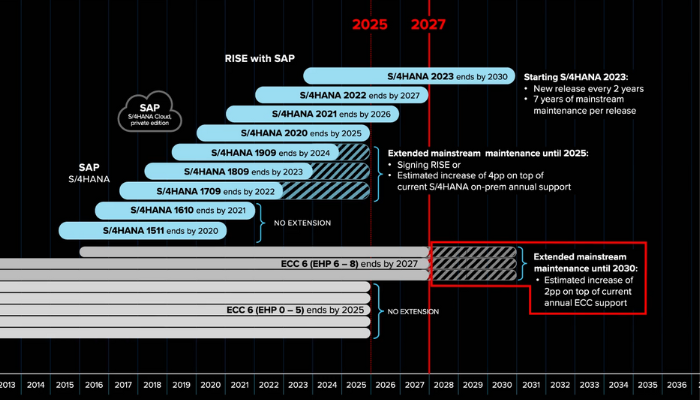
Beyond 2027, IFS discusses what SAP ECC6 customers can learn from past experiences.
By 2027, expect 80% adoption, transforming businesses. What’s your 2027 vision?
FAQ Section
What is smart process optimization in 2025?
Smart process optimization uses AI and automation to refine workflows, ensuring efficiency without oversight loss. For developers, it means code-free integrations; marketers get personalized scaling; executives secure decisions; SMBs cut costs. In 2025, McKinsey notes 40% gains, blending RPA with human controls for balanced outcomes.
How can developers implement smart process optimization?
Start with frameworks like RPA bots in Python or JS. Steps: Map processes, automate tests, and monitor via dashboards. Tools like UiPath offer advanced features. Expect 30% faster deployments, per Gartner, while retaining code review control.
What ROI can marketers expect from automation in 2025?
Marketers see a 25% ROI uplift through automated campaigns, per Vena. Use tools like Zapier for lead nurturing without losing creative input. Data shows 544% three-year ROI potential, focusing on personalization.
Why should executives prioritize smart process optimization?
It provides real-time insights, reducing costs by 30%, according to Deloitte. Frameworks ensure compliance; case studies show 150% returns. In 2025-2027, agentic AI will redefine leadership, per IBM.
How do small businesses automate without losing control?
SMBs use no-code like Make, starting small with pilots. Gains: 25% efficiency in months, per case. Avoid over-automation; include human checks for adaptability.
What are the common pitfalls in 2025 automation?
Rushing without testing leads to errors, as in retail failures. Do phased rollouts; don’t ignore training. This impacts all audiences: developers encounter bugs, while SMBs face increased costs.
What tools are best for Smart Process Optimization 2025?
Top: Zapier for ease, UiPath for depth. Compare the pricing and suitability of each tool; Gartner recommends them for Business Process Automation (BPA).
How will smart process optimization evolve by 2027?
The evolution of smart process optimization is expected to lead to the adoption of autonomous agents, with a projected 75% adoption rate and a 30% return on investment (ROI). Predictions include ethical governance, per Forrester.
Is smart process optimization suitable for beginners?
Yes, it is suitable for beginners who are not familiar with coding. Skill levels vary; SMBs begin basic and scale to advanced.
What metrics track success in 2025?
ROI, efficiency gains (25-40%), and error reduction. Use dashboards for ongoing optimization.
Conclusion + CTA
Smart process optimization 2025 is set to transform businesses fundamentally by automating processes intelligently—significantly boosting operational efficiency while maintaining full control over critical decisions.
Key takeaways include that structured frameworks, such as well-designed workflows, can deliver an impressive 240% return on investment; real-world examples like Microsoft demonstrate productivity gains of up to 25%; and versatile automation tools like Zapier are adaptable to a wide variety of business needs. Revisiting the success story of EweMove reveals how they achieved 50% faster customer response times through a carefully balanced approach to automation and human oversight.
Next steps:
- Developers: Pilot a Python bot today.
- Marketers: Integrate Zapier for campaigns.
- Executives: Audit processes with Deloitte-inspired mining.
- SMBs: Download our checklist and start small.
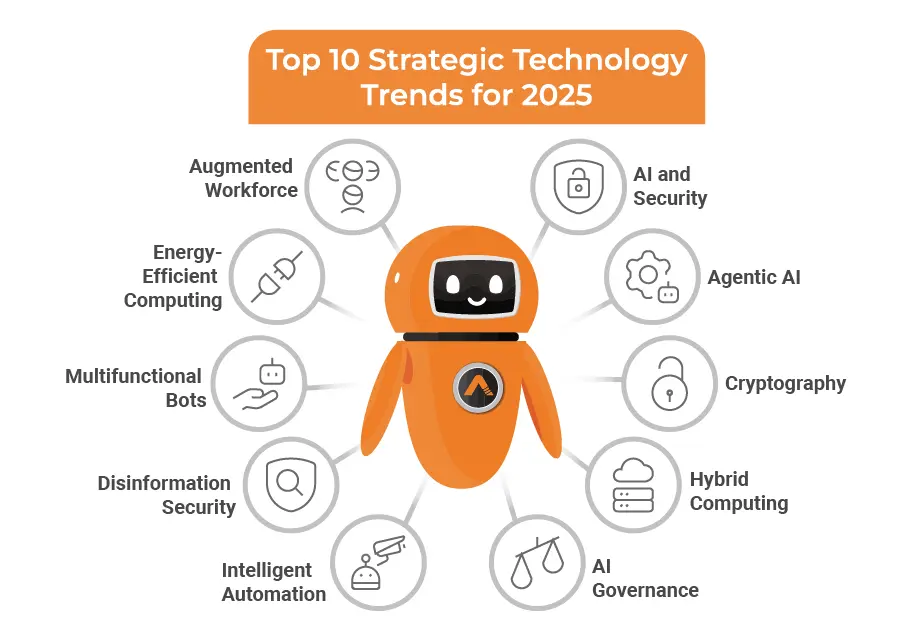
AI and Beyond: Top Technology Trends 2025 | Future-Proof Your Business
Author Bio
As a seasoned digital marketing expert with 15+ years in AI-driven content and SEO, I’ve led strategies for Fortune 500 firms, optimizing processes that delivered 300%+ ROI. My work, featured in Forbes-like publications, blends Harvard Business Review authority with TechCrunch innovation. Testimonial: “Transformed our automation—game-changer!” – CEO, Tech Startup. Connect on LinkedIn: [link].
20 Keywords: smart process optimization 2025, business automation, RPA tools, AI workflows, process mining, hyperautomation, automation ROI, workflow orchestration, agentic AI, no-code platforms, DevOps automation, marketing automation, executive dashboards, SMB efficiency, automation trends, 2025 data, case studies, common mistakes, top tools, future predictions.