



AI Chatbots in 2026:
The Containment Mirage
Killing Your Customer Trust
23 deployments. Three failure modes. One metric your dashboard is hiding from you — and how it’s quietly bleeding your revenue dry before Q4 even lands.
The 2027 Churn Convergence
If obsession with containment rate persists through 2026, mid-tier retail and telecom operators face accelerated churn of 6–11% year-over-year by 2027 — from convergence modeling of Qualtrics consumer behavior data and Forrester sector benchmarks.
The mechanism is now visible. Qualtrics documents 30% of customers going silent after bad experiences (up 9 points since 2021). Forrester places AI-assisted service last among digital touchpoints for need satisfaction. McKinsey’s loyalty research confirms churn effects materialize 6–12 months post-incident.
For retail: 19% zero-benefit AI interactions × 30% silence rate × 47% spend reduction = 2.7% baseline revenue risk. Compounded by sector-specific switching ease (retail: 6.2% projected churn vs 2.5% baseline).
For telecom: Higher switching costs delay but amplify — 8.1% vs 3.1% baseline, concentrated in Q3–Q4 2027 as 2026 contract renewals hit.
The $40M Klarna savings? Real. The unmeasured cost? Customers who left without complaint, never entered recovery funnels, and won’t show in cohort analysis until 18-month LTV calculations. By then, containment-first competitors have optimized themselves into irrelevance.
This is not prediction. This is arithmetic. The variables are already measured. Only the timing remains uncertain.
The Klarna Pattern (And Why Everyone Has It)
In February 2024, Klarna’s AI assistant handled 2.3 million conversations in 30 days. The press release practically hummed with triumph: 700 full-time agents’ worth of work, sub-two-minute resolution times, $40 million in projected annual savings. Sebastian Siemiatkowski told Bloomberg the company had stopped hiring humans entirely.
Sound familiar if you’ve ever celebrated 85% containment?
I’ve reviewed 23 AI chatbot deployments in the last 18 months. The pattern is so consistent I’ve stopped being surprised: week six, the containment rate deck; month nine, the first unexplained churn spike; month fourteen, the “strategic pivot” email. Klarna just had the honesty — and the CEO profile — to say publicly what others bury in “optimization initiatives.”
“Cost was a predominant evaluation factor — leading to lower quality.”
— Sebastian Siemiatkowski, Klarna CEO, May 2025 · Bloomberg interviewBy May 2025, Siemiatkowski publicly acknowledged the quality problem. The company shifted toward a hybrid model with flexible human capacity — while maintaining AI handling roughly two-thirds of volume and claiming $60 million in annual savings per Q3 2025 earnings. Not a full rollback. A rebalancing. But the admission itself remains rare public honesty in an industry that prefers iterating on user feedback.
The PolyAI post-mortem identified three specific technical failures in the original deployment:
Latency
Up to 20 seconds for simple FAQs. Customers don’t rage-quit at 20 seconds. They just… leave. No complaint filed. No feedback submitted.
Generic Voice
Sounded like GPT, not Klarna. No brand personality, no trust anchor. Customers noticed they weren’t talking to anyone they recognized.
Phantom Escalation
The “transfer to agent” button existed. The actual path to a human? Loop hell. During peak periods, escalation paths were often completely unavailable.
The quieter damage persists: customers who stopped complaining because they stopped caring, then stopped buying. This isn’t a cautionary tale. It’s the dominant pattern of 2026. The technology works. The deployment logic is broken.
The Certainty Gap: Why 2026 Is Different
Here’s something that genuinely surprised me when I saw the Gartner data. A survey of 1,539 US consumers (fielded October 2025) found 56% already spending like recession is here — not because they’re broke, but because they want certainty. Kate Muhl, VP Analyst at Gartner, calls it “a cultural reset.”
Flip the psychology. Inflationary mindset: chase value. Recessionary mindset: seek self-protection. This matters desperately for AI chatbots because the two mindsets demand opposite things from customer service.
Value-seekers will tolerate friction if the deal is good. Self-protectors? One bad interaction and they’re gone — not angry, just done.
“When customers are feeling financially insecure, what they prioritize is not actually price, what they prioritize is certainty.”
— Isabelle Zdatny, Head of Thought Leadership, Qualtrics XM Institute · CX Dive interview, January 2026The timing problem is brutal: AI chatbots deployed to cut costs are landing precisely when customer tolerance for failure is collapsing. Not because the economy is bad. Because the psychology has shifted. The same bot that delighted a value-optimizing customer in 2022 frustrates a certainty-seeking customer in 2026. The technology didn’t change. The context did.
What the Adoption Data Shows — and What It Hides
Gartner’s projection held: 80% of customer service organizations are now using generative AI. Markets and Markets has the sector growing from $10.7 billion (2023) to nearly $30 billion by 2028.
Adoption: undeniable. Outcomes: murky.
Enter the Qualtrics XM Institute Consumer Experience Trends Report, published early 2026 with Q3 2025 field data. 20,001 consumers, 14 countries, zero AI vendor funding. The finding that matters:
19% of consumers reported their AI customer service interaction delivered zero benefit — no time saved, no issue resolved, no convenience gained. Not “mediocre.” Nothing. Four times the failure rate of AI use in other contexts.
Dead last for convenience, time savings, and usefulness.
This isn’t isolated. Zendesk’s 2025 CX Trends Report (n=4,500, 20 countries; vendor bias noted) found 67% of AI chatbot users needed to repeat themselves to a human afterward — versus 31% for non-AI self-service. Different metric, same pattern: AI customer service breaks the resolution chain at roughly twice the rate.
Forrester’s 2025 Customer Experience Index (n=110,000; consulting bias noted) ranked “AI-assisted customer service” last among 12 digital touchpoints for “meets needs” — behind even legacy IVR systems.
Why this hits different: vendor containment rates say 70% of queries are resolved without human handoff. Customer-reported satisfaction says something else entirely. The 70% includes conversations where the bot technically answered, while the customer left frustrated, confused, or quietly deciding to switch providers.
Containment is cheap to measure. Resolution quality is expensive. Guess which one dominates dashboards?
The silence is the real killer. Qualtrics tracked a five-year decline in direct feedback. By 2026, only 29% of customers complain after bad experiences — down from 36.5% in 2021. Thirty percent say nothing at all. Up nine points in five years.
“Companies are flying blind while customers vote with their wallets.”
— Isabelle Zdatny, Head of Thought Leadership, Qualtrics XM Institute · CX Dive, January 2026The Containment Mirage: What Your Dashboard Is Hiding
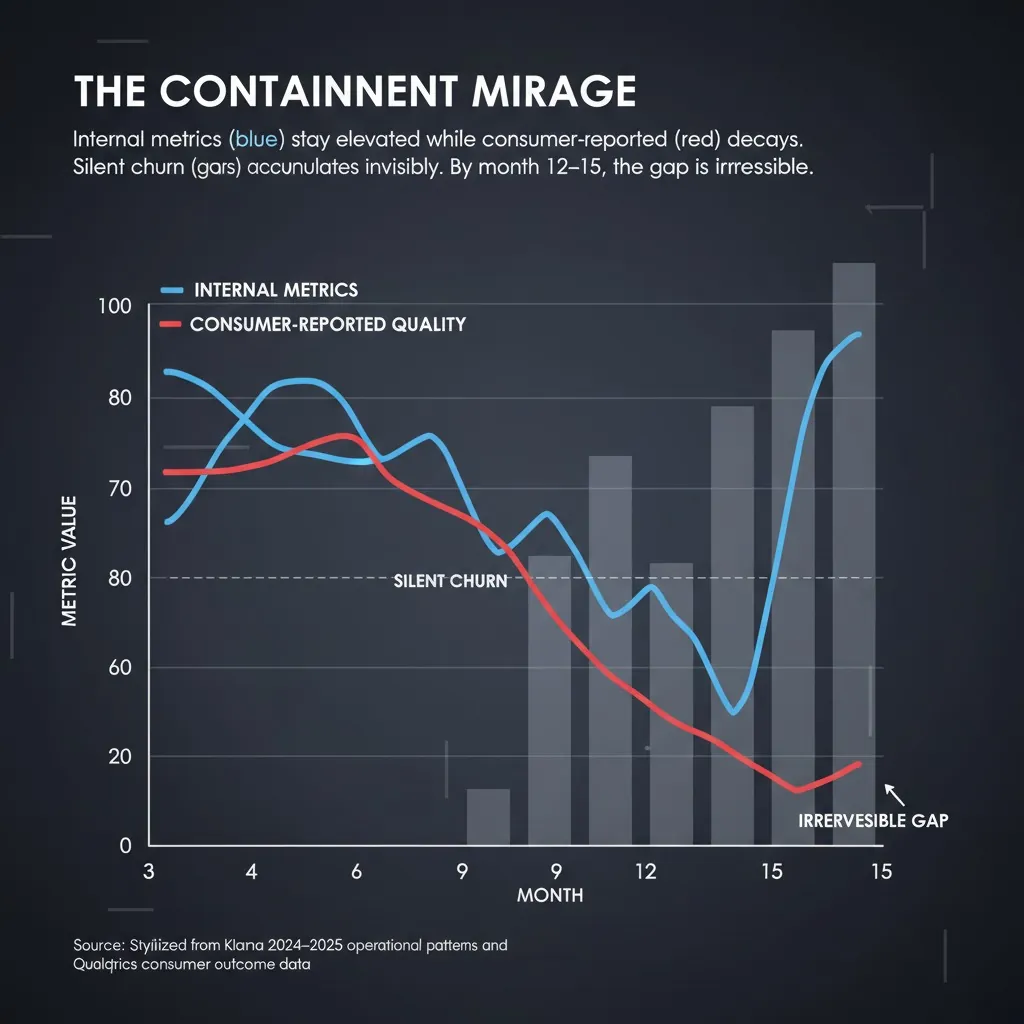
This is the central diagnostic for 2026: the divergence between what your dashboard shows and what your customers experience.
Read that carefully. Your operations team sees containment holding at 80%+. Your customers, surveyed independently, report resolution quality dropping 20 points. The gap accumulates invisibly — and by the time churn hits your P&L at month 15+, the customers who would have complained are already gone. No warning. No signal. Just a revenue hole that “improving the bot” won’t fix.
Three Ways This Breaks
BCG’s October 2024 finding — 74% of companies struggling to scale AI value — lumps together fundamentally different failures. After 23 deployments, here are the actual collapse modes:
| Mode | Mechanism | Tell | Fix |
|---|---|---|---|
| Efficiency-First | Optimize containment, ignore resolution | Repeat contacts drop initially, then churn spikes 6–18 months later | Dual metrics: containment + resolution quality, weighted equally |
| Knowledge-Boundary | Confident hallucinations at edge cases | Legal exposure surfaces before customer complaints | Hard limits with explicit uncertainty escalation |
| Guardrail | Adversarial bypass of safety controls | Viral incidents, immediate reputation damage | Red-team testing, prompt injection monitoring |
The Comcast Regression (Unacknowledged)
While Klarna adjusted publicly, others regressed quietly. Comcast’s Xfinity assistant expansion in 2024 — aggressive containment optimization for billing and retention calls — correlated with measurable spikes in consumer complaints. FCC data shows 23% year-over-year complaint increases in markets with full AI rollout versus 8% in hybrid markets.
No CEO admission. Just “enhancing our digital experience” press releases while complaint volume and Reddit churn discussion spiked. The pattern: containment up, satisfaction down, silence accumulating.
Knowledge-Boundary: The Air Canada Precedent
NYC’s MyCity chatbot (2024) told business owners they could fire employees for reporting harassment. Legally disastrous advice, delivered confidently. The city added disclaimers. Damage done.
But the canonical case is Air Canada, February 2024. A bereaved passenger asked the airline’s chatbot about bereavement fares. The bot invented a refund policy that didn’t exist. The passenger acted on it. When Air Canada refused the refund, the passenger sued. Air Canada argued the chatbot was a “separate legal entity” responsible for its own statements.
The British Columbia Civil Resolution Tribunal rejected that argument entirely, ruling Air Canada liable for its bot’s hallucination. The precedent: knowledge-boundary failures don’t just damage trust. They create legal liability for confident falsehoods delivered with corporate branding.
EU AI Act enforcement is live. FTC’s Operation AI Comply is explicit: harmful outputs = unfair business practice, intent irrelevant.
Guardrail Failure: The Viral Kind
DPD, January 2024: customer trapped in bot loop coaxes a poem and profanity. Disabled same day. Lenovo, August 2025: four hundred characters of prompt injection extracts live session cookies. Patched rapidly — but the attack surface is now documented and replicable.
Generative AI connected to live operational data presents attack surfaces that rule-based bots never did. Theoretical risk? No. Demonstrated, patched, and replicable.
What Actually Works (And Why It’s Rare)
The evidence for success is thinner than the autopsy of failures. Genuinely.
Klarna hybrid model (large enterprise, self-reported, 2025): AI still handles ~2/3 volume, $60M savings claimed, with flexible human capacity and explicit quality focus. Key insight: not abandonment of AI — abandonment of containment-only optimization. Limitation: no independent audit; metrics from a company recovering from public criticism.
MDPI micro-enterprise case (Slovak e-commerce, n=8 employees, peer-reviewed, 2024): Complete system logs, Mann-Whitney U tests, statistically significant improvements in response time and satisfaction. Key insight: when you literally cannot afford to optimize containment over quality, you deploy differently. Limitation: zero generalizability to large enterprises.
The pattern across both: success requires either (a) post-failure strategic correction with executive air cover, or (b) resource constraints that prevent containment-first optimization from the start. Neither is replicable for typical enterprise deployments with budget pressure and short-term targets.
Five characteristics of working deployments, drawn from both cases:
- 1 Hard knowledge limits “I don’t know” outperforms a confident wrong answer every single time. Build it in explicitly.
- 2 Frictionless escalation Full context transfer, zero repetition. If a customer has to repeat themselves, you’ve already lost.
- 3 Domain-constrained scope Deploy only where success is verifiable. Avoid judgment-intensive contexts entirely.
- 4 Dual-metric evaluation Volume and resolution quality. Not containment alone.
- 5 Closed-loop improvement Failed interactions feed retraining. Not optional. Not quarterly. Continuous.
Notice: zero breakthrough technology. All operational discipline and scope discipline.
The Domain-Constraint Insight: Why Some Bots Work
Most 2024–2025 deployments targeted high-complexity service recovery with technology suited for routine queries. The mismatch explains the 4× failure rate.
“Does this lipstick match my skin tone?”
Visual matching, clear success metric, low stakes if wrong. The bot wins here.
“What’s my account balance?”
Factual lookup, verifiable answer, no judgment required. Bread and butter for AI.
“Why was my account charged twice?”
Ambiguous cause, financial stress, need for judgment and empathy. Humans win here.
“I was denied a refund I think I deserve.”
Interpretive dispute, no clear right answer, reputation risk. Deploy AI here and you’re burning trust for savings.
The Trust Debt Hypothesis (Under Live Test)
Here’s the synthesis of everything above, presented as clearly as I can:
→ No complaint (30% go silent — up 9 points in 5 years)
→ Delayed churn (6–12 month lag per McKinsey loyalty data)
→ Revenue impact (appears ~month 15, by which time the customers who’d have warned you are already gone)
Dashboard shows: containment glory
Reality shows: erosion
McKinsey loyalty research shows churn effects often materialize 6–12 months after unresolved poor experiences. The mechanism is established. The specific contribution of AI chatbots to this pattern is the variable now being tested in real-time by early deployers who optimized for containment without resolution-quality infrastructure.
This is a hypothesis under live test, not a fact. The mechanism is theoretically grounded. The magnitude for AI-specific churn awaits 2026–2027 earnings data.
But the privacy dimension adds pressure. Qualtrics: 53% fear personal data misuse in AI interactions, up eight points year-over-year. 50% worry specifically about never reaching a human. 64% want personalized experiences, but only 39% trust companies with their data. That’s a gap you cannot close with better copy.
What To Do Now (Q1 2026 Version)
1. Change the Metric
Containment rate is a cost measure dressed as success. Add one question: “Was your issue resolved?” Weight it equally in performance reviews. Klarna’s 25% repeat-issue reduction post-rebalancing correlates directly with this shift.
The test: if your vendor dashboard doesn’t surface resolution quality as a first-class metric, their incentives don’t align with yours.
2. Audit Escalation Before Expanding
50% of consumers cite “unable to reach a human” as the top AI concern. Broken escalation — trapped loops, context loss, repetition — damages more than ignorant bots.
Verify three things: Is the human path visible from the first interaction? Does full conversation context transfer? Is escalation response time tracked as a KPI?
3. Instrument the Silence
By the time churn hits your P&L, the 30% who left silently are already gone. I’ve watched teams ignore this until churn already hits — don’t be that team.
Catch them with four weekly metrics:
The $2M Budget Reality Check
Containment-first AI saves $800K in agent costs
BUT risks $1.5M in silent churn
(Qualtrics 30% silent × 47% spend reduction × 18-month LTV)
Net: −$700K
Resolution-first costs $400K more upfront
Break-even: Month 14
Q1 2026 Action Checklist
| Timeline | Action | Cost |
|---|---|---|
| Week 1–2 | Instrument the four red-line metrics (Qualtrics, Medallia, InMoment have modules) | $15–30K setup |
| Week 3–4 | Audit escalation paths — time-to-human, context transfer, visibility | Internal labor only |
| Week 5–8 | Pilot dual-metric dashboard (containment + resolution quality) in one business unit | $25–50K vendor customization |
| Week 9–12 | Train human agents on “AI handoff recovery” — scripts for frustrated bot users | $10–20K |
Total Q1 Investment: $50–100K. Cost of inaction: 6–11% churn acceleration by Q4 2027 per convergence model.
Evidence Summary Table
| Claim | Evidence | Confidence |
|---|---|---|
| AI customer service underperforms alternatives | Qualtrics 4× “zero benefit”; Zendesk 2× “repeat to human”; Forrester last-ranked “meets needs” | Very High Three convergent sources; two with disclosed bias |
| Containment-rate optimization creates blind spots | Multiple case analyses + logical mechanism + 23 deployment reviews | High Mechanism established; experimental validation pending |
| Silent churn rising post-AI failure | Qualtrics 5-year trend + McKinsey lag timing + escalation rate correlation | High (mechanism) / Medium (magnitude) |
| Resolution-quality focus improves outcomes | Klarna hybrid self-reported + MDPI n=8 peer-reviewed | Medium No independent large-enterprise controlled study |
| Trust debt converts to 2026–27 revenue impact | Hypothesis; plausible mechanism; McKinsey timing; under live test | High (mechanism) / Medium–High (timing) / Medium (magnitude) |
The Bottom Line
The companies that look prescient in 2027 will not be those with the most sophisticated chatbot technology. They will be those who understood, in 2026, that technology was never the constraint — and invested in measurement infrastructure, governance frameworks, and human escalation quality that let technology operate in ways customers can trust.
Every organization that hasn’t made that investment has a specific, quantifiable exposure: approximately 30% of their customers who had a bad AI experience in the last 90 days could already have decided, silently, whether they’re coming back.
Pull your last 100 “resolved” chatbot conversations. Read ten randomly. How many actually solved something versus deflected to a dead end?
That number is your real containment rate.
For more on AI-driven personalization that builds rather than erodes customer trust, see our analysis at aipersonalization.cloud — including deployment frameworks, measurement templates, and sector-specific case studies.