
How ML Keeps Conversations Alive —
And Why Klarna Had to Walk It Back
Three-layer AI stacks now deliver 82% faster response times and handle two-thirds of all customer queries. Klarna proved those numbers are real. Then its CEO admitted the approach produced “lower quality” — and started rehiring humans. Both things are true. Here’s exactly why.
A customer starts chatting on your website about a disputed charge. They close the tab. Two days later they message on WhatsApp about something else entirely. The AI picks up mid-sentence — same name, same order, same frustration level it flagged the first time. No “Can you repeat your issue?” No fresh start. The conversation simply continues.
That’s not a proof-of-concept. That’s production infrastructure, running at scale in 2026 across fintech, retail, e-learning, and telecoms. And for a while, Klarna was the loudest proof it worked. Then Klarna’s CEO admitted the opposite. Understanding both sides of that story is worth more than a hundred glowing case studies.
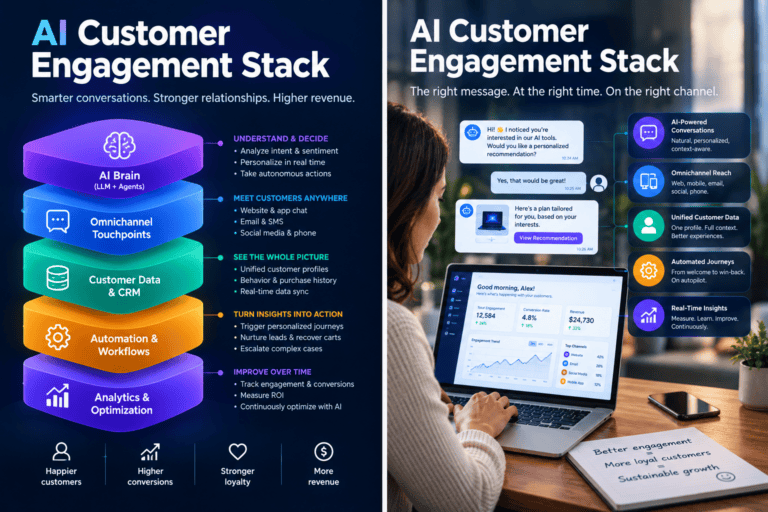
The Three-Layer Stack That Actually Runs Engagement
Coverage of “AI engagement” tends to flatten everything into chatbots with better autocomplete. The reality is a three-layer architecture — each layer doing something fundamentally different from the last. You can deploy Layer 1 on a reasonable timeline. Layer 3 takes years to get right, and punishes you visibly when you don’t.
Layer maturity as of Q1 2026. Badge reflects deployment breadth, not technical complexity.
Earlier chatbots optimized for “correct answer.” The best 2026 systems optimize for “next message.” That shift in objective function has consequences running in both directions — and Klarna made all of them visible.
The Klarna Case: The Best Controlled Experiment the Industry Didn’t Mean to Run
No company has given the market a more detailed public record of AI engagement’s ceiling and floor than Klarna — involuntarily, over 18 months. The CEO announced every stage. Which makes it invaluable.
Klarna AI: Timeline of the World’s Most Publicized CX Experiment
What makes this extraordinary isn’t the reversal. It’s the IPO timing. Klarna pitched AI-driven efficiency to public market investors in July. By September, the company was quietly undoing the same strategy. Investors who bought the AI efficiency story in July learned by September that the company was rehiring humans because the AI couldn’t handle the cases that mattered.
The 82% faster response time is real. The $60M savings are real. And the quality erosion is also real — because those success metrics measured what AI did well (speed, deflection volume) while ignoring what it couldn’t do at all (empathy, nuance, discretion on complex cases). The objective function delivered precisely what it was told to optimize. That was the problem.
“AI gives us speed. Talent gives us empathy. Together, we can deliver service that’s fast when it should be, and empathetic and personal when it needs to be.”
— Clare Nordstrom, Klarna spokesperson, May 2025 · Outsource AcceleratorThat sounds like damage-control messaging. It’s also the correct technical conclusion. The error wasn’t deploying AI. It was never defining the conditions under which AI should not handle a conversation. Klarna needed an abort trigger — a sentiment threshold, a complexity classifier, an escalation condition. It launched without one.
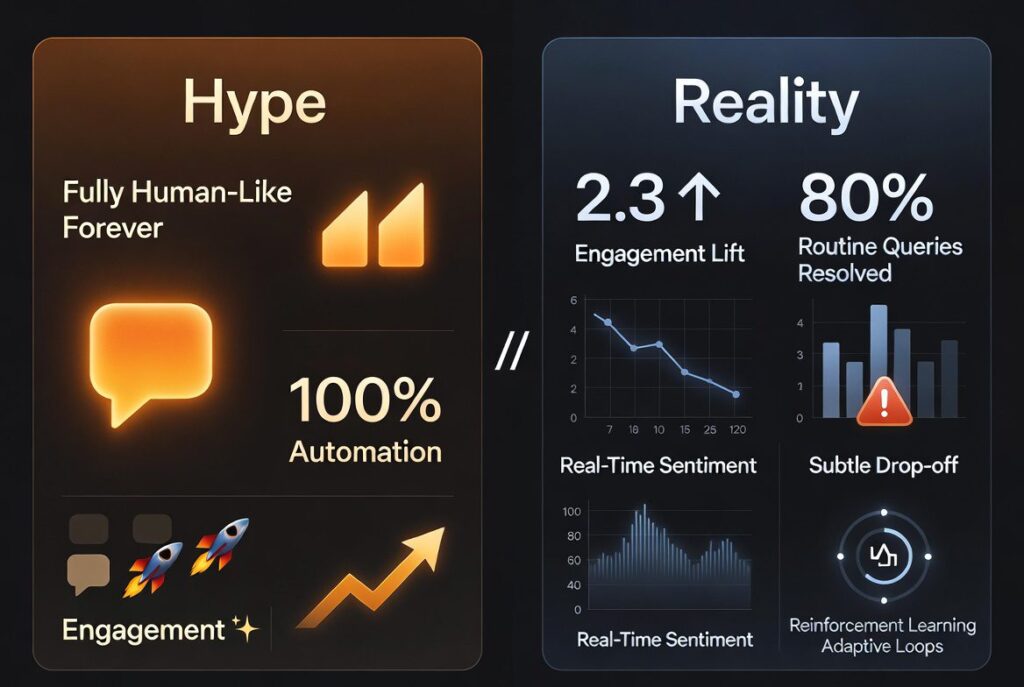
The Hype/Reality Gap — With Named Sources
Hype/Reality matrix compiled from independent analyst reports, named case studies, and direct CEO statements. Self-reporting disclosures noted inline.
Four Named Failures — Mechanism, Not Just Incident
The failures in this space aren’t random. They’re predictable outputs of systems doing exactly what they were designed to do — with the wrong objective, missing exit logic, or insufficient governance. Here are four that are documented, named, and resolved (or not).
All four documented by named outlets. The shared mechanism: none failed because the model was incompetent. All failed because objective, governance, or exit logic was missing.
The November 2025 peer-reviewed study on LLM hallucinations in customer service (274 participants, International Journal of Human-Computer Interaction) documented that users rate confident wrong answers as far more damaging than incomplete ones. Customers can absorb “I don’t know.” Confident fiction ends relationships.
Where the Stack Earns Its Keep — A Sector Breakdown
Self-reporting disclosures: Klarna and Yellow.ai/IKEA figures are platform self-reported. No independent audit was located for either. Treat as directional, not verified.
| Sector | Where AI earns its keep | Documented result | Primary failure mode | Human handoff? |
|---|---|---|---|---|
| Fintech / BNPL | Routine inquiry deflection, payment reminders | 82% faster response, 25% fewer repeats — Klarna (self-reported) | Empathy gap in disputes; quality erosion on nuanced cases | ✓ All disputes |
| Retail / e-commerce | Cart recovery, product recommendations | 35% of revenue from AI recs; 40% engagement lift vs. static (Optimove, client-base sample) | Personalization tips into “creepy” — threshold undefined | ✓ High-value carts |
| Customer support | FAQ, order status, tier-1 triage | Up to 80% routine deflection in mature deployments | Hallucination on policy-specific answers (3–27%) | ✓ Emotional / legal |
| Financial services | Fraud alerts, notifications, identity triage | 75% of transactions monitored by ML in 2025 | High hallucination cost; EU AI Act high-risk classification | ✓ Any advice |
| Recruiting (cautionary) | Application intake, scheduling | McDonald’s McHire: admin access via “123456”; basic Q&A failures | Security, legal discrimination risk, brand damage | ✓ All decisions |
Synthesized from EdgeTier, Optimove, HyperEngage / IBM, Monte Carlo Data, SQ Magazine. Platform self-reporting labeled throughout. “Human handoff” is editorial judgment based on hallucination risk and legal exposure.
The Metrics That Predict Conversation Health — Before CSAT Does
Most deployments measure containment rate and post-chat CSAT. Both are useful. Neither tells you the conversation is dying until it’s already dead. The teams achieving durable engagement measure four leading indicators across every session — what practitioners call LSDE signals:
- Length. Are user responses getting longer or shorter across turns? A paragraph followed by one word is a warning. Shrinking replies signal disengagement before the customer says anything explicit.
- Self-disclosure. Is the customer volunteering information you didn’t ask for? That’s the clearest signal of genuine engagement — the sense that the system can actually help. Terse, closed answers mean the relationship is transactional at best, and probably about to end.
- Emotion. Sentiment polarity alone isn’t enough. You want emotional range — any consistent expression signals investment. Sustained neutral flatness is often the precursor to silent churn, not contentment.
- Specificity. “I have a problem” vs. “My Tuesday delivery hasn’t arrived and I need it for an event tonight” signals completely different states. Specificity means the customer believes the system is capable of actually helping them. Generic questions mean they’ve already given up on that hope.
Layer 3 systems running RLHF adaptive policy train reward models on LSDE patterns rather than task completion flags alone. That’s the structural difference between “the bot answered correctly” and “the customer came back.” Note: the LSDE framework is established practitioner shorthand in conversational AI. A single canonical peer-reviewed citation was not located for this article — a publisher fact-check should verify or add a research source.
Where the Market Is Actually Going — Two Confirmed Patterns
Two shifts are moving faster than trade press suggests, and both come from independent analysts rather than platform marketing.
Pattern 1: Multi-agent orchestration is replacing single-bot deployments. The 2025–2026 shift isn’t toward smarter individual chatbots — it’s toward networks of specialized agents handing work between each other mid-conversation. Sentiment detection fires; retrieval fetches the policy; generation drafts the reply; monitoring logs the exchange for the next RLHF cycle. Reinforcement learning saw a 28% increase in enterprise trials in 2025, most of it in exactly these multi-agent architectures. Gartner separately predicts that 50% of companies cutting CX staff via AI will need to rehire by 2027 — which suggests the correction is structural, not anecdotal.
Pattern 2: Regulatory enforcement is becoming a quality mechanism. The EU AI Act, enforcing since 2024, mandates documentation, continuous monitoring, and incident reporting for consumer-facing AI systems. Companies operating in European markets now have legal exposure for hallucination failures — which is a forcing function for governance infrastructure that the market wasn’t building voluntarily. The Air Canada ruling showed litigation is real. The NYC chatbot showed the regulatory political exposure is also real. Both signals are pointing in the same direction.
See our guide on how personalization engines segment users in real time → and our EU AI Act compliance breakdown for consumer-facing AI systems →
Three Moves to Make Before Touching Layer 3
Don’t start with adaptive policy. You don’t have the data infrastructure for it, and EU AI Act enforcement means you need to document current model behavior before letting it self-adapt. Start with Layer 1 — persistent context across channels. That alone separates you from the majority of deployments, because most still reset on every session switch.
Build the human handoff first. Klarna’s mistake wasn’t deploying AI — it was defining success exclusively as speed and deflection volume, with no exit condition for when those metrics diverge from quality. Define your abort triggers before launch: when sentiment drops below threshold for two consecutive turns, transfer to a human agent with full context preloaded. Not a hold queue. A warm handoff with everything already open.
Measure LSDE signals alongside containment rate. Containment tells you whether the bot answered. LSDE signals tell you whether the customer actually engaged. Those two things consistently diverge in mature deployments, and the divergence is exactly where churn hides before CSAT catches it.
The Three Technical Gaps That Produce the Worst Incidents
Add loop detection before launch, not after the viral clip. The Taco Bell drive-thru failure had nothing to do with model quality — it was a missing abort condition. Three identical unresolved intents in a row require a hard exit path. This is not a complex feature. Shipping without it is the kind of omission that produces the exact incident that damages the product more than any competitor could.
Treat embedding drift as a production monitoring issue. Monte Carlo’s post-mortem analysis identifies it as one of the most common causes of gradual performance degradation in production — the kind that doesn’t alert or page anyone, just slowly worsens until customers notice before engineering does. Schedule drift checks against held-out eval sets. Alert on drift, not just on errors.
Rearchitect for prompt injection at the infrastructure level. The Lenovo Lena breach used 400 characters with a hidden HTML switch. Input sanitization designed for form validation does not stop LLM prompt injection. This is a different layer of the stack, and the distinction between “content filter” and “architecture-level isolation” is the difference between patching quickly and never being breached in the first place.
The Honest Synthesis
The performance numbers are real. Klarna’s 82% response time improvement happened. The 40% engagement lift from real-time ML over static campaigns happened. The $60M in savings happened. None of this is hype or fabrication.
And — quality dropped. Customer satisfaction eroded on exactly the cases that mattered most to customers. The CEO said it plainly. Forrester’s analyst said it plainer. The AI delivered precisely what its objective function asked for. That was the problem.
The question for 2026 isn’t whether to deploy AI engagement. It’s simpler and harder: what exactly are we optimizing for, and do we have a mechanism to catch it when that optimization produces something we didn’t intend? Klarna didn’t have that mechanism. Air Canada didn’t. Taco Bell definitely didn’t. The model is not the variable. The objective function and the governance are.
The companies that get this right in the next 18 months won’t have better models than anyone else. They’ll have clearer answers to that question. That’s the entire game.
AI Chatbots in 2026: How Intelligent Automation Is Redefining Customer Experience
Virtual Assistants for Business: How Smart Bots Save Time and Multiply Productivity
Conversational AI and Customer Retention: The Secret Weapon Behind Modern Loyalty
AI Agents in 2026: Why 78% of Enterprise Pilots Never Reach Production
https://www.aipersonalization.cloud/blog/