
AI E-Commerce Tools: What the Evidence Supports, What It Doesn’t, and What to Buy First
Updated September 30, 2026. Every figure below was traced to its publisher where I could reach the source, and recalculated where the inputs were public. I did not hands-on test any of these tools, and the article says so wherever that matters.
The short answer
Quick answer: For a small or mid-size Shopify-style store, buy in this order. First, email and SMS flows on Klaviyo or Omnisend (about $0–$60 a month for lists under roughly 2,500 contacts). Second, a profit-per-SKU view, because ROAS hides losing products. Third, switch on the AI-channel distribution your platform already gives away, and fix your product data. Only then add AI support, repricing, product photography and forecasting, each priced against your own volume. Distrust any tool whose pitch rests on a number you can’t trace to a publisher.
The argument behind that order is narrower than most roundups admit. Adobe’s data shows AI is changing where shoppers come from quickly. The evidence that AI tools change how profitably you operate is thinner, mostly vendor-published, and often measured in ways that flatter the vendor. So the first dollar should go where evidence and payback are strongest, and that is rarely the chatbot.
What actually changed in 2026
Google shipped six confirmed updates in eight months
| Window | Update | Notes |
|---|---|---|
| Feb 5 – Feb 27 | Discover core update | First core update aimed only at Discover; Google said it favors local, less sensational, more original content |
| Mar 24 – 25 | Spam update | Finished in under a day |
| Mar 27 – Apr 8 | Core update | 12 days; Google’s standing advice unchanged |
| May 21 – Jun 2 | Core update | Industry trackers called it much larger than March |
| Jun 24 – 26 | Spam update | |
| Aug 18 – 21 | Spam update | Google named no new policy; enforcement of existing rules such as scaled content abuse |
As of the sources I checked on September 30, I found no confirmed core update after May. Google publishes no schedule, so a Q4 update is plausible but unannounced.
What this means for you: Google’s spam policy targets content produced at scale to manipulate rankings, however it was produced. Thousands of near-identical AI-written product pages are the risk. A human-reviewed page with real specifics is not. Independent analysis of the March update also found Google reducing visibility of sites that aggregate or syndicate other people’s content, in favor of the originators.
AI referrals now convert better than other traffic, and this flipped within a year
Adobe Analytics, which measures visits across more than a trillion retail sessions, published the clearest trend line in the category:
| Period | AI-referred traffic vs. non-AI: conversion | Revenue per visit |
|---|---|---|
| Jan 2025 | 49% less likely to convert | n/a |
| Apr 2025 | 38% less likely | n/a |
| Jul 2025 | 23% less likely | n/a |
| Holiday 2025 (Nov–Dec) | 31% higher | more than doubled year over year |
| Mar 2026 | 42% higher | 37% higher |
| May 2026 | 54% higher | 53% higher |
| Jul 2026 | 60% higher | 53% higher |
Two corrections to widely repeated numbers. The famous “4,700% growth” is July 2025 and is stale. By Adobe’s July 2026 reading, AI-referral traffic to U.S. retail was up 62% year over year. That is not a slowdown in absolute terms, because growth rates shrink as the base grows, but it should stop appearing in 2026 headlines. And the “AI Overviews on 14% of shopping queries, up 5.6x” figure compares March 2026 with November 2025, not November 2024 as it is often written.
Limitation: Adobe’s retail sample skews toward large retailers that use Adobe Analytics. A 60-person DTC brand may see different numbers. Adobe’s 2025 reporting also noted AI referral volume remained smaller than paid search or email, and I found no 2026 figure that reverses that.
AI Overviews are common on “best X” queries and uncommon on buying queries
Visibility Labs analyzed 20,900,323 shopping keywords and found AI Overviews on 2,919,229 of them (14.0%), up from 2.1% in November 2025. I re-divided those figures and they hold.
Here the sources genuinely disagree. One analysis reports around 83% AI Overview presence on informational “best [product]” queries; a Semrush-based analysis puts that category near 23% and transactional queries near 14%. The definitions of “shopping query” differ, and I couldn’t reach either primary dataset. Treat “AI Overviews will eat shopping” and “shopping is safe” as both unproven. What is solid: transactional SERPs still lean on product carousels, Shopping ads and merchant listings.
The “35% more clicks if you’re cited” statistic is weaker than it sounds
Seer Interactive found cited brands earned 0.70% organic CTR against 0.52% for uncited brands on the same AI Overview queries. That is the “35% more clicks” figure, and it is the right arithmetic (0.70 ÷ 0.52 = 1.35). In absolute terms it is 0.18 percentage points. Seer itself notes the likely confound: brands with stronger authority are more likely to be cited and more likely to get clicks anyway. It is a correlation on informational queries, not evidence that citation causes clicks on buying queries.
One more discrepancy worth knowing: the headline “AI Overviews cut organic CTR 61%” is quoted from Seer endpoints of 1.76% and 0.61%, which actually imply a 65% drop. I could not reach Seer’s primary PDF to reconcile the two, so use “roughly 60–65%, on informational queries” and don’t quote a precise figure.
How much to trust each number
Before the tools, a ranking of the evidence used in this guide. The original version of this article blended all four tiers as if they were equal.
| Tier | Type | Examples in this guide | How to use it |
|---|---|---|---|
| 1 | Platform measurement at scale, or official status records | Adobe Analytics (1T+ visits); Google Search Status Dashboard | Plan around it |
| 2 | Independent surveys and large third-party datasets | McKinsey AI Discovery Survey (n = 1,927); Visibility Labs (20.9M SERPs); Seer (3,119 queries, 42 organizations) | Directionally reliable; check the definitions |
| 3 | Vendor-run datasets | Rep AI (17M sessions); Triple Whale (606,489 citations) | Useful, never decisive; vendors choose what to publish |
| 4 | Vendor pricing pages, vendor ROI claims, reviews | Every price in this guide; “75x ROI” style claims | Verify on the vendor’s page before buying |
Tool by tool: what each one is worth
1. Email and SMS: the cheapest thing on this list with a working business case
Klaviyo is free for up to 250 active profiles and 500 sends a month. Paid email plans start at about $20 a month for the first paid band, roughly $30 at 1,000 profiles and $60 by 1,501–2,500 profiles, and they scale steeply after that, reaching about $150 at 10,000. Omnisend has a free plan (250 contacts, 500 emails), Standard from $16 a month, and Pro from $59.
| Klaviyo | Omnisend | |
|---|---|---|
| Free tier | 250 profiles, 500 sends | 250 contacts, 500 emails |
| First paid price | ~$20/mo (251–500 profiles) | From $16/mo (500 contacts) |
| Pricing basis | Active profiles | Billable contacts |
| Sending limit on paid | Scales with tier | Standard: 12× list size; Pro: unlimited |
| SMS | Separate credits | Pro only for accounts opened on or after May 4, 2026 |
A correction: the old claim that Omnisend includes all features on every plan is no longer accurate. Pricing trackers report that SMS is restricted to Pro for new accounts since May 2026.
Verdict: start here. The evidence that email automation pays is mostly vendor-published: the widely quoted “5.4x ROI” attributed to Nucleus Research could not be traced to a primary report, so don’t budget on it. The better argument is cost. With a free tier and $20–$60 a month under 2,500 contacts, an abandoned-cart flow only has to recover a handful of orders a month to cover itself.
2. AI support chat: the price on the page is not the price you pay
The source article said Tidio’s Lyro costs “$68 a month.” That figure is the floor, and it is wrong for the stores the article addressed.
- Tidio’s Free plan covers 50 conversations a month; Starter is about $29 (100 conversations) and Growth about $59.
- Lyro, the AI agent, is metered separately. Reviewers report add-on tiers of roughly $39 for 50 AI conversations, about $75 for 100, and about $159 for 250. Free and Starter include only a one-time 50-conversation Lyro allotment.
- That works out to about $0.64–$0.78 per AI conversation. A store whose AI handles 1,000 conversations a month is looking at roughly $640–$780 before the base plan, not $68. The higher Tidio tiers are reported at anywhere from $300-plus to $749 depending on source and date, so read the pricing page directly.
The number that matters is your own monthly support-conversation count, which you can pull from your helpdesk today. Multiply AI-handled volume by the per-conversation rate and compare it to agent hours saved at your real hourly cost.
On the “4x conversion” statistic. Rep AI reports 12.3% conversion for shoppers who engaged with AI chat versus 3.1% for those who didn’t, across 17 million sessions. Rep AI sells AI chat, and the comparison is between people who chose to chat and people who didn’t. It is not randomized, and shoppers who open a chat window are plausibly already higher-intent. One independent guide describes it as vendor-sourced, not a randomized study. The statistic tells you chatting shoppers buy more. It does not tell you a chatbot makes shoppers buy more.
Verdict: worth it if a large share of your volume is repetitive order-status and returns questions and you’ve done the cost math above. Not worth it as a conversion play on current evidence. I also could not verify the old claim that Lyro runs on Anthropic’s Claude, so it has been removed.
3. Discoverability in AI answers: mostly a settings page, not a software purchase
The original argued that Algolia’s MCP Server puts your products into ChatGPT and Perplexity answers. The evidence doesn’t support that for a typical merchant. Algolia’s own announcements (June 2025, reissued September 15, 2026 as a “production-grade” release) describe MCP as developer infrastructure that lets agents query live catalog data. I found no independent evidence that it gets an ordinary store recommended in consumer AI answers.
What does exist for Shopify merchants: Shopify’s Agentic Storefronts syndicate your catalog to ChatGPT, Microsoft Copilot, Google AI Mode and Gemini, managed from the Shopify admin. Shopify states that merchants remain the merchant of record, and that orders arrive with referral attribution. Industry coverage reports it is on by default for eligible stores and carries no additional platform fee. Check the channel toggles in your admin rather than trusting any secondary summary, including this one.
Verdict: before paying anyone for “AI visibility,” do four free things: verify the Agentic Storefronts channel settings, confirm your Merchant Center feed is complete and accurate, make sure price, name and description appear in the initial HTML of product pages (view the page source and check), and review your product titles and attributes. Algolia remains a legitimate on-site search product, but its value to you is on-site relevance, not external AI distribution, and I could not verify its current pricing.
A correction on JavaScript. The source article claimed Google “warned” in December 2025 and that AI crawlers make up about 28% of Googlebot traffic. I couldn’t verify the 28% figure. Google’s December 2025 documentation updates clarified how noindex and JavaScript interact, and Google removed a JavaScript accessibility warning from its docs on March 4, 2026. The real residual risk is other crawlers: industry coverage notes non-Google AI crawlers render JavaScript less reliably, and Google’s own docs still call server-side rendering a good idea for that reason.
4. Repricing: check which tier actually reprices
Prisync monitors competitor prices. Reported tiers: Professional from about $99 a month (100 products), Premium about $199 (1,000 products), Platinum about $399 (5,000). Its Shopify app lists entry pricing from $49. The dynamic pricing engine, the part that changes your prices automatically, is listed on Premium, not Professional. The original implied the $99 plan adjusts prices automatically; per published feature lists, it doesn’t. At $199 for 1,000 products that is about $0.20 per product per month, which is reasonable only if repricing affects those products’ margins.
Two caveats. I found no independent evidence for the old claim that RepricerExpress is inferior, so it’s removed. And Buy Box repricing on Amazon is a different product category from competitor price monitoring; check what a tool actually does on marketplaces before assuming it does both.
Verdict: useful for commodity SKUs where competitors are visible and price drives choice. Harmful if applied to brand-led products.
5. Profit analytics: the most underrated purchase, and you can do half of it in a spreadsheet today
Conjura’s documentation defines contribution profit as net revenue minus cost of goods, shipping, refunds, ad spend, marketplace fees and custom costs, with ad spend attributed at SKU level. Its claim to be the only platform that does this accurately is a marketing statement I can’t verify. I also could not confirm the $299-a-month price from the original; the Shopify listing points to a separate pricing page, so verify there.
Here is why the category matters, using a hypothetical SKU with stated inputs (not a case study):
| Line | Amount |
|---|---|
| Units sold | 1,000 at $40 |
| Revenue | $40,000 |
| Cost of goods | −$14,000 |
| Shipping | −$5,000 |
| Refunds (8%) | −$3,200 |
| Ad spend | −$19,000 |
| Contribution profit | −$1,200 |
That product shows a ROAS of 2.1, which looks healthy on most dashboards. But costs before ads are $22,200, or 55.5% of revenue. That leaves 44.5% of revenue to spend on ads before losing money, so the break-even ROAS is 1 ÷ 0.445 ≈ 2.25. Any ad spend at a ROAS of 2.1 loses money on this SKU.
Try this before buying anything: for your top 20 SKUs, compute
break-even ROAS = 1 ÷ (1 − (COGS + shipping + refunds) ÷ revenue). Any SKU whose real ROAS sits below that number is paying to lose money. Whether an analytics platform is worth $299 a month versus a disciplined spreadsheet depends on how many channels and SKUs you run. Triple Whale targets cross-channel attribution instead; I could not verify its current pricing.
6. AI product photography: cheap per image, but the real cost is review time
Pricing pages conflict. Some 2026 listings show a free tier of 40 images a month and a $19 Basic plan; an August 2026 review found no free plan, with Lite at $9 (30 images), Basic at $19 (200 images) and Pro at 500 images. Using the August figures, Basic costs about $0.095 per image, or about $0.075 on annual billing. The claim that AI imagery costs “under $1 per image” is true and beside the point. The operating cost is someone checking each image for wrong label text, distorted proportions and colors that don’t match the product.
I did not test Pebblely’s output, so I can’t rate its quality for your catalog. A fair test is a controlled batch: run 10–20 SKUs, check each against the real product, and track how many you’d publish unedited.
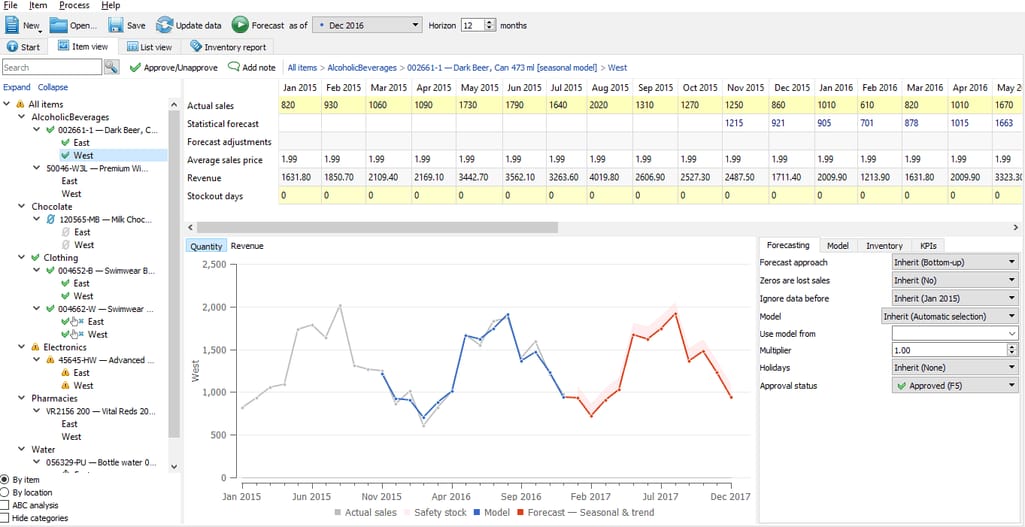
7. Demand forecasting: validate before you trust
Prediko, built for Shopify, publishes plans from $49 a month with pricing scaled to store revenue, and a 14-day free trial. Its “75x ROI” and “60% fewer stockouts” figures are first-party claims. A forecast is only as good as the history behind it, and I found no published minimum. Rather than rely on a rule of thumb, backtest: have the tool forecast a quarter you already know the outcome of, for your top 10 SKUs, and compare to actual sales. If it can’t beat “same as last quarter,” it isn’t ready for your data.
The numbers I used to rank the tools
Some of the widely quoted figures in this category did not survive checking. If you’ve seen these elsewhere, here is where they stand:
| Claim in circulation | What I found |
|---|---|
| “AI Overviews on 14% of shopping queries, up 5.6x from Nov 2024” | True figure and ratio, but the baseline is Nov 2025 |
| “AI traffic up 4,700%” | July 2025; Adobe’s July 2026 reading is +62% YoY |
| “Deloitte: 91% face personalization barriers, 63% cite fragmented data” | Appears only on aggregator pages; I could not trace it to Deloitte. Deloitte’s 2026 Retail Outlook (330 executives, 86% at $1B+ retailers) found 67% expect AI personalization within a year |
| “520% ROI on AI personalization”, “34% conversion lift”, “$74B market by 2034” | Could not be traced to a primary source; omitted |
| NVIDIA adoption bars (96% support, 67% content, etc.) | Not found in NVIDIA’s published results. NVIDIA reports 58% of retail/CPG respondents actively deploying AI (up from 42%), 91% using or assessing it, among hundreds of mostly enterprise respondents |
| “Reddit is 28.8% of AI citations” | Triple Whale’s own count on its sample: 174,519 of 606,489 (28.8%). Other studies put Reddit anywhere from about 1% to about 40% depending on whether the denominator is all citations, social citations, or answers containing a Reddit link |
| “Google Visual Quality Score is a ranking factor” | Could not verify. Industry coverage of Google’s Discover guidance recommends images at least 1,200px wide and the max-image-preview:large setting; that is for Discover, not product rankings |
| McKinsey “44% prefer AI search” | Accurate but narrower: 44% of AI-search users (survey of 1,927 U.S. consumers, August 2025) call it their primary source, against 31% for traditional search |
The Reddit row matters for strategy. Many guides tell you to “be present on Reddit because AI cites it.” The share of Reddit citations swings tenfold or more between studies, and some trackers show it falling sharply inside weeks. Reddit matters, but anyone quoting a single percentage is hiding their denominator.
What a realistic stack costs
Using the verified price points above. Your real costs depend on your volumes, so treat these as ranges.
| Stage | Tools | Approx. monthly cost |
|---|---|---|
| Starter (under ~250 contacts) | Klaviyo or Omnisend free; Tidio free tier; spreadsheet for contribution profit | $0 |
| Growth (about 1,000–2,500 contacts) | Klaviyo ($30–$60) + Tidio Growth (~$59) + Lyro at about 100 AI conversations (~$75) + Prediko (from $49) | About $215–$245 |
| Growth + pricing | Add Prisync Premium ($199) if you have up to 1,000 competitive SKUs | About $415–$445 |
| Scale | Add a profit-analytics platform (price unverified) and revisit support costs at your real volume | Depends on volume; get quotes |
The Lyro line is the most likely to move. At 500 AI-handled conversations it becomes roughly $320–$390 on its own.
What I could not establish
- Whether AI tools raise your conversion rate. Adobe shows AI-referred shoppers convert well. Rep AI shows chat-engaged shoppers convert well. Neither is an experiment showing the tool caused the lift.
- How AI Overviews will change shopping traffic. Sources disagree on current prevalence for “best X” queries by more than 3×.
- Pricing stability. Tidio, Omnisend, Pebblely and Prisync all show conflicting prices across sources, consistent with recent plan changes. Confirm on the vendor’s page.
- Tool output quality. I read sources and recalculated figures. I did not run these products.
- Hands-on case outcomes. The anecdotes in the original version of this article (the $8,400 skincare stack, the $47,000 win-back flow, and the photography misjudgment) could not be supported and are removed. You should discount any roundup, including earlier versions of this one, that offers unnamed client outcomes with round numbers.
A 30-day plan that follows the evidence
- Week 1: margin. Build the contribution-profit and break-even-ROAS table for your top 20 SKUs. Pause or reprice any SKU whose real ROAS is below break-even.
- Week 1: visibility. Confirm your AI-channel settings in Shopify admin, check Merchant Center feed completeness, and view-source a product page to confirm price and description render in the initial HTML.
- Week 2: email. Launch three flows on Klaviyo or Omnisend: abandoned cart, welcome, post-purchase. Keep the free tier until you cross its limits.
- Week 3: support. Export last month’s support conversations. Categorize them. Buy AI support only if repetitive categories dominate and the per-conversation math beats agent time.
- Week 4: forecasting. Backtest one quarter for 10 SKUs before paying for, or trusting, any forecast.
Hold off on repricing and photography until those five are done, unless your catalog is large and price-driven (repricing) or you have hundreds of images waiting (photography).
FAQ
What is the best AI tool for a small e-commerce store in 2026? Email automation (Klaviyo or Omnisend) has the lowest cost and clearest mechanism. A profit-per-SKU view is the second priority. Everything else should be priced against your own volume first.
Does AI traffic convert better than regular traffic? In Adobe’s data, yes since late 2025: 42% higher conversion in March 2026 and 60% higher in July 2026, from a position of being 49% lower in January 2025. The sample skews toward large retailers.
How much does Tidio’s Lyro AI really cost? The add-on is reported at roughly $0.64–$0.78 per AI conversation, on top of the base plan, so cost scales with how many conversations the AI handles.
Is Omnisend really all-features on every plan? Not any longer. Trackers report SMS is Pro-only for accounts opened on or after May 4, 2026.
Do I need Algolia to show up in ChatGPT? No independent evidence supports that. Shopify merchants can manage AI-channel distribution through Agentic Storefronts in the admin. Algolia’s MCP Server is developer infrastructure.
Will Google penalize AI-generated product content? Google’s spam policy targets scaled, low-value content regardless of how it’s produced. Review and enrich pages with specifics instead of publishing drafts unedited.
Methodology
I compiled this update on September 30, 2026 by reading publisher reports, Google status records, vendor pricing pages and independent reviews; re-dividing and recalculating figures where inputs were public (Visibility Labs, Triple Whale, Seer, Tidio cost per conversation, the SKU example, break-even ROAS); and recording every place sources disagreed. Where I could not reach a primary document, the text says so. No tool was hands-on tested. Prices reflect third-party trackers and vendor pages seen in June–September 2026.
Sources
Google updates
- Search Engine Roundtable, February 2026 Discover core update complete: https://www.seroundtable.com/february-2026-google-discover-core-update-done-41006.html
- Search Engine Land, March 2026 core update complete: https://searchengineland.com/google-march-2026-core-update-rollout-is-now-complete-473883
- Search Engine Land, May 2026 core update complete: https://searchengineland.com/google-may-2026-core-update-rollout-is-now-complete-479119
- Search Engine Land, August 2026 spam update complete: https://searchengineland.com/google-august-2026-spam-update-done-rolling-out-485471
- Amsive (Lily Ray), March 2026 core update analysis: https://www.amsive.com/insights/seo/google-march-2026-core-update-winners-losers-analysis/
- PPC Land on Google’s December 2025 JavaScript documentation updates: https://ppc.land/google-clarifies-javascript-rendering-for-error-pages-in-december-documentation-update/
- ALM Corp on the March 2026 removal of a JavaScript warning: https://almcorp.com/blog/google-removes-javascript-seo-warning/
AI search and traffic
- Adobe, generative-AI shopping traffic (2025 data): https://business.adobe.com/blog/generative-ai-powered-shopping-rises-with-traffic-to-retail-sites
- Adobe Digital Insights, Q2 2026 AI traffic report: https://business.adobe.com/resources/sdk/.2026-q2-ai-traffic-report/q2-2026-adi-ai-sourced-traffic-insights.pdf
- Digital Commerce 360, April 23, 2026: https://www.digitalcommerce360.com/2026/04/23/ecommerce-trends-ai-key-conversion-metric/
- Digital Commerce 360, August 19, 2026 (July data): https://www.digitalcommerce360.com/2026/08/19/adobe-ai-referral-traffic-data-july-2026/
- MarketingTech News, May 2026 data: https://www.marketingtechnews.net/news/ai-referrals-ecommerce-traffic-conversions/
- Digital Transactions, 2025 holiday data: https://www.digitaltransactions.net/ai-is-driving-more-online-traffic-conversions-and-revenues-adobe-analytics-says/
- Visibility Labs, AI Overviews on shopping queries (20.9M SERPs): https://visibilitylabs.com/blog/ai-overviews-shopping-queries/
- Search Engine Land coverage of that study: https://searchengineland.com/google-ai-overviews-shopping-queries-report-471981
- Seer Interactive, AIO impact on CTR: https://www.seerinteractive.com/insights/aio-impact-on-google-ctr-september-2025-update
- McKinsey, “New front door to the internet”: https://www.mckinsey.com/capabilities/growth-marketing-and-sales/our-insights/new-front-door-to-the-internet-winning-in-the-age-of-ai-search
- Triple Whale, AI in ecommerce statistics: https://www.triplewhale.com/blog/ai-in-ecommerce-statistics
- Strive Labs on citation-share disagreements: https://strivelabs.ai/blog/llm-citation-sources/
- Shopify, agentic commerce: https://shopify.com/news/agentic-commerce-momentum
- Algolia MCP Server announcement (Sept 15, 2026): https://finance.yahoo.com/technology/ai/articles/algolia-launches-production-grade-mcp-130000040.html
Industry surveys
- NVIDIA, State of AI in Retail and CPG: https://www.nvidia.com/en-eu/lp/industries/state-of-ai-in-retail-and-cpg
- SiliconANGLE on the NVIDIA report: https://siliconangle.com/2026/01/21/nvidia-report-finds-ai-set-take-off-retail-openness-required-scale/
- Deloitte, 2026 Retail Industry Outlook: https://www.deloitte.com/us/en/insights/industry/retail-distribution/retail-distribution-industry-outlook.html
- Rep AI, AI ecommerce statistics (vendor): https://www.hellorep.ai/blog/the-future-of-ai-in-ecommerce-40-statistics-on-conversational-ai-agents-for-2025
- Cloudtech note on Rep AI data being vendor-sourced: https://cloudtech.com/feeds/blog/ai-chatbot-ecommerce-sales-conversions-2025
Pricing (verify on each vendor’s page)
- Tidio pricing analyses: https://www.dragapp.com/blog/tidio-pricing/ and https://aitoolskey.com/tidio-review/
- Klaviyo pricing tiers: https://spoks.com/resources/klaviyo-pricing-breakdown
- Omnisend pricing: https://www.sendx.io/blog/omnisend-pricing-plans-costs-alternatives-2026 and https://checkthat.ai/brands/omnisend/pricing
- Prisync tiers: https://www.capterra.com/p/153451/Prisync/ and https://apps.shopify.com/prisync-ai-dynamic-pricing
- Conjura contribution-profit definition: https://www.conjura.com/blog/ecommerce-inventory-management-best-practices-and-tools-for-profitable-growth
- Pebblely review with August 2026 pricing: https://pikes.ai/blog/pebblely-review-2026
- Prediko pricing: https://www.prediko.io/forecasting-demand-planning/ai-powered-demand-planning-software
To connect your customer data across these tools, see AI Personalization Cloud.