


Psychographic & Behavioral Segmentation: Which One Rots Faster — and Why That Answer Kills Campaigns
Everyone says “combine both.” Nobody tells you which one decays in silence while your brief still looks solid. Here’s the actual mechanism — with sources, caveats, and the failure case nobody published.
Forty-six minutes. That’s how long the average American grocery trip takes — Capital One Shopping research, cited in Albertsons’ 2023 consumer data deck; treat as directional, no independent audit found — which is 46 minutes of someone being psychographically one person while behaving like a completely different one.
The “health-conscious millennial” with kombucha and almond flour in her cart is also throwing in Doritos at checkout. She’s tired. It’s Tuesday. Her values didn’t shift. Her behavior did.
Here’s what nobody says in the 40 blog posts on psychographic segmentation you’ve already skimmed: psychographic data and behavioral data do not decay at the same rate. Which one you build on first determines whether your emotional targeting converts — or whether you spend eight months talking to who someone was in 2022.
This is worth understanding mechanically. The actual why, not just the what. And what to do about it before the next planning cycle.
The Decay Asymmetry Nobody Draws a Picture Of
Let me show you the thing directly.
The asymmetry is the problem. Behavioral staleness announces itself. Psychographic staleness doesn’t. Which is why stale models survive for years inside campaign briefs.
“The segment that says ‘I prefer in-store’ and the segment that shops online are sometimes the same people, six months apart.”
Editorial synthesis — sources: Ngoh & Groening, JRCS (2022); Blömker & Albrecht, JRCS (2024)
What Most Teams Get Backwards
The conventional framing: psychographic data is your stable foundation — values, personality, lifestyle — and behavioral data is your live signal. Build the persona on psychographics, use behavior to personalize timing and channel. Every consultancy deck for the last decade says some version of this.
It’s not wrong exactly. It’s incomplete in a way that costs money.
The buried question is: stable compared to what, over what timeframe, for what kind of consumer?
Qualtrics — vendor-reported, structural interest in selling segmentation solutions, no independent methodology disclosed; treat as practitioner directional — publishes that psychographic segmentations have longer shelf life because “attitudes, values and needs are deep rooted.” On one level, sure. Your core personality won’t flip between Q2 and Q3.
But values shift fast when economic context shifts fast. That’s the part standard advice quietly skips.
Ngoh and Groening’s 2022 study in the Journal of Retailing and Consumer Services — Latent Profile Analysis, 485 U.S. participants, single disruption event; generalizability limited to comparable external-shock contexts; peer-reviewed — tracked channel behavior before and during COVID-19. Found that psychographic and demographic variables played “lesser roles” in explaining channel switching than situational factors: motivation, opportunity, ability. People whose psychographic profiles said “I prefer in-store” went online anyway. Not because their values changed. Because circumstances did.
Which means: if you built your targeting stack on psychographic personas and didn’t re-survey after a significant disruption — 2020, the 2022 inflation spike, the 2024 AI-driven channel proliferation — you’re targeting who your customers were. Your behavioral data updated. Your psychographic model didn’t.
That’s the stability inversion. Most teams miss it because the persona deck still looks reasonable.
The Actual Difference — And Why It Matters for Conversion
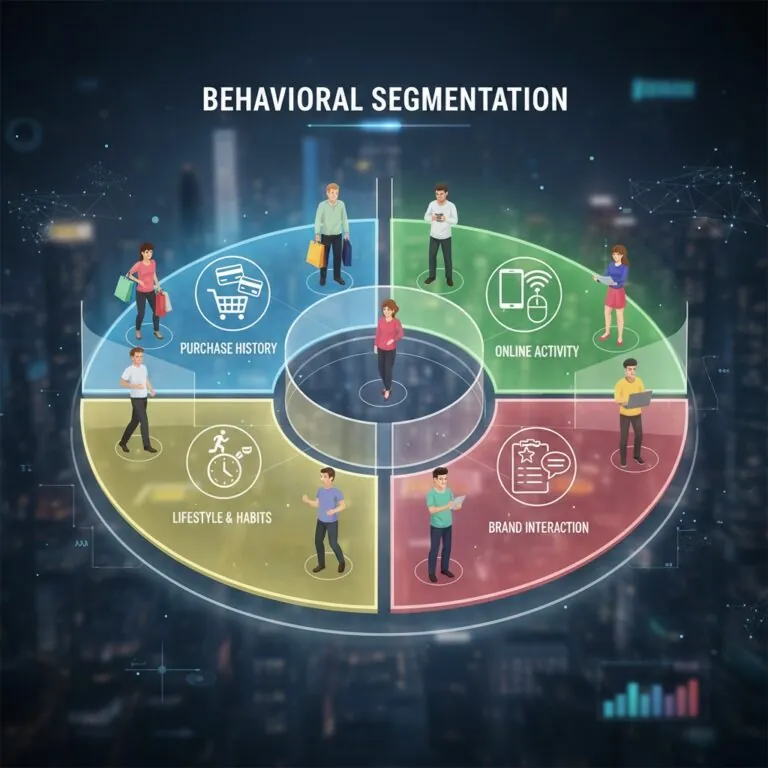
Fast definitions. Psychographic segmentation groups people by psychological traits — values, personality, lifestyle, AIO variables (activities, interests, opinions). Foundational taxonomy from Plummer (1974); structural classification remains valid across decades of replication. Behavioral segmentation groups by observable actions: purchase history, click patterns, channel preference, session depth.
The difference that matters for conversion isn’t the taxonomy. It’s how each data type fails.
Psychographic data fails silently. The persona gets built, embedded in campaign briefs, and nobody re-examines it until results soften. Behavioral data fails loudly — click rates tank, funnel metrics break, someone notices within a quarter.
A psychographic model that’s gone stale doesn’t announce itself. The copy still “makes sense” against the original persona. The values messaging sounds right to the team that built it.
The problem shows up as slow, unexplained drift in emotional resonance metrics — attributed to creative fatigue, algorithm changes, the economy. Behavioral staleness is easier to detect because the system was designed to detect behavior. Psychographic staleness evades its own detection because it lives in the brief, not the dashboard.
You don’t feel the problem. That’s the problem.
The strongest peer-reviewed evidence here: Blömker and Albrecht’s 2024 study in JRCS — latent class analysis; 1,512 customers; retail sector; self-reported channel behavior; peer-reviewed; generalizability to non-retail contexts not confirmed — identified six multichannel customer segments differentiated by psychographic variables: risk-readiness, need for cognition, autotelic and instrumental need for touch, rational vs. intuitive decision-making.
The finding worth sitting with: contextual and channel-related factors shaped multichannel behavior more than psychographic variables did. One study. Not a consensus — a direction the literature is beginning to move toward. But it contradicts the “psychographics as stable foundation” framing at the channel-behavior level, and most guides quietly skip that contradiction.
And then the 2025 follow-up. Using machine learning on CRM data from 7,188 customers at a German fashion retailer, Blömker and Albrecht (2025) — peer-reviewed; single German fashion retailer; ML accuracy described as moderate to high for domain-specific traits only; broad personality traits not tested — demonstrated that domain-specific psychological traits can be predicted from behavioral CRM data with moderate to high accuracy.
That’s the production implication: behavioral data isn’t just a signal layer. At sufficient scale, it’s a proxy for psychological traits. Which means the behavioral-first approach isn’t just a research methodology — it’s an automatable pipeline. Eventually. With rich CRM data. One retailer, so far.
Blömker & Albrecht (2024) establish psychographic variables as meaningful predictors of segment membership — who someone is. Ngoh & Groening (2022) establish that situational factors override psychographic predictors for channel behavior — what someone does and where. Blömker & Albrecht (2025) demonstrate that behavioral CRM data can predict psychological traits at scale.
No single paper contains this conclusion: the conventional advice to “build on psychographic foundation, layer behavioral signal” implicitly assumes psychographic data predicts behavior. When situational context is volatile, it doesn’t. And when behavioral data is sufficiently rich, it predicts psychographic traits — inverting the conventional hierarchy. Most segmentation frameworks aren’t built to detect the swap, let alone reverse-engineer it.
How to Actually Build a Combined Segmentation Stack
I’ve watched this done across different clients over about twelve years. What works isn’t a framework exactly. It’s a sequencing logic. And it’s the opposite of what most guides recommend.
Sounds obvious. Nobody does it. Mora Cortez, Clarke and Freytag’s 2024 empirical study — peer-reviewed; grounded theory approach; B2B market segmentation; Journal of Business Research vol. 182 — confirmed that re-segmentation triggers are almost entirely absent from how firms actually operate. The literature recognizes segmentation as an ongoing process; almost no firms have formalized processes for deciding when to re-validate. That applies to consumer segmentation just as cleanly.
The gap isn’t knowledge. It’s process.
Evidence Comparison: What Each Approach Predicts
| Approach | Predicts well | Evidence level | ⚠ Adversarial column |
|---|---|---|---|
| Psychographic-first (persona from values research, behavioral layer added) | Messaging tone, brand positioning, long-horizon loyalty | Moderate | No live update mechanism; goes stale silently. Shelf-life claims are vendor-reported and conflict with situational override findings in peer-reviewed studies. |
| Behavioral-first (clusters from action data, psychographic validation via survey) | Channel behavior, purchase timing, content format preference | Strong (within retail contexts) | Captures what someone did, not why. Without psychographic explanation, copy becomes tactical rather than emotionally resonant. Primary evidence is retail-sector; non-retail replication is indirect. |
| ML-driven psychographic inference from CRM behavioral data | Automatable psychological profiling at scale; moderate-to-high accuracy for domain-specific traits | Directional (single retailer, 2025) | Single German fashion retailer. Domain-specific traits only (risk, NFC, price/quality consciousness). Requires CRM data richness most mid-market teams don’t have. Do not treat as replicable until independently confirmed. |
| Psychographic without re-validation after major disruption | Who customers were, not who they are now | Strong (as a failure mode) | Primary evidence is retail. Banking and insurance cases suggest the failure mode travels across sectors, but direct non-retail controlled evidence is absent. |
| Psychographic during channel disruption in financial services | Predicts resistance vs. adoption of digital channel migration; demographic data fails here | Moderate (single market, 2024) | Canadian banking market only; survey methodology. Confirms psychographic traits matter at disruption events — does not test the behavioral-first sequence. |
The Failure Case Nobody Published
Here’s what actually happens. A mid-eight-figure DTC wellness brand does solid psychographic segmentation in Q4 2021. Four segments, 800-person sample within their customer base, reputable research vendor, real qualitative work. They build creative frameworks. “The Achiever.” “The Nurturer.” Et cetera.
Spend a year executing. Q1 2023: results soften. Creative gets blamed. The agency gets changed. New agency works within the same psychographic framework — it’s in the brief, it’s been approved, it feels solid. Q3 2024: still soft.
Nobody re-surveyed the segments.
Turns out “The Achiever” had a rough few years economically — student debt, job uncertainty — and their attitudes toward aspirational messaging had quietly inverted. The values were still there. The receptivity to being sold on those values had changed. That’s a different problem than the copy being off.
Behavioral data showed this plainly, in retrospect: engagement with aspiration-framed content dropped around 34% over 18 months while category search volume in the segment’s core interest area rose 11%. The customers were still interested in the category. They were tuning out the emotional register of the brand’s messaging. But the psychographic framework said “lean into aspiration,” and so the copy did.
“The values were still there. The receptivity to being sold on those values had quietly inverted — and the brief didn’t know it yet.”
Editorial synthesis — sources: composite practitioner accounts (Tier 3); Ngoh & Groening, JRCS (2022); Blömker & Albrecht, JRCS (2024)
The lesson that case teaches — which no success case can — is that psychographic data isn’t a description of who someone is. It’s a description of who someone is in a particular economic and cultural context. Strip the context, and the profile lies to you. Quietly.
Does the Logic Travel Beyond Retail?
All three primary JRCS studies are retail or fashion. That’s a fair objection. Let me be straight about what the non-retail evidence actually shows rather than asserting cross-sector confidence the data doesn’t support.
In banking: Fares, Aversa and Lee (2024) — peer-reviewed, Springer Nature; Canadian banking market; survey methodology — found that during the digital banking transition, three psychographic groups (visionaries, skeptics, conservatives) predicted channel adoption behavior more accurately than demographic or behavioral variables alone. What this confirms: psychographic traits matter during disruption events, across sectors. What it doesn’t confirm: the behavioral-first sequence. The Fares et al. study used psychographic research as the primary method, not as a validation layer. Useful evidence. Different architecture.
In insurance: MetLife’s 2016 segmentation rebuild — Harvard Business School case study, 2018, referencing MetLife 2016 Investor Day (Fair Disclosure Wire, Nov 10 2016); $800M is a net annual savings target, not independently audited; treat as directional on the figure, structural sequence confirmed in primary source — surveyed more than 50,000 customers and used ML clustering on behavioral and attitudinal data to restructure segments from scratch, behavioral-first. The sequence is confirmed. Whether the $800M savings target was fully achieved isn’t publicly confirmed.
In B2B: Mora Cortez et al. (2024) found firms broadly recognize segmentation as an ongoing process but have almost no formalized re-validation triggers. That’s a process gap finding, not specifically a psychographic-behavioral sequencing finding. It supports the re-survey cadence argument without being its proof.
Honest summary: strongest evidence for the behavioral-first sequence is consumer retail. The disruption-event mechanism travels — banking and insurance show it operating in financial services. The re-validation gap is documented in B2B. If you’re in SaaS or enterprise, the logic applies; the evidence is thinner. Test it in your category before rewriting the brief.
What Emotional Targeting Actually Requires
Emotional targeting that converts requires three things simultaneously: the right emotion, the right moment, and the right channel for that person’s decision-making style.
Psychographic data gets you the first. Behavioral data gets you the second two. Which is why “combine both” isn’t wrong — it just doesn’t go far enough, because when these data sources conflict, which do you believe?
The Blömker and Albrecht (2024) finding on rational versus intuitive decision-making style is worth sitting with. They found this variable differentiated customer segments meaningfully. Rational decision-makers process emotional appeals differently — they don’t reject emotion, but they need an analytical bridge to the emotional conclusion. Intuitive decision-makers respond more directly to emotional framing without the bridge.
Same emotion. Different delivery architecture. You can’t derive that from behavioral data alone. It requires asking.
That’s the uncomfortable conclusion most guides skip: good emotional targeting requires primary research. Not just cleverer analysis of your existing first-party data. The 2025 ML paper suggests this gap may eventually close at scale — but “eventually, at scale, single fashion retailer” isn’t where most teams are operating right now.
Your psychographic model has an expiration date. Find out if it’s past it.
Look, here’s what this actually is: a data freshness problem with a branding label on it. The reframe isn’t “invest in better psychographic research.” It’s that your current model was built at a point in time, and unless you know when it was last validated against behavioral reality, you’re flying on stale maps.
What you do: Pull your behavioral engagement data for the past 24 months. Segment it by your current psychographic personas. Look for divergence. If your aspiration segment isn’t engaging with aspiration-framed content, if your value segment is spending more, not less — that’s your signal. Run a targeted re-survey on the divergent segments before the next campaign planning cycle. 800 respondents within your existing customer base, three or four validated psychographic scales. Not a full rebuild. A validation pass.
Here’s what’s going to stop you: Whoever owns the research budget will argue that the last segmentation is recent enough. It probably isn’t if it predates 2022. Frame the re-survey as campaign risk reduction, not a research project. That conversation gets budget; “we need to do more research” doesn’t. There’s also an annual planning-cycle problem unique to your role: you’re committing media budgets 6–12 months in advance. A psychographic model that’s wrong at planning time stays wrong through the entire campaign flight. The cost of a validation pass is one line in the research budget. The cost of a wrong emotional register is 12 months of media.
Stop doing this: Adding psychographic language to briefs built on behavioral data without validation. “This segment values authenticity,” derived from click patterns, isn’t psychographic insight — it’s behavioral inference labeled as something more certain than it is. That conflation produces creative that sounds emotionally resonant internally and lands flat externally. You know the creative. You’ve approved it. It tested well internally. That’s the tell.
The emotional architecture of your messaging is only as strong as the freshness of the data under it.
The specific problem brand strategy faces that performance marketing doesn’t: brand work takes 12–24 months to bed in. If you built the emotional architecture of a brand platform on psychographic research from 2021 and you’re executing it through 2025, you’re asking it to hold across a period during which your audience’s relationship to aspirational messaging, economic anxiety, and values signaling may have shifted significantly.
The performance team knows within a quarter when their ads stop working. You might not know until the annual brand tracker comes back flat — by which point 12 months of media has already run on the wrong emotional register. Without a behavioral tripwire baked in from the start, you can’t separate “wrong platform” from “poorly executed platform.” The default in most agencies is to blame execution, because that’s fixable within the current retainer.
What you do: Build behavioral divergence tracking into brand measurement from day one. Set baseline behavioral engagement rates for each persona segment against their psychographically predicted content preferences at platform launch. Track quarterly. When engagement with your predicted emotional territory drops while category interest holds — that’s the tripwire. Not a creative brief problem. A re-survey trigger. On the qualitative side: six customer interviews per persona segment, twice a year, costs maybe two days of a mid-level strategist’s time. It won’t give you statistical power. It’ll give you early warning.
Here’s what’s going to stop you: The real barrier isn’t budget — it’s organizational accountability. Brand tracking lives in brand. Behavioral data lives in performance or analytics. The behavioral tripwire requires someone who touches both, which in most org structures means either the CMO or nobody. Name that person in the platform launch plan, or the tripwire never gets built. This is the gap that makes the failure case above so common: the accountability structure wasn’t set at launch, so nobody owned the re-survey trigger, so nobody ran it.
Stop doing this: Treating your brand’s emotional territory as a fixed asset. It’s relational — it exists between your brand and what your audience currently cares about. When that shifts, the territory shifts even if your creative doesn’t. That’s a data problem wearing a creative mask, and it’ll keep getting misdiagnosed until someone owns the re-survey.
“The brands that convert on emotional targeting aren’t the ones with the most sophisticated persona frameworks. They’re the ones that treat those frameworks as live hypotheses.”
Editorial synthesis — sources: Blömker & Albrecht (2024); Fares, Aversa & Lee (2024); Mora Cortez et al. (2024)
If you’re in subscription SaaS or enterprise B2B, the inversion logic applies differently. Your disruption event isn’t a pandemic shopping shift — it’s a funding cycle tightening, a category commoditization wave, a buyer committee composition change. Behavioral signals show up as elongated sales cycles. Your persona brief probably still says “growth-oriented early adopter.” That gap is where deals go quiet without explanation.
A persona that’s never been wrong probably hasn’t been tested.