

Top 8 Generative AI CRM Strategies for Smarter Selling
An unsparing field guide to the strategies that actually move revenue—built on 2025 data, unit economics, and the failure forensics most vendors refuse to publish. Warning: some of this will contradict what your CRM vendor told you last quarter.
Before Strategy 1The Uncomfortable Reality Check Nobody Wants to Read First
Let me tell you about a mistake I made. Years ago, advising a mid-market SaaS company, I helped them push through a six-figure AI add-on for their CRM because the demos were gorgeous. Conversational lead scoring. Generative follow-up drafts. Sentiment analysis on deal conversations. The vendor promised 40% lift in pipeline velocity within a quarter.
Eighteen months later, actual pipeline velocity had improved by roughly 4%. The real culprit? Their CRM held 11 years of contacts, 60% of which were duplicates, dead addresses, or mislabeled deal stages. The AI was training on a lie and producing confident-sounding garbage. We’d polished the hood of a car with a broken engine.
I’m telling you that story because it perfectly previews the central tension in everything that follows. The technology in generative AI CRM is genuinely extraordinary. The data underneath it, at most organizations, is genuinely a mess. What separates companies posting 80%+ win-rate improvements from the majority experiencing stagnation is almost never the AI model—it’s data readiness, workflow integration, and clarity about what success means before anything is built.
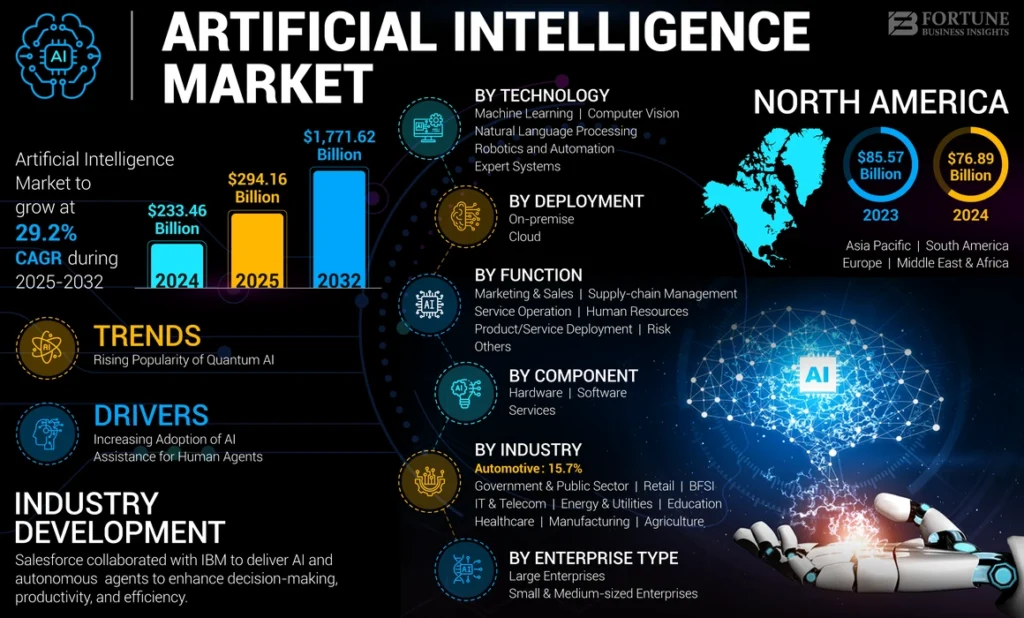
Here is the market picture as it stands right now, stripped of vendor optimism:
So we have a paradox: the best practitioners are seeing transformational results, and the average organization is burning money on demos. Both things are true simultaneously. The following eight strategies represent what the 5% are actually doing—ordered not by hype but by how reliably they produce documented, measurable revenue impact when executed correctly.
Strategy 01AI-Driven Lead Scoring and Predictive Pipeline Prioritization
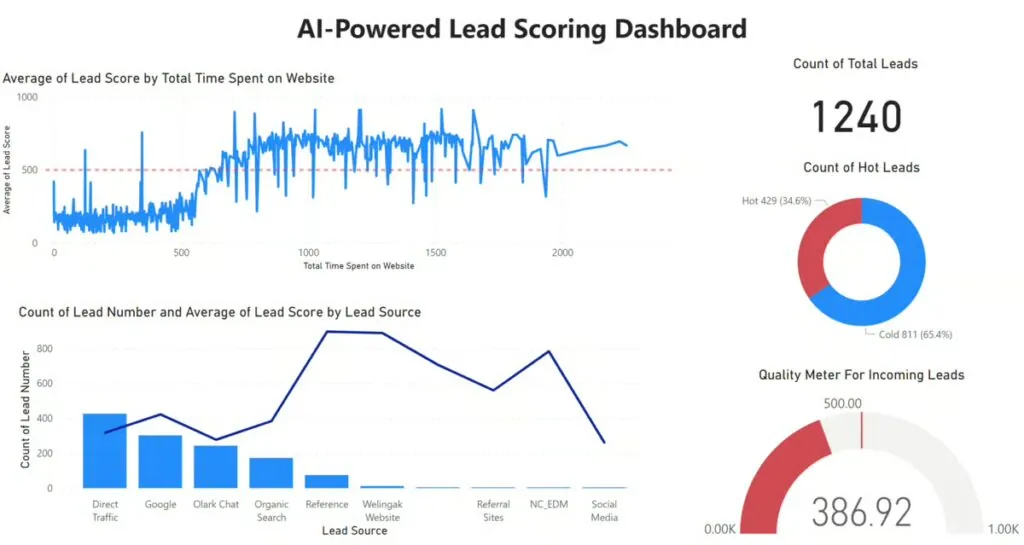
This is the strategy with the clearest, most consistent track record—which is why I’m leading with it. When AI-driven lead scoring works, it works immediately, the impact is measurable, and it’s hard to attribute to anything else. CRM research from Kixie (2025) puts the conversion rate lift at up to 20%, with a 40% improvement in forecast accuracy. ZoomInfo’s 2025 State of AI in Sales survey found 81% of frequent AI users reported shorter deal cycles.
What classical lead scoring misses—and why it matters that AI replaces it—is behavioral signal decay. Traditional systems assign static scores based on demographic fit and a few logged interactions. But a lead that engaged intensely three months ago and has been silent since isn’t the same as a lead that opened three emails last Tuesday. Classical scoring treats them identically. AI scoring doesn’t.
How it actually works (the technical layer)
Modern AI lead scoring in CRMs like Salesforce Einstein or HubSpot’s Predictive Lead Scoring pulls from five signal categories simultaneously: firmographic fit (company size, industry, tech stack), engagement recency and frequency (email opens, page visits, demo requests), behavioral intent signals (pricing page views, competitor comparisons, documentation downloads), CRM history (past deal outcomes with similar profiles), and third-party intent data (G2, Bombora, TechTarget). It then trains a classification model—usually gradient boosting or a lightweight transformer—on historical closed-won and closed-lost deals. The output isn’t a single score. It’s a probability distribution with confidence bands.
The insight that most articles miss: the model is only as good as your historical close data labeling. If your team has inconsistently logged why deals were lost—which most CRMs show is true for 60%+ of records—your training set is poisoned. This is why two companies using identical AI lead scoring tools can see wildly different results.
Before turning on AI lead scoring: audit your historical won/lost data. You need at minimum 12 months of cleanly labeled closed-won and closed-lost deals with consistent loss reasons to train a scoring model that outperforms a human heuristic. Without this, the AI will simply systematize your past biases at scale.
Strategy 02Generative AI for Hyper-Personalized Outreach at Scale
This is where the demos are the most impressive and the real-world results are the most variable. Generative AI’s ability to synthesize a prospect’s LinkedIn activity, recent company news, product review history, and past email threads into a contextually sharp, personalized opener in 0.3 seconds is genuinely remarkable. The commercial reality is more complicated.
The problem most teams discover after month two is what I’d call the personalization paradox: AI-generated personalization at scale starts to feel like AI-generated personalization at scale. Sophisticated buyers—exactly the ones you most want to impress—have developed a finely tuned radar for “the AI noticed you just raised a Series B” openers. When every company in your category uses the same Salesforce Einstein or HubSpot AI outreach tools trained on the same best-practice corpora, the outputs converge. Personalization becomes a new form of sameness.
The teams breaking through this paradox in 2025 are doing something counterintuitive: they’re using AI not to generate the personalization itself, but to surface the specific insight a human should personalize around. The AI scans a prospect’s last six months of digital activity and surfaces three genuinely unusual data points—a niche industry conference they keynoted, a specific technical complaint in a G2 review, a partnership announcement that creates a new pain point. The human rep writes a short message around one of those. It takes 90 seconds instead of 45 minutes. The message doesn’t read like AI because it wasn’t written by AI.
The three-tier personalization architecture
Elite revenue teams in 2025 are building a three-tier system. Tier 1 (AI-generated, no human review): highly segmented but not individually personalized sequences for cold contacts below a certain deal-size threshold. Volume play. Tier 2 (AI-surfaced insight, human-written message): for accounts in target ICP with ACV above $15K. AI provides the raw material; rep writes the opener. Tier 3 (full human research + AI drafting as speed tool only): for strategic accounts above $100K ACV. AI handles the drafting and CRM updates; the insight, framing, and tone are entirely human.
Gartner (2025) reports 87% of sales leaders are under direct pressure from boards to deploy generative AI for outreach—but the metric that matters isn’t whether you’re using AI, it’s response rate. And ZoomInfo’s 2025 survey found that AI-personalized outreach shows measurable improvement in deal size (73% of reps reported larger deals) only when paired with human editorial judgment on the final message.
Generative AI will occasionally produce plausible-sounding but factually wrong personalizations—a “recent product launch” that didn’t happen, a “team expansion” based on a stale LinkedIn update, a “challenge” the prospect actually solved 18 months ago. A single bad personalization sent to a high-value prospect can do more reputational damage than 50 generic emails. Implement a human review gate for Tier 2 and above. This is non-negotiable.
Bain & Company (2025) observed a 30%–50% decrease in content creation time for sales and marketing teams using generative AI for outreach personalization. That’s the right metric to track initially—time saved, not response rate—because it takes 90–120 days to accumulate enough A/B data to draw statistically valid conclusions about response rate lift from AI-personalized versus human-written sequences.
Strategy 03Conversational AI and Smart Deal Intelligence
Conversation intelligence—AI that transcribes, analyzes, and scores sales calls in real time—has quietly become the highest-ROI AI investment in the CRM stack for field sales organizations. Why? Because it fixes the most expensive information leak in the entire revenue process: the fact that 80% of what happens in a sales call never makes it into the CRM.
Tools like Gong, Chorus (part of ZoomInfo), and Salesforce Einstein Conversation Intelligence now do far more than transcription. They identify deal risk signals (competitor mentions, pricing objections not logged, decision-maker changes), track talk ratio (reps talking more than 60% of the time correlates strongly with lower close rates), surface question quality (open versus closed questions at key stages), and generate CRM summary updates automatically post-call.
Salesforce’s 2025 Einstein data shows Copilot users saving an average of 12 hours per employee per week on CRM administrative tasks—the majority of which is call logging and follow-up drafting. At a fully loaded cost of $75/hr for a mid-market sales rep, that’s $900/week per rep in reclaimed capacity. For a team of 20 reps, that’s over $900,000 per year in recovered selling time before any top-line lift from better deal execution.
The deal risk matrix: what AI is actually watching
| Risk Signal | What AI Detects | CRM Action Triggered | Historical Close Rate Impact |
|---|---|---|---|
| Competitor mention (late stage) | Named competitor in call transcript, Stage 4+ | Deal risk flag, manager notification, battle card surfaced | –28% close probability if unaddressed within 72h |
| Decision-maker absence | Champion mentions “I’ll need to check with…” without follow-on access | Opportunity stage held, multi-thread outreach sequence triggered | –41% if DM not engaged by Stage 3 |
| Pricing objection without resolution | Price discussed but no mutual next step committed on call | Rep alert, discount approval workflow if needed | –33% if objection surfaces and isn’t resolved same call |
| Timeline drift | Prospect uses language like “sometime next quarter” vs. specific date | Close date auto-adjusted, manager forecast alert | –52% on deals where close date slips twice |
| Champion disengagement | Email open rate drops >60% in last 14 days | Re-engagement sequence, alternate contact research | –38% probability within 21 days of disengagement |
Note: Impact figures are directional averages drawn from published Gong, Salesforce, and ZoomInfo revenue intelligence research. Individual results vary by sales motion and industry.
Strategy 04AI-Powered Sales Forecasting and Revenue Intelligence
Sales forecasting is where AI earns its most unambiguous argument for adoption—because the baseline it’s competing against is so catastrophically bad. The average sales forecast is wrong by 15–20% in absolute terms. Reps over-report because they fear looking weak. Managers adjust gut-down. Finance adjusts gut-down again. By the time a number reaches the board, it’s been through four layers of human cognitive bias and organizational politics.
AI forecasting bypasses the pipeline-hygiene theater and builds predictions from behavioral signals: actual engagement velocity, historical close rates by rep, deal age decay curves, and macroeconomic input factors. CRM.org (2025) reports AI improves sales forecast accuracy by over 40%—which, on a $50M revenue target, translates to the difference between missing guidance by $8M and missing by under $5M. That’s the difference between a calm board meeting and a very uncomfortable one.
The caveat—and it’s a real one—is that AI forecasting models require at minimum four to six quarters of clean CRM data with consistent stage definitions to outperform experienced human managers. If your Stage 3 means “demo completed” to one rep and “proposal sent” to another, the model learns nothing useful. Forecast accuracy is, once again, a data governance problem dressed as an AI problem.
Strategy 05Agentic CRM Automation and Workflow Orchestration
This is the newest and most misunderstood category. Agentic AI is not a smarter chatbot. It’s a system that can plan, sequence, and execute multi-step workflows across your CRM, email, calendar, and connected tools—without waiting to be prompted for each step. Salesforce’s Agentforce, launched in 2024 and refined aggressively through 2025, is the clearest enterprise example: unlike Copilot (which waits for input), Agentforce initiates actions—scheduling follow-ups, updating CRM records, triggering nurture sequences, routing support cases—based on defined triggers and learned context.
ZoomInfo’s 2025 RevOps survey found AI users in revenue operations report being 46% more productive, with workflow automation named as the most satisfying capability by 71% of RevOps practitioners. That’s a staggering productivity figure—but notice the qualifier: it applies specifically to people in RevOps roles, who tend to be power users with cleaner data and stronger systems discipline than the average sales rep.
What agentic automation actually handles well right now
-
Post-call CRM updates: Agent ingests call transcript, updates deal stage, logs key objections, creates follow-up tasks, and drafts the follow-up email—without rep input. Time saved: 20–40 minutes per call.
-
Inbound lead routing and enrichment: New form fill triggers agent to enrich the record (company data, LinkedIn, tech stack), score against ICP, and route to the right rep or sequence within 90 seconds—replacing a process that previously took hours or never happened.
-
Quote-to-close workflow: Agent handles CPQ data entry, approval routing, and contract attachment after the rep selects a deal configuration. Reduces quote cycle time by 3–5 days on complex deals.
-
Re-engagement campaigns: Agent monitors engagement decay across the pipeline and initiates personalized outreach for deals showing risk signals, without rep involvement until a response arrives.
Gartner predicts over 40% of agentic AI projects will be cancelled by 2027. The primary failure mode is scope creep during implementation: teams start with simple workflow automation, then layer on increasingly complex autonomous decisions without building the governance guardrails to catch errors before they propagate. An agent that autonomously sends 500 incorrectly personalized emails to key accounts in an afternoon is not a hypothetical. Build human-in-the-loop review stages for any agent action that contacts an external party.
Strategy 06Generative AI for Customer Retention and Churn Prevention
Here’s a figure that should recalibrate how you think about where AI CRM investment pays off: CRM systems improve customer retention rates by up to 27%. When you add AI-driven churn prediction and proactive intervention, the economics of that retention improvement shift from interesting to essential. A 1% improvement in retention at a $20M ARR business is worth more in net revenue terms than a 10% improvement in new logo conversion. The math isn’t close.
AI churn models work differently from lead scoring models in one critical way: they’re predicting absence of behavior as much as presence of it. A customer who was logging in daily and suddenly goes silent for 10 days is a much stronger churn signal than one who never logged in daily to begin with. Classical rule-based systems struggle to detect this because they require someone to define the rule. Machine learning models identify the pattern automatically from historical churn data.
The generative AI layer adds two capabilities rule-based systems can’t match. First: personalized save plays. When a customer shows churn risk signals, the AI drafts a tailored intervention—not “We noticed you haven’t logged in”—but a specific message referencing their use case, their onboarding goals, and the feature gap that behavioral data suggests is driving disengagement. Second: root cause synthesis. AI can analyze support tickets, NPS verbatims, usage data, and call transcripts simultaneously to identify whether a customer’s risk is driven by product fit, competitor evaluation, internal champion change, or billing friction—and route to the right response.
BearingPoint (2024) reported Klarna cut sales and marketing spend by 11% in Q1 2024, attributing 37% of annualized cost savings (~$10M) to AI—including significant reductions in CRM and customer engagement costs. Klarna trimmed external marketing services spending by 25% while maintaining engagement quality, largely through AI-native customer communication workflows. This is the most precise public case study available on AI CRM cost efficiency at scale.
Strategy 07AI-Augmented Sales Coaching and Rep Performance Intelligence
This is the strategy that makes sales managers deeply uncomfortable to discuss—which is usually a sign it’s important. AI coaching systems in 2025 can tell you, with statistical confidence, which specific rep behaviors correlate with closed-won deals in your organization. Not generic best practices. Your data. And when the answer is that your highest-earning rep closes differently than what your sales methodology prescribes, you have to decide what to do with that.
The mechanics: conversation intelligence tools (Gong, Chorus, Einstein Conversation Insights) analyze thousands of hours of recorded calls and score them against outcome data. They identify patterns: reps who spend 65–70% of calls listening close 22% more deals than reps at 50%. Reps who reference a specific use case in the first 90 seconds convert at 2.1x the rate of those who lead with features. Reps who ask “what happens internally if this project doesn’t move forward?” at Stage 3 have 34% higher close rates. These aren’t anecdotes. They’re statistically derived from your own pipeline.
Salesforce’s 2025 data shows Einstein Copilot users saving an average of 12 hours per employee per week on repetitive CRM tasks—time that leading sales organizations are redirecting specifically toward coaching conversations and strategic account planning. The AI handles the administrative layer; managers use the freed time for the human layer it cannot replace.
Strategy 08Zero-Party Data Loops and AI-Personalized Customer Experience
This is the strategy most CRM articles ignore entirely because it requires rethinking the data collection model—not just the AI layer on top of existing data. Zero-party data refers to information customers voluntarily and explicitly share: quiz responses, preference selections, stated intent, configuration choices. It’s distinct from first-party behavioral data (what you observe them doing) and infinitely more valuable than third-party data (what you inferred from aggregated sources).
The generative AI application here is a loop, not a one-time event. The customer shares preferences. The AI personalizes the next experience. The response to that personalized experience generates new signal. The AI updates its model. The next experience is more precisely tailored. Over time, the CRM profile evolves from a static contact record into a living model of customer intent, preference, and relationship trajectory.
Research from Teamgate (2025) shows CRM systems improve customer retention by up to 27% through unified data and personalized interactions—and the companies seeing the upper bound of that range are almost uniformly those who’ve built explicit feedback mechanisms into the customer journey rather than relying entirely on behavioral inference.
The privacy architecture matters here in ways that most implementations underestimate. GDPR and emerging US state privacy laws require clear consent for AI-driven profiling. The CRM data that powers your personalization loop is also, increasingly, a compliance liability if not structured correctly. The solution isn’t to avoid the loop—it’s to make the value exchange explicit. Customers share preferences when they can see the immediate, tangible benefit of doing so. The AI personalization becomes the value proposition, not just the output.
The AI CRM Readiness Framework: Before You Build Anything
After working through what the 8 strategies actually require, a consistent precondition emerges. You can sequence the strategies however you like. You cannot skip the foundation. I’m calling this the RACI-D Framework—not the project management RACI, but five preconditions that separate implementations that deliver ROI from the 95% that don’t:
Minimum viable data standard: <15% duplicate rate, 90%+ of active contacts with valid email + firmographic data, consistent loss-reason logging for 12+ months. Without this, no AI strategy produces reliable output.
AI CRM tools require real-time data flow between your CRM, marketing automation, support desk, and product analytics. If these systems don’t talk to each other via maintained APIs, your AI layer is working on a partial picture.
Define a single primary KPI per strategy before deployment: lead scoring → SQL conversion rate; AI outreach → positive reply rate; forecasting → % variance from actuals. Teams that skip this step cannot determine if the AI is working.
Reps who see AI as a threat to their commission or their job will sabotage adoption—consciously or not. The single biggest driver of failed CRM AI projects cited in ZoomInfo’s 2025 survey is lack of frontline trust in AI outputs. Address this before launch, not after.
The MIT NANDA 2025 report and Informatica’s CDO Insights survey identify data quality as the primary failure cause in 43% of cases—not the AI model. Assign a specific person (not a committee) accountable for CRM data quality before any AI initiative begins. This person has authority to reject bad data, mandate field completion, and enforce stage definitions. Without them, your data quality will degrade back to baseline within six months of any cleanup initiative.
The Unpopular Take: You Probably Need Less AI, Not More
I want to be careful here because “AI skepticism” is its own form of intellectual laziness. But the data pattern in 2025 is unmistakable, and I think it deserves a direct articulation: most sales organizations do not have a strategy problem that AI will solve. They have a process discipline and data quality problem that AI will amplify.
The MIT NANDA finding—95% of generative AI pilots delivering zero measurable ROI—is not primarily a technology indictment. It’s a systems indictment. AI in CRM is a multiplier. A multiplier applied to a poor process gives you a faster, more expensive poor process. A multiplier applied to clean data, clear ICP definitions, consistent stage management, and a motivated team gives you the 83% likelihood of exceeding sales goals that Salesforce’s data shows.
The companies winning with AI CRM are, almost without exception, companies that had already built strong operational foundations. They were managing CRM data rigorously, running consistent sales processes, coaching reps systematically, and measuring the right things before they added AI. The AI didn’t save them from operational dysfunction—it accelerated their existing advantage.
“Most companies are pursuing efficiency gains with generative AI, but leaders believe the biggest value creation opportunity lies in revenue growth that requires more fundamental transformation.”
McKinsey, 2025 State of AI ReportThe implication: if you’re evaluating a $200,000 generative AI CRM investment this quarter, and you have a >20% duplicate contact rate, no consistent loss-reason logging, and a rep adoption rate under 70% on your existing CRM, the right answer is probably to spend $50,000 cleaning your data and fixing your process, and revisit the AI investment in six months with a foundation that will actually let it work. That advice will make your CRM vendor’s sales rep very unhappy. It will make your CFO very happy.
What Separates the 5% That Win
The eight strategies in this guide aren’t secrets. The technical infrastructure exists, the AI platforms are mature enough, and the case studies are compelling enough that any organization could build a defensible case for each one. The 5% producing real P&L impact from generative AI CRM aren’t using better AI. They’re using AI better—by which I mean:
They fixed the data before they layered on the model. They defined success metrics before deployment, not after. They got frontline rep buy-in through visible, personal productivity wins before asking reps to trust AI-generated lead scores. They kept a human in the loop for any AI action that touches an external party. They assigned a single accountable owner for data quality and treated that as a permanent role, not a project. And when AI outputs conflicted with their reps’ intuitions, they investigated rather than automatically deferring to either side.
The result of all that discipline is that the AI in their CRM is trained on accurate data, producing outputs their reps actually trust, which means the reps actually use it, which generates more behavioral data that makes the model more accurate. It’s a flywheel. And like most flywheels, starting it requires significantly more effort than keeping it spinning.
The uncomfortable final thought: the 8 strategies are real, the results are real, and they are significantly harder to achieve than your vendor demo suggested. That’s not a reason to walk away from them. It’s a reason to walk toward them with your eyes open.
Sources and Further Reading
- ZoomInfo — State of AI in Sales & Marketing 2025
- Salesforce / CRM.org — CRM Statistics 2025–2026
- MIT Project NANDA — The GenAI Divide: State of AI in Business 2025 (July 2025)
- Gartner — Hype Cycle for Agentic AI & Generative AI, 2025; I&O Research April 2026
- McKinsey & Company — State of AI Report 2025
- S&P Global Market Intelligence — AI Rapid Adoption Survey, 2025
- Salesforce — Einstein AI & Agentforce Product Data 2025
- Bain & Company — Generative AI in Marketing: Content Creation Benchmark, 2025
- SellersCommerce — Top CRM Statistics 2026
- Teamgate — State of CRM in 2025
- Informatica — CDO Insights: AI Data Readiness Survey, 2025
- BearingPoint — Klarna AI Cost Savings Case Study, 2024
- RAND Corporation — “Why AI Projects Fail,” 2025
- G2 — Winter 2025 Grid Report: Sales AI & CRM