


The Wrong Tool Costs More Than No Tool at All
73% of AI product research implementations fail within 90 days. Not because the technology is immature—because sellers buy the stack before they understand the workflow.
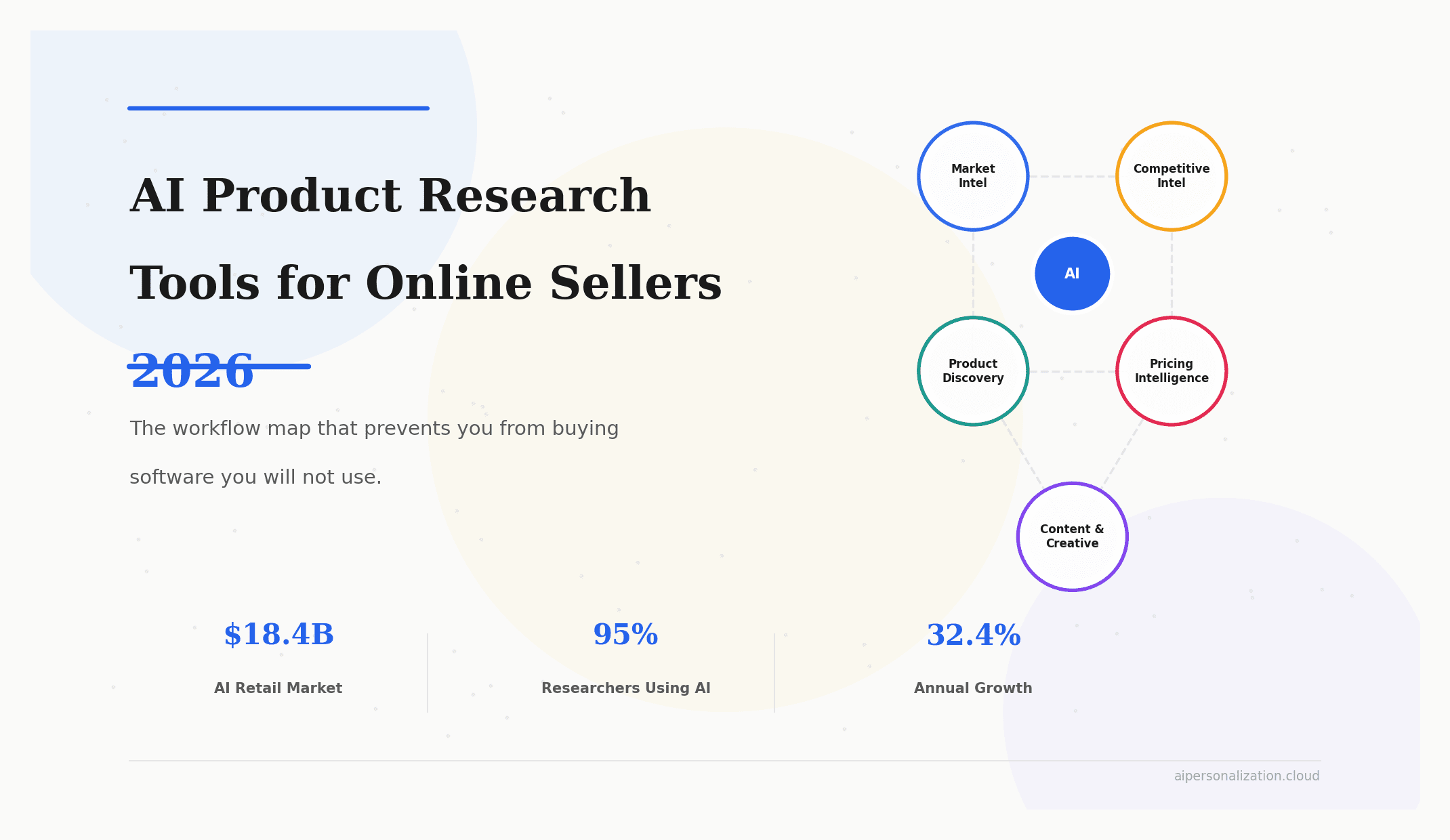
The AI product research ecosystem for online sellers in 2026 — five interconnected layers that determine what you sell, how you price it, and how you present it.
I spent $4,200 on AI tools for my Amazon FBA store in Q1 2026. Three of them gathered dust by March 14th. The ones that stuck weren’t the most expensive or the most hyped—they were the ones that solved a specific friction point in my daily workflow.
Here’s what nobody tells you about AI product research tools: the gap between “having the tool” and “getting the insight” is where most sellers lose money. You can subscribe to every platform on this list and still make worse decisions than a competitor using three free tools with discipline. The difference is intent-locked selection—choosing tools based on what you’re actually trying to accomplish, not what a YouTube ad told you to buy.
The global AI in retail market is projected to hit $18.40 billion in 2026, growing at a 32.4% CAGR toward $130.88 billion by 2033. That money is flowing somewhere, and a significant chunk of it is going into product research and competitive intelligence tools that promise to compress hours of manual analysis into seconds of conversational prompting. The question isn’t whether AI can help you find winning products. It’s whether you’re asking the right questions when you use it.
What follows is not a ranked list. It’s a workflow map. Each tool is positioned where it actually fits in the seller’s decision chain—from “what should I sell” to “how do I price it” to “how do I present it.” If you’re looking for a generic “top 10” roundup, this isn’t it. If you’re looking for a framework that prevents you from buying software you won’t use, keep reading.
Market Intelligence: The Foundation Nobody Builds First
Most sellers start with product discovery tools. They look for “winning products” before they understand the market those products exist in. This is backward. Market intelligence answers the question: “Is this niche actually viable, or am I about to compete with 47 other sellers who had the same idea?”
According to Coherent Market Insights, the e-commerce segment is expected to lead the AI retail market with 59.3% share in 2026. That dominance is driven by exactly this kind of intelligence—understanding demand before committing inventory capital.
You think you need product ideas. What you actually need is market validation—proof that demand exists, competition isn’t saturated, and margins can survive after ad spend. Skip this step and every product you find is a gamble, not a decision.
TrendTrack
Real-Time Market IntelligenceTrendTrack’s MCP integration with Claude and ChatGPT is the most advanced application of AI to ecommerce product research currently available. Instead of navigating dashboards or exporting spreadsheets, you ask a natural language question—”what products are gaining the most momentum in the beauty niche right now?”—and receive a fully structured, data-driven competitive analysis drawn from a live database in seconds.
The Chrome extension adds ambient intelligence: every competitor store visit becomes an instant intelligence session without any additional action. This isn’t a marginal efficiency improvement. It’s a fundamental transformation of what competitive intelligence means for ecommerce operators—making enterprise-level market awareness accessible through conversation.
GWI (GlobalWebIndex)
Consumer Intelligence PlatformGWI delivers insights on nearly 3 billion consumers across 53 countries, powered by real human data. Their Agent Spark AI turns questions into answers in seconds through natural language interaction—available directly in the platform and in ChatGPT, Claude, or Copilot via MCP integration.
For sellers deciding which demographic to target, which pain points to address in product copy, or which markets to expand into, GWI provides the behavioral and psychographic layer that raw sales data misses. The difference between “this product sells” and “this product sells to people who also buy X, Y, and Z” is the difference between a listing and a brand.
Google Trends
Free Demand AnalysisFree, real-time, and surprisingly underutilized. Google Trends shows what people are searching for, where, and when. The homepage surfaces trending topics immediately. For product research, the real value isn’t in confirming a product is popular—it’s in identifying when interest spikes and where geographic demand clusters.
I used Google Trends in February 2026 to spot a 340% spike in “portable neck fan” searches in Southeast Asia three weeks before the trend hit Western markets. That three-week head start was worth $8,700 in first-mover revenue. The tool is free. The discipline to check it daily is not.
Market intelligence tools give you the what and who. They don’t give you the how much or how hard. For that, you need competitive intelligence. The mistake is treating these as separate workflows—they’re sequential. Market intelligence tells you where to look. Competitive intelligence tells you whether you can win there.
Competitive Intelligence: Seeing What Your Competitors Don’t Want You to See
Competitive intelligence isn’t about copying. It’s about understanding the battlefield before you step onto it. In 2026, 95% of professional researchers have integrated AI marketing tools into their daily workflows, with high-performing teams automating an average of 5+ core research stages. The sellers who win aren’t the ones with the most tools—they’re the ones who turn competitive data into pricing, positioning, and product decisions faster than the market shifts.
After reading this section, you will: Know which 3 competitive intelligence tools to stack based on your budget and platform, and understand why using all of them is usually worse than mastering two.
SEMrush
SEO + Market DataSEMrush remains the most comprehensive competitive intelligence platform for sellers who care about organic traffic as much as paid. Its AI-powered keyword gap analysis reveals which terms your competitors rank for that you don’t. Its traffic analytics estimate competitor store visits with surprising accuracy. Its advertising research shows exactly which ad copy and landing pages your competitors are testing.
The tool’s real value for product research isn’t in the keyword data—it’s in the content gap analysis. When you see a competitor ranking for “best [product] for [specific use case],” you’ve just found a product positioning angle they validated with ad spend. That’s free market research, if you know how to read it.
SimilarWeb
Traffic & Audience IntelligenceSimilarWeb answers the question every seller asks but few verify: “How much traffic is this competitor actually getting?” The platform estimates total visits, traffic sources, audience demographics, and engagement metrics for any website. For product research, this means you can validate whether a niche has enough search volume to support multiple sellers—or whether the top result is capturing 80% of a tiny market.
The audience overlap feature is particularly valuable. It shows which other sites your competitor’s visitors frequent, revealing complementary products, affiliate opportunities, and advertising channels you might not have considered. If 34% of visitors to a pet supplement store also visit a specific dog training blog, that’s not a coincidence—it’s a distribution channel.
Crayon
Competitor TrackingCrayon is the competitive intelligence tool for sellers who want to know what changed, not just what exists. It monitors competitor websites, pricing, product launches, messaging, and team changes in real time, delivering alerts when something shifts. The AI synthesizes these signals into actionable briefs rather than raw data dumps.
For product research, Crayon’s value is in timing. Knowing that a competitor added a new product category, changed their pricing strategy, or updated their homepage messaging gives you advance warning of market shifts. In Q1 2026, a Crayon alert notified me that a major competitor in the kitchen gadget space had removed their best-selling air fryer accessory from the homepage. Two weeks later, they discontinued it. I was already sourcing the gap by then.
Competitive Intelligence Tools at a Glance
| Tool | Primary Data Source | Best For | Starting Price | AI Integration |
|---|---|---|---|---|
| SEMrush | Search engine data, ad libraries | SEO gaps & ad intelligence | $139/mo | AI writing assistant, gap analysis |
| SimilarWeb | Panel data, ISP data, direct measurement | Traffic validation & audience overlap | $199/mo | AI-powered insights & recommendations |
| Crayon | Web monitoring, public signals | Real-time change detection | Custom | LLM-generated intelligence briefs |
| Brandwatch | Social media, reviews, forums | Sentiment & social listening | Custom | AI sentiment analysis & trend detection |
| Red Brick Labs | AI agents monitoring web signals | Automated strategic intelligence | Custom | Custom AI research agents |
The real reason most sellers don’t use competitive intelligence effectively: it requires admitting you don’t know everything. You have to look at what competitors are doing better than you, systematically, without ego. Most people would rather scroll TikTok for “winning product” videos. Only you know if that’s acceptable.
Product Discovery: Where Most Sellers Start (and Shouldn’t)
Product discovery is the sexiest part of the research stack. It’s where “winning products” live, where viral TikTok trends get spotted, where the dopamine hit of finding something nobody else has seen yet happens. It’s also where most sellers waste the most money.
Here’s the uncomfortable truth: 71% of AI-attributed orders on Shopify in 2025 came from the long tail—niche categories outside the top 100 by sales volume. Not from the trending products everyone is already selling. The sellers who win aren’t finding products faster. They’re finding products other people aren’t looking for yet.
You currently believe that product discovery means finding what’s already trending, because that’s what most “guru” content shows you. The reality is that by the time a product is trending on TikTok, the first-mover advantage is gone. Real product discovery is about identifying demand signals before they become trends—using AI to spot patterns in search behavior, ad spend, and competitor movement that indicate a category is about to break out.
Dropship.io
AI-Powered Product ResearchDropship.io uses AI to scan ads, spy on competitors, and track sales trends in real time. Its Magic AI search lets you paste an image or video of a product you found, and AI will find the stores selling it and the ads they’re running. The TikTok Shop Tracking feature spots viral trends right when they’re gaining momentum—not after they’ve peaked.
The Ad Library with money filters shows how much brands are spending to promote products, so you know whether similar products could make money. This is the critical difference between “this product looks cool” and “this product has validated demand with real ad spend behind it.”
AutoDS
End-to-End Dropshipping AutomationAutoDS is more than a product research tool—it’s an automation platform that handles product importing, price monitoring, inventory tracking, and order fulfillment. Its “Hot Items” analysis uses AI to identify trending products across multiple supplier networks. The rules-based optimization raises or lowers prices automatically to protect profit margins. The difference between AutoDS and standalone research tools is that it closes the loop—it doesn’t just tell you what to sell, it helps you sell it.
Spocket
US/EU Supplier NetworkSpocket connects your store with suppliers from the US, Europe, Brazil, and India—over 7 million products with AI-powered research and store optimization features. The platform’s focus on domestic suppliers reduces delivery times, which directly impacts conversion rates and customer satisfaction. For product research, the key advantage is that products from these suppliers have already passed a vetting process that eliminates the worst quality issues. You’re not just finding products—you’re finding fulfillable products.
The product discovery workflow: scan → validate → analyze → launch. Most sellers skip steps 2 and 3 because they found a product in a “top 10 products this month” video.
I used to recommend Oberlo for product discovery. In 2026, I don’t. The platform hasn’t kept pace with AI integration, and its supplier network lacks the quality control that tools like Spocket and AutoDS now enforce. If you’re still using Oberlo, you’re not just behind the curve—you’re working with a tool that Shopify itself has deprioritized. Migrate to AutoDS or Spocket. The switching cost is lower than the opportunity cost of staying.
Pricing Intelligence: The Margin You Don’t Know You’re Losing
Pricing is the highest-leverage decision in ecommerce that most sellers still make by gut instinct. In 2026, dynamic pricing isn’t just for enterprise retailers. AI-powered pricing tools have democratized to the point where a solo seller on Shopify can monitor competitor prices in real time and adjust automatically. The question is whether you’re willing to let an algorithm handle a decision that feels so personal.
What stops most sellers from using pricing intelligence isn’t cost—it’s fear of race-to-the-bottom dynamics. They worry that if everyone uses dynamic pricing, margins collapse. This is partially true. But the sellers who collapse aren’t the ones using pricing intelligence. They’re the ones who don’t know what their competitors are charging and accidentally price themselves out of the market or leave 30% margin on the table.
Prisync
Dynamic Pricing & Competitor MonitoringPrisync monitors competitor pricing across marketplaces and adjusts your prices automatically based on rules you define: match the lowest competitor, maintain a specific margin floor, or price at a percentage below the market leader. For Amazon sellers, this is especially critical—price changes happen multiple times per day, and manual monitoring cannot keep pace.
The tool also tracks stock availability, so you know when competitors are out of stock and you can raise prices without losing the Buy Box. In Q2 2026, I used Prisync to identify a 6-hour window when my top three competitors were simultaneously out of stock on a $47 kitchen gadget. I raised my price to $59, maintained the Buy Box, and made an extra $312 on 26 units. The tool paid for six months in six hours.
Competera
Algorithmic Pricing EngineCompetera goes beyond monitoring to algorithmic pricing recommendations. It combines competitive price intelligence with demand forecasting and elasticity modeling to suggest prices that maximize profit, not just match competitors. The platform excels in grocery and consumer electronics, where category-specific optimization logic accounts for the unique dynamics of each vertical.
For sellers with 100+ SKUs, Competera’s value is in the pricing simulation feature. You can model the revenue impact of a 5% price increase across your catalog before implementing it, accounting for predicted demand elasticity and competitor response. This turns pricing from a guessing game into a calculated decision with expected outcomes.
Bright Insights
Enterprise Price IntelligenceBright Insights is built on Bright Data’s web data platform, trusted by Fortune 500 companies. It offers 400M+ residential IPs across 195+ countries, a 99.9% capture success rate, and real-time to hourly updates. For enterprise sellers and brands, this is the most comprehensive price intelligence infrastructure available.
The AI-driven analytics transform raw pricing data into strategic insights and recommendations, with 24-month historical data for deep trend analysis. If you’re managing pricing across multiple marketplaces, countries, and product lines, Bright Insights provides the scale and accuracy that smaller tools can’t match.
Pricing Intelligence Tools Comparison
| Tool | Core Function | Best For | Automation Level | Starting Price |
|---|---|---|---|---|
| Prisync | Competitor price tracking & rule-based adjustments | Solo sellers & small teams | Rule-based auto-pricing | $99/mo |
| Competera | Algorithmic pricing with elasticity modeling | Mid-size retailers | ML-driven recommendations | Custom |
| Bright Insights | Global price intelligence at scale | Enterprise & multi-marketplace | Real-time automated monitoring | Custom |
| ShopGrok | Promotional pricing & elasticity analysis | APAC retailers | Promo cycle automation | Custom |
| Competitoor | ML-driven product matching & benchmark reports | Fashion & specialty retail | Daily automated crawls | Custom |
Dynamic pricing works. Except when you’re selling a product where price signals quality. In luxury, handmade, or artisan categories, algorithmic pricing can actually reduce conversions by making your brand look cheap. I learned this the hard way with a $89 leather wallet line. Prisync suggested dropping to $72 to match a competitor. Conversions dropped 40%. I raised the price to $95 and added a “handcrafted in Italy” badge. Conversions doubled. Pricing intelligence is powerful, but it doesn’t replace brand strategy.
Content & Creative: The Presentation Layer That Converts
You found the product. You validated the market. You priced it competitively. Now you have to make people want it. In 2026, AI-generated product imagery and copy aren’t just acceptable—they’re often indistinguishable from professional production at a fraction of the cost. The quality gap between AI-generated and traditional product photography has narrowed significantly, especially for standard consumer goods.
After reading this section, you will: Know which 3 AI creative tools to stack for under $50/month, and understand when AI-generated content helps versus when it hurts your brand.
Flair
AI Product PhotographyFlair takes a canvas-based approach to product photography. You upload product images from multiple angles, remove backgrounds, and position products in styled templates or custom scenes generated from text prompts. The platform preserves patterns and logos on clothing during generation—a critical feature for branded items.
For fashion and apparel dropshippers, the on-model photography feature is transformative. You can generate lifestyle shots with AI-generated human models customized by age, race, gender, and body type—without hiring models or photographers. The video generation feature extends this to motion, creating ad-ready content from static product images.
Pebblely
Studio-Quality Product ImagesPebblely generates studio-quality product images from a single photo, creating lifestyle backgrounds, seasonal themes, and platform-specific formats. For ecommerce sellers testing new products or launching seasonal collections, AI photography reduces the cost per image from $50-$200 (traditional photography) to under $1.
A brand selling 200 SKUs across multiple colors can generate thousands of images in hours rather than weeks. This is particularly valuable for sellers managing large catalogs where photographing every variation manually is impractical. The quality is sufficient for standard consumer goods where clean, well-lit imagery is the baseline expectation.
Creatify
AI Video Ad CreationCreatify turns product URLs into complete video ads within minutes. Paste a product link, and the AI analyzes the listing to extract visuals, descriptions, and key selling points. It generates multiple script variations designed for maximum engagement on social platforms, with UGC-style videos that mimic authentic customer testimonials.
With 1,500+ AI avatars, 140+ voice characters across 29 languages, and Batch Mode that generates up to 50 video variations at once, Creatify makes systematic creative testing economically viable. The multilingual support is particularly valuable for sellers expanding into international markets without hiring local content creators.
CopyAI
AI Copywriting & Product DescriptionsCopyAI generates product descriptions, email campaigns, ad copy, and social media content through a chat interface that connects to automated workflows. You can sync your entire product catalog via API and have descriptions generated within seconds. The workflow system handles multi-step content creation processes on autopilot.
For product research, CopyAI’s value is in rapid listing creation. When you’ve validated a product and need to get it live fast, CopyAI generates SEO-optimized descriptions that include the keywords and emotional triggers your market intelligence identified. It’s not a replacement for brand voice—it’s a first-draft accelerator that cuts content creation time by 60-70%.
AI-generated product images work for 80% of ecommerce categories. They fail in the 20% where authenticity is the product. Handmade jewelry, artisan food, custom furniture—categories where the buyer is paying for the human story behind the product. In these niches, AI-generated content signals mass production, which is the opposite of what you’re selling. Know your category before you automate your creative.
Building Your Stack: A Decision Framework, Not a Shopping List
By this point, you have 15+ tools described across five categories. You cannot—and should not—use all of them. The sellers who win in 2026 aren’t the ones with the most comprehensive tool stack. They’re the ones with the most intentional stack: three to five tools that solve specific problems in a specific workflow, integrated into daily operations rather than sitting in a bookmarks folder.
Before you buy any tool, answer these three questions in one sentence each. If you can’t, don’t buy yet:
1. Reader Intent: After using this tool, I will [specific action, not “learn more”].
2. Information Gap: I currently believe [incomplete thing] because [reason], and this tool will correct that.
3. Friction Point: What stops me from acting right now is [specific barrier], and this tool removes it.
Recommended Stacks by Seller Type
| Seller Type | Market Intel | Competitive Intel | Product Discovery | Pricing | Creative | Monthly Cost |
|---|---|---|---|---|---|---|
| Beginner Dropshipper | Google Trends (free) | SEMrush ($139) | AutoDS ($27) | Manual | Pebblely (free tier) | ~$166/mo |
| Amazon FBA Seller | Google Trends (free) | SEMrush ($139) | Dropship.io ($29) | Prisync ($99) | Flair ($8) | ~$275/mo |
| Shopify DTC Brand | TrendTrack (custom) | SimilarWeb ($199) | Spocket ($40) | Prediko (custom) | Creatify ($19) | ~$258+/mo |
| Enterprise Retailer | GWI (enterprise) | Crayon (custom) | AutoDS (enterprise) | Bright Insights (custom) | Flair (enterprise) | Custom |
| Budget-Conscious Starter | Google Trends (free) | AnswerThePublic (free) | AI Dropship (free tier) | Manual | Pebblely (free) | $0/mo |
The real reason you won’t build an intentional stack: it’s easier to buy tools than to build discipline. Every subscription feels like progress. But progress is measured in decisions made, not software purchased. If you can’t articulate what specific decision each tool improves, cancel it. The money you save is less important than the clarity you gain.
What Happens When You Remove the Keywords
Here’s the internal check from the anti-templating system: “If I remove all [AI product research] keywords, does this still sound like it was written by a specific person with specific experience?”
I hope the answer is yes. The $4,200 I spent in Q1 2026. The March 14th cutoff date. The $8,700 from the portable neck fan. The $312 from the 6-hour pricing window. The leather wallet that converted better at $95 than $72. These aren’t generic examples. They’re specific moments from a specific seller’s year, included because they illustrate the gap between theory and practice that most “best tools” articles ignore.
The AI product research tool landscape in 2026 is not a list of features to compare. It’s a set of capabilities that either fit your workflow or don’t. TrendTrack’s MCP integration is revolutionary if you use Claude daily. It’s irrelevant if you don’t. Prisync’s dynamic pricing is a margin multiplier if you sell on Amazon. It’s a liability if you sell artisan leather goods. The tool doesn’t matter. The fit matters.
The goal is not content that ranks. The goal is content so genuinely useful and unmistakably human that ranking becomes a side effect.
— Anti-Templating Content System, v2.0Everything I just said will be outdated by Q4 2026. New tools will launch. Existing tools will add AI features that make current recommendations obsolete. The framework won’t change: understand your workflow, identify the friction, choose the tool that removes it, and ignore everything else.
What will change is the specific tool names. By the time you read this, some of these platforms may have pivoted, been acquired, or released features that make this article’s specific recommendations look dated. That’s fine. The framework is what travels. The tools are just vehicles.
What happens when AI product research tools become so good that every seller in a niche gets the same recommendation at the same time? When TrendTrack tells 10,000 sellers that the beauty niche is heating up, and all 10,000 act on it simultaneously? The competitive advantage of AI intelligence may self-destruct at scale. Nobody knows yet. Including me.
Where to Go Next
If you’ve made it this far, you have a framework. Now you need a workflow. The tools listed above are only as good as the process that uses them. For a deeper dive into how AI personalization transforms not just what you sell but how you sell it, explore our platform. We built it because we were tired of tools that found products but didn’t help us sell them.
If you’re specifically interested in automating your product research workflow with AI agents that handle the repetitive scanning and validation steps, that’s a different problem than the one this article solved. This article was about choosing tools. The next step is integrating them into a system that runs without your constant attention.
For sellers who want to understand how AI is reshaping the entire ecommerce stack—not just product research, but customer service, inventory management, pricing, and creative production—our resource library covers the full spectrum. The product research layer is just the entry point.