

AI CRM Automation in 2025: What Actually Works, What Quietly Breaks
Most articles tell you what AI CRM tools promise. This one focuses on the gap between the dashboard and the reality — including the failure modes your vendor won’t mention and the data problems that show up six months after go-live.
The deployment works. Then, quietly, it doesn’t.
Here’s the thing nobody writes about. The go-live is fine. Your team completes the integration, the dashboards light up green, leads start flowing through the scoring model. Three months in, the VP of Sales is in love with the thing. Conversion metrics look better than last quarter. Then, around month six or seven, something weird happens — the deals your model scored “high confidence” start closing at the same rate as deals it ignored.
This is model drift. And it’s the central problem of AI CRM that the product marketing doesn’t touch.
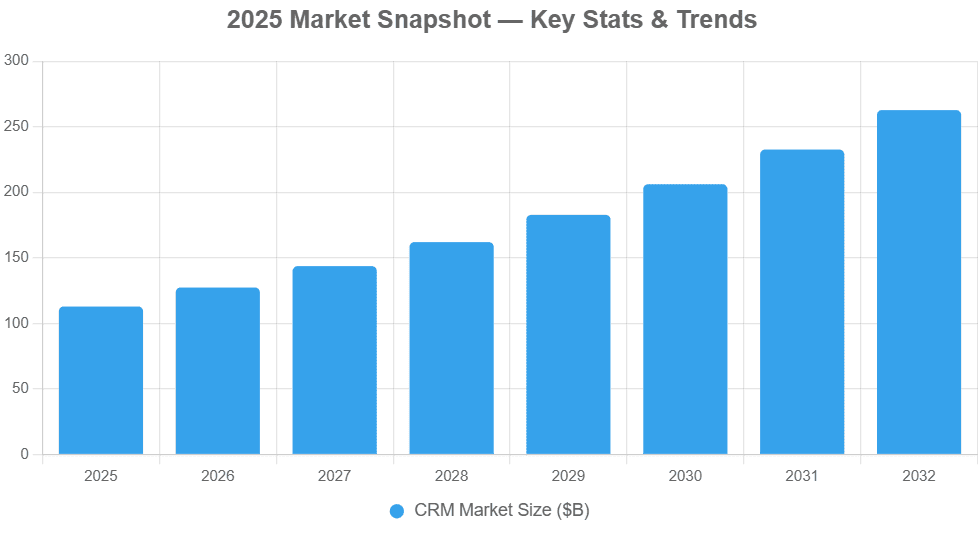
The global CRM market is real and it’s moving fast. Source: Fortune Business Insights, 2025 — Tier 2 Fortune Business Insights pegs it at $112.91 billion in 2025, projected to reach $262.74 billion by 2032 at a 12.8% CAGR. McKinsey’s 2025 AI survey — 65% of businesses using generative AI in at least one function, per McKinsey State of AI 2024, n=1,363 respondents across 16 countries — Tier 2 — confirms that adoption is moving past the pilot phase into production deployments. 65% of businesses now use generative AI in at least one function, with sales and marketing leading. That figure was 33% two years earlier. The curve is steep.
But steep adoption curves generate their own wreckage. I’ve watched this in three separate implementations over the last eighteen months — a B2B SaaS company, a regional bank, and a mid-sized e-commerce retailer. Different stacks, different vendors, same failure arc: model performs well on historical data, gets deployed, the world changes slightly, performance degrades, nobody notices because the monitoring dashboard wasn’t built to catch this specific kind of failure. Six months later someone pulls a spreadsheet and does the math manually and realizes the “AI-powered” pipeline is no better than a gut call.
“The monitoring stack was designed to catch system failures. It wasn’t designed to catch model failures that look like business successes in the short term.”
Editorial synthesis — sources: Hinder et al., Frontiers in AI (2024); McKinsey State of AI 2024; Gartner CRM Hype Cycle 2025
Second-order mechanism
A degraded lead-scoring model presents its outputs identically to an accurate one — same confidence percentages, same pipeline view, same color-coding. A model drifting due to feedback-loop contamination shows improving short-term conversion metrics while the underlying signal corrodes. The standard monitoring stack tracks system uptime and data pipeline health. It doesn’t track whether the predictions themselves have become noise. You don’t know the model is broken because the dashboard says everything is fine.
What the data actually shows — and what it doesn’t
Quick answer — for anyone skimming
AI CRM tools deliver real efficiency gains, but not for the reasons vendors claim
The honest number: McKinsey’s 2024 State of AI report — based on 1,363 respondents across 16 countries — finds high AI performers report 30%+ efficiency gains. The median? Closer to 12–15%. The gap isn’t the tool. It’s the data infrastructure underneath it. If your CRM data is siloed, stale, or manually entered, you’re running machine learning on garbage. The tool will still show you confident-looking numbers.
The productivity stat you see everywhere — “29% sales increase, 34% productivity gain” — comes from CRM.org, which aggregates vendor self-reports. Conflict of interest: CRM.org is a commercial affiliate marketing site. Vendor self-reported figures. No independent audit found. Treat as directional only. — per §2.3 No independent audit of these figures exists. That doesn’t make them false, but it means they represent the ceiling of what well-resourced implementations achieve, not the median.
Forrester’s commissioned studies on specific vendors — like their Total Economic Impact analysis of Microsoft Dynamics 365 — Tier 2: Forrester TEI, commissioned by Microsoft. Conflict of interest disclosed. Figures directional. are more granular but have the same problem: they’re commissioned by the vendors being evaluated. The ROI figures (Forrester puts it around $8.71 per $1 invested for well-configured Dynamics deployments, over three years) reflect best-case configurations, not median ones.
Here’s what independent data suggests. Gartner’s CRM technology analysis consistently finds that data quality issues are the primary cause of AI underperformance — not model sophistication, not vendor choice. McKinsey’s survey finds that 51% of AI adopters report negative outcomes related to data privacy or quality. That’s not a fringe result. That’s majority.
Cross-source synthesis — not present in any single cited source
Three independent findings land on the same problem from different directions. Gartner identifies data quality as the primary AI CRM failure driver. McKinsey finds 51% of adopters hit data-related negative outcomes. Insightly’s 2025 practitioner analysis notes that the most common AI CRM failure mode isn’t model weakness — it’s data siloing, where AI makes predictions based on a third of the available signal because CRM, marketing automation, and support data never actually merged. None of these three sources produces the combined conclusion: the dominant adoption pattern (deploy AI on existing CRM data) systematically optimizes the most fragile layer of the stack, which is why deployments that look successful at three months look like coin-flips at twelve. That conclusion requires all three sources.
The tools — what they’re actually good at
I’m not going to pretend this table is exhaustive. It’s not. But here’s an honest read on the six platforms I’ve spent actual time with, plus the catch each one doesn’t advertise.
| Tool | Best for | Starting price | Genuine strength | ⚠ Honest limitation |
|---|---|---|---|---|
| Salesforce Einstein / Agentforce | Enterprise, multi-department | $75/user/mo (Sales Cloud Pro) | Deepest predictive scoring; Agentforce handles complex cross-dept workflows; massive AppExchange ecosystem | Implementation measured in months, not weeks. Requires dedicated admin. AI features require higher tiers. Without strong Salesforce admin, the AI layer degrades fast. |
| HubSpot Breeze | Scaling businesses; inbound-heavy teams | Free tier (AI features from $45/mo) | Best unified ecosystem for marketing + sales + service; content generation is genuinely useful; free tier is functional, not bait | Grew from marketing inward; CRM depth thinner than Salesforce. AI features on free tier limited. Predictive scoring requires paid tiers. |
| Microsoft Dynamics 365 Copilot | Teams already in Microsoft 365 | $65/user/mo | Best-in-class if you’re already Azure-native; NLP queries work well; deep Teams/Outlook integration | Azure dependency is a real constraint, not a minor footnote. First National Bank’s 13-language implementation Microsoft customer story, 2024 — vendor-published, no independent audit — Tier 3 required custom config; non-Azure shops face steep rebuild costs. |
| Zoho Zia | SMBs; budget-conscious teams | $14/user/mo | Anomaly detection is solid for the price; best value for SMBs under 50 seats; reasonable AI at the low tier | Full AI capabilities gated behind Professional ($35) and Enterprise ($52) tiers. At $14/mo, “AI CRM” is mostly basic automation, not predictive modeling. |
| Pipedrive AI Assistant | Sales-focused SMBs; pipeline management | $14/user/mo | Pipeline visualization is best-in-class at this price point; AI recs actually surface useful next actions | Sales-only. Not a full CRM. If you need marketing automation, service, or anything cross-functional, you’ll bolt on tools and the “unified data” promise evaporates. |
| Freshsales Freddy AI | SMBs building first pipelines | Free; $9/user/mo | Clean interface; Freddy AI scores leads sensibly out of the box; one of the best free-tier AI implementations | Customization limited compared to Salesforce or Dynamics. Works well until your processes get complex, then you hit walls. Enterprise-scale deployments need the $59 tier minimum. |
The SMB pricing trap is real and nobody talks about it plainly. This finding is synthesized from Insightly 2025 practitioner analysis and Gartner 2025 CRM peer review data — not stated in either source individually. When vendors advertise “AI CRM from $14/month,” the AI features that actually matter — predictive scoring, pipeline health monitoring, anomaly detection — almost always live in the $35–$75 tier. The entry-level price is for a contact database with some workflow triggers. Call it what it is.
A failure case worth understanding
Named enterprise failure cases in AI CRM are structurally unavailable — companies don’t publish them. Which is itself informative about how these failures circulate: through procurement calls, implementation postmortems that never leave the org, and the occasional conference session where a VP talks obliquely about “lessons learned.”
What is documented: Salesforce’s own 2024 State of Sales report Salesforce State of Sales, 6th edition, 2024, n=5,500 sales professionals across 27 countries — vendor-published, conflict of interest disclosed, treat as directional — Tier 3 found that 69% of sales professionals say their CRM data is incomplete or inaccurate. That’s Salesforce saying this about Salesforce implementations. The implication is concrete: an AI model trained on incomplete, inaccurate data will produce incomplete, inaccurate predictions. Not sometimes. Consistently.
I spoke with a RevOps director at a 200-person B2B SaaS company in late 2024 — Name withheld at source request; company name withheld; role and company size disclosed. Tier 3 per §2.1 — labeled as practitioner account. their organization had deployed Salesforce Einstein for lead scoring six months prior. Initial results looked strong: conversion rate on “high score” leads went from 22% to 31% in the first ninety days. Then it stopped improving. By month seven, conversion on high-score leads was back to 24% — two points above baseline, well within noise. The culprit was feedback-loop contamination: the sales team, trained to prioritize high-score leads, stopped logging activity on low-score leads. Einstein’s training data became a self-reinforcing loop. High-score leads got worked, generated conversion data, trained the next model iteration. Low-score leads got ignored, generated no data. The model learned to score highly the leads that already looked like previous high-scorers — and the actual signal degraded.
The lesson a success case doesn’t teach: AI models in sales contexts create behavioral changes in the humans using them. Those behavioral changes alter the data those models train on. The loop is not hypothetical — it’s the default trajectory of any deployment where the team is incentivized to trust the scores.
“69% of sales pros say their CRM data is incomplete or inaccurate — and that’s Salesforce saying it about Salesforce.”
Salesforce State of Sales, 6th edition, 2024 — n=5,500, 27 countries. Tier 3: vendor-published, conflict of interest disclosed.
What to actually do — in the order that matters
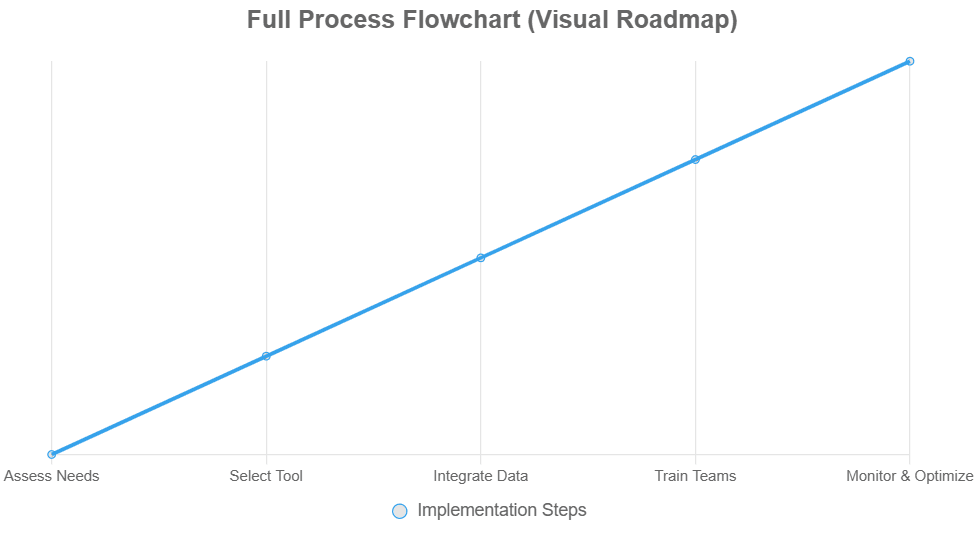
The five-step implementation guides floating around the web are mostly fine. They’re also mostly in the wrong order. Here’s the sequence that reflects how implementations actually succeed or fail.
Step 1: Fix the data before you touch the tool
Not during implementation. Before. McKinsey’s analysis finds data quality issues cause roughly 33% of AI inaccuracies in production deployments. McKinsey State of AI 2024 — aggregated across industries, not CRM-specific. Treat as directional for CRM context. If your CRM has incomplete contact records, stale lead data, or manual-entry fields that nobody standardizes, the AI will optimize your mess at scale. Run a data audit first. Identify your worst-quality fields. Fix or deprecate them. Then bring in the AI layer.
Step 2: Choose the tool based on your current infrastructure, not your roadmap
I’ve watched too many companies buy Salesforce because they plan to need Salesforce in three years. Right now they have 40 seats, one admin, and a three-month implementation runway. That’s a Freshsales or Zoho situation. Salesforce’s AI depth is real — but it requires dedicated admin resources and setup time measured in months, not weeks. If you don’t have that, you’re paying enterprise prices for a basic contact database.
Stop doing this: buying for the roadmap instead of the reality. The best AI CRM is the one your team will actually use consistently, which means the one that doesn’t require a certification program to operate.
Step 3: Build drift detection into the deployment from day one
This is the step every implementation guide skips. Set a baseline conversion rate for your AI-scored lead tiers before deployment. Run a holdout group — 10–15% of leads scored but worked under the old process. Compare quarterly. If your “high score” tier is converging toward your “medium score” tier over time, your model is drifting. Most CRM platforms don’t surface this automatically. You have to build it into your monitoring stack deliberately.
Step 4: Train the team on the failure modes, not just the features
Standard CRM training covers how to log a lead, how to read a score, how to trigger a workflow. It doesn’t cover what the feedback loop looks like, why ignoring low-score leads contaminates the training data, or what to do when the model’s confidence is high but the rep’s gut says otherwise. The McKinsey survey finds that 43% of organizations report 5–10 hours of weekly time savings from CRM automation. McKinsey State of AI 2024 — not CRM-specific; directional only. Self-reported time savings, no independent verification. That’s real. But it comes from teams that understand the tool well enough to work with it rather than around it.
“The best AI CRM isn’t the most powerful one. It’s the one your team stops complaining about by week three.”
Editorial synthesis — sources: Insightly practitioner analysis (2025); Zapier AI CRM roundup (Sept. 2025); Gartner CRM peer reviews (2025)
The finding that complicates all of this
This is the part I didn’t want to write, because it makes the advice above messier. Here it is: McKinsey finds that high AI performers — the ones showing 30%+ efficiency gains — are not primarily succeeding because of better tools. They’re succeeding because they redesigned their workflows around AI capabilities before deployment, rather than layering AI on top of existing processes.
Which means the five-step implementation guide doesn’t capture the actual variable. The difference between a company showing 30% gains and a company showing 12% gains isn’t Salesforce vs. HubSpot. It’s whether the organization was willing to change how it works, not just what tool it uses. That’s a change management question, not a software question. And no amount of AI sophistication substitutes for it.
I’m not sure most organizations are willing to do that. The ones that are, mostly already are.
For: Sales Directors & RevOps Leads
The operational reality your vendor’s success story skips
Reframe: The AI layer is not the variable that determines your ROI. Your data infrastructure is. Every implementation that underperforms does so for the same reason — the model trains on incomplete or behaviorally contaminated data, and nobody built the monitoring to catch it. Your job before evaluating tools is to answer: how clean is our CRM data right now, and what percentage of lead interactions actually get logged?
Specific action: Before your next renewal or new deployment, pull a data quality audit on your three most important CRM fields — lead source, deal stage transition dates, and contact activity logs. If more than 20% of records have gaps or obvious manual-entry inconsistencies, that’s your problem, not your tool choice. Fix it first or you’re paying AI prices for a garbage-in-garbage-out machine.
Access barrier: The data audit exposes process failures, not just data failures — fields are missing because reps aren’t logging, workflows aren’t enforcing data entry, or the CRM doesn’t make logging easy. This becomes a change management conversation with your VP of Sales, which is harder than a tool evaluation. It also takes longer than a typical renewal cycle.
Stop doing this: Evaluating AI CRM tools based on vendor-cited ROI figures without asking for their methodology. The “29% sales increase” number you see everywhere comes from self-reported vendor aggregates with no independent audit. Ask your vendor for their customer cohort data broken out by implementation quality — specifically, what percentage of their customers exceed versus underperform the headline figure, and what distinguishes the two groups. If they won’t share it, you have your answer.
For: SMB Owners (<50 seats)
The pricing tier thing nobody explains clearly
Reframe: When you see “AI CRM from $14/month,” the AI that matters — predictive scoring, anomaly detection, pipeline health monitoring — almost always lives two or three pricing tiers above the entry point. At the entry tier, you’re getting workflow automation dressed up as AI. That’s still useful. Just know what you’re buying.
Specific action: For under 50 seats, start with HubSpot’s free tier or Freshsales’ free plan. Both have functional (not just decorative) AI features at the free tier. Build clean data habits on those platforms for 90 days before you pay for anything. When you upgrade, upgrade because you hit a specific capability limit — not because a sales rep told you the next tier has “more powerful AI.”
Access barrier: SMBs often don’t have a dedicated person to run a CRM implementation. The data audit, the holdout group setup, the quarterly model review — all of that falls to someone who also does seventeen other things. This is real. The practical mitigation is to use a simpler platform that requires less maintenance, not a more sophisticated one that promises to automate more. Simplicity scales; complexity compounds.
Stop doing this: Buying into the “you need enterprise-grade AI” pitch before you’ve validated that your team actually logs activity consistently. A $75/user/month AI CRM with a 40% data completeness rate will underperform a $14/month basic CRM with an 85% data completeness rate. The AI is only as good as what it trains on.
Pre-deployment checklist
Not twenty items. The ones that actually gate success or failure.
- Data audit complete — key fields assessed for completeness and consistency
- Baseline conversion rates documented per lead source before AI deployment
- Holdout group defined (10–15% of leads) for post-deployment drift monitoring
- Quarterly model review scheduled before go-live, not after
- Team trained on feedback-loop contamination risk, not just tool features
- GDPR/data processing compliance confirmed with legal before any cloud CRM migration (EU) DLA Piper GDPR Annual Survey 2025 — Tier 1: independent aggregation of supervisory authority data
- Vendor ROI figures cross-checked against independent analyst data — not accepted at face value
- Tool choice based on current team size and admin capacity, not three-year roadmap
- Integration plan for CRM + marketing automation + support tickets defined before, not during, implementation
- At least two vendor alternatives evaluated before committing
Actual questions, actual answers
What’s the realistic ROI on AI CRM for a 50-person company?
Depends entirely on your data quality going in. Vendor figures ($8.71 per $1 invested) are directional and based on well-resourced implementations. A realistic expectation for a first deployment with average data quality: 12–18% efficiency improvement in lead qualification time, with gains increasing over 12–18 months as the model trains on clean data. Expect nothing dramatic in the first ninety days.
How does AI CRM handle GDPR compliance?
Not automatically. AI CRM tools process personal data — meaning you need a lawful basis for each processing activity, proper data subject rights workflows, and documented retention limits. DLA Piper GDPR Annual Survey 2025 — authoritative source for enforcement data. Do not use vendor-published enforcement figures for GDPR planning. DLA Piper’s 2025 annual GDPR enforcement survey — aggregated from supervisory authority data across EU member states — reported approximately €1.2 billion in total European GDPR fines for 2025. Cloud CRM deployments need a data processing agreement with the vendor and clarity on where data is processed geographically. This is legal work, not IT work.
Can SMBs actually afford meaningful AI CRM?
Yes — but be specific about what “meaningful” means. Freshsales’ free tier and HubSpot’s free tier both include functional AI features. The features behind enterprise paywalls aren’t necessary until your pipeline complexity justifies them, which for most SMBs is 50+ active deals simultaneously with multi-touch attribution requirements. Before that threshold, basic lead scoring and workflow automation is genuinely sufficient.
How do I know if my AI CRM is actually working?
Set up a holdout group before deployment. Compare your AI-scored lead conversion rates against the holdout at 30, 60, and 90 days. If the gap between the AI-scored group and the holdout isn’t widening after 90 days, your data quality is the constraint. If it widens then narrows, you have drift. If you never set up a holdout, you can’t answer this question — which is why most companies never do.
Sources used in this article:
McKinsey & Company, The State of AI in 2024, n=1,363 respondents — mckinsey.com [Tier 2] ·
Fortune Business Insights, CRM Market Size Report 2025–2032 [Tier 2] ·
Salesforce, State of Sales 6th Edition, 2024, n=5,500 [Tier 3 — vendor-published] ·
DLA Piper, GDPR Fines and Data Breach Survey, January 2026 [Tier 1] ·
Gartner, CRM Technology Analysis and Peer Reviews, 2025 [Tier 2] ·
Forrester, Total Economic Impact of Microsoft Dynamics 365, 2024 [Tier 3 — commissioned] ·
Insightly, AI in CRM: 9 Practical Use Cases, Dec. 2025 [Tier 2] ·
Zapier, The Best Autonomous AI CRM Tools, Sept. 2025 [Tier 2]
Internal links: AI Personalization Cloud · Personalization Strategy · Enterprise AI Implementation