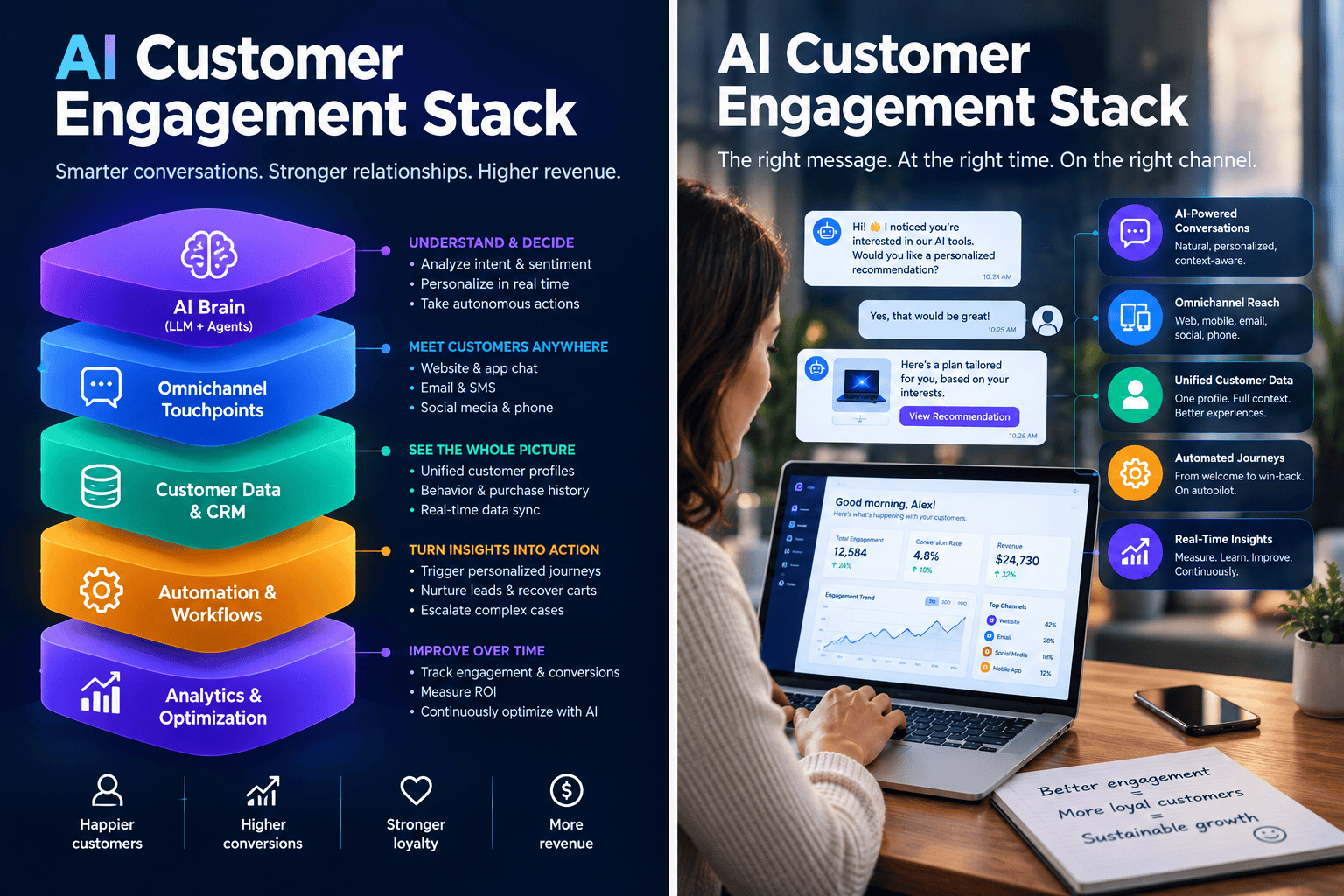


Direct answer: An AI customer engagement stack has five working layers (customer data, conversation channels, autonomous resolution, agent assist, and measurement) plus a compliance constraint that cuts across all of them. The layer that most often wrecks budgets is autonomous resolution, because “price per resolution” means something different at every vendor, so the only comparable number is the cost per audited, genuinely resolved conversation.
By Tom Morgan. Sources checked 15 October 2026. No product testing was performed for this article; every figure comes from the documents linked inline.
Two quotes, two different units
Intercom charges $0.99 per outcome for its Fin agent and publishes the number. Zendesk bills per automated resolution and, according to several third-party comparisons, does not display its rate on the pricing page. Those comparisons report roughly $1.50 on a committed plan and about $2 pay-as-you-go (Macha), while others describe it as a quote-only figure in the $1 to $2 range (Toolradar).
Put $0.99 next to $1.50, and Intercom looks a third cheaper. Almost every buyer’s guide stops there. The comparison is wrong, because the two vendors do not count the same event.
Intercom’s documentation counts a resolution when the customer confirms the answer or simply stops asking. If the customer disengages for 24 hours after Fin’s last reply, that is an assumed resolution, billed at $0.99 (Fin pricing: outcomes). Intercom also bills a second outcome, the procedure handoff: Fin completes a procedure you configured to end by passing the conversation to a human or a workflow (Intercom: Fin AI Agent outcomes). A conversation can end up with a human agent and still produce an invoice line.
Zendesk’s structure is stricter. Since 18 May 2026 its automated resolutions sit in tiers. Assisted escalations and contained resolutions do not count against the resolution allowance; only a verified resolution does (Zendesk: automated resolution tiers). Earlier Zendesk documentation describes the verification step as an LLM check (Zendesk, pre-tier documentation).
My position: a silent customer is not a satisfied customer, and a billing model that treats silence as success transfers measurement risk to the buyer. That does not make Intercom a bad product. It means its cheaper headline rate has to be tested against your own conversations before it can be called cheaper.
Read the amber rows. Those are the conversations where the AI did something, the customer may or may not have been helped, and Intercom bills. Intercom’s own help page tells buyers to configure escalation rules so Fin hands off when it detects frustration, to reduce the chance that an annoyed customer who quits is counted as resolved (Intercom). That advice is sensible, and it is also an admission that the metric can be inflated by customers giving up.
The five layers, and where the money goes
The stack matters because each layer fails differently and is measured differently. Vendors sell bundles, so the layers blur on pricing pages, but they stay separate in your operations.
| Layer | Job | Typical failure | What to measure |
|---|---|---|---|
| Customer data (CRM, identity, order history) | Gives every other layer context | Stale or duplicated records produce confidently wrong answers | Share of conversations where the agent can resolve identity and fetch the right account |
| Channels and conversation (helpdesk, messaging, voice) | Carries the interaction and the handoff | Context lost at escalation; the customer repeats everything | Handoff completeness; repeat-explanation rate |
| Autonomous resolution (AI agents such as Fin or Zendesk AI agents) | Closes issues without a human | Wrong answers delivered fluently; silence counted as success | Audited true-resolution rate; re-contact within 7 days |
| Agent assist (copilots, suggested replies) | Makes human agents faster and more consistent | Over-reliance; weak effect on your best agents | Handle time and quality by agent tenure |
| Measurement and QA | Tells you whether the other four work | Vendor dashboards grading the vendor’s own output | Independent sample audit; cost per true resolution |
Product names in this article are examples of each category, not recommendations. Pricing differs by layer. Seats pay for layers two and four. Outcome fees pay for layer three. Layer five is usually unpriced, which is why it is usually missing.
Entry seat prices are themselves disputed across sources. One guide lists Intercom’s entry plan at $39 per seat per month (Fini); others quote seats from $29 (Pavior). Fini sells a competing product and is the source of the higher figure. Check the live pricing page rather than any comparison, including this one.
A cost model you can reuse
The useful unit is cost per true resolution. If the vendor bills a flat price p per outcome and a share s of billed outcomes were not true resolutions, then:
cost per true resolution = p ÷ (1 − s)
True resolution needs a definition you control. A workable one: the answer was correct under your policy, and the customer did not come back about the same issue within seven days. If your goal is deflection, billed procedure handoffs also count against you, because they bill and still consume a human.
Worked example. The inputs are invented for illustration and are not measured data.
- 10,000 conversations reach the AI agent in a month.
- 4,500 produce a billed outcome. At $0.99, that is $4,455.
- A manual audit finds 20% of the billed outcomes were not true resolutions (s = 0.20), leaving 3,600 true resolutions.
- Cost per true resolution: $4,455 ÷ 3,600 = $1.24, which is 25% above the headline $0.99.
Now the comparison that buyer’s guides skip. Suppose a rival bills only genuine resolutions at about $1.50. Setting $0.99 ÷ (1 − s) = $1.50 gives s = 0.34. If more than about 34% of Intercom’s billed outcomes in your traffic are not true resolutions, the $1.50 alternative is cheaper per true resolution. Against a $2 pay-as-you-go rate, the break-even is about 50%.
Limits of this arithmetic: Zendesk’s rate is unpublished, and the figures above are third-party reports; its LLM-based verification has its own error rate, so the rival’s error rate is not zero; and seats are excluded. Third-party estimates that include seats put Intercom’s all-in cost near $1.32 to $1.42 per resolution under their own volume assumptions (Macha). The structure of the model survives all of this. Only the inputs change.
To estimate s at a useful precision, audit about 200 billed conversations. At a true rate near 20%, a 200-conversation sample gives a margin of roughly ±5.5 percentage points at 95% confidence (1.96 × √(0.2 × 0.8 ÷ 200)).
Which evidence deserves your trust
Ranked from strongest to weakest, for the claims in this article:
- Primary legal and academic sources. The text of the EU AI Act, the Moffatt tribunal decision, and the peer-reviewed productivity study discussed below.
- Vendor documentation. Authoritative on what is billed. Silent on how often the AI is right.
- Third-party pricing comparisons. They agree on Intercom’s $0.99. They disagree on Zendesk’s rate and on entry seat prices, and several are written by vendors competing in the same category.
- Competitor-authored performance claims. Deflection and resolution percentages circulating in comparison guides, including one attributed to a Forrester benchmark that I could not trace to a primary source. I excluded them.
Here is the gap that matters most. The only rigorous, independent evidence I found concerns agent assist, not autonomous resolution. In a study of 5,179 customer-support agents, access to a generative AI conversational assistant raised issues resolved per hour by 14% on average, and by 34% for novice and low-skilled workers, with minimal impact on experienced and highly skilled workers (Brynjolfsson, Li and Raymond, NBER; published in the Quarterly Journal of Economics in 2025). It covered one Fortune 500 software company (BLS summary). In the sources I reviewed, I found no independent audit of autonomous resolution rates. Vendor-reported resolution rates are first-party numbers.
The practical reading: if you must sequence investment, agent assist has the stronger evidence base and a cost structure that does not depend on how a vendor defines “resolved.”
An open question the study cannot answer. If AI compresses the time novices need to reach competence, does the entry-level support pipeline shrink or grow? The study’s abstract reports productivity, customer sentiment, and retention, not hiring or wages, so this evidence is silent on it. The data that would resolve it is multi-year headcount by tenure band at comparable firms with and without deployment. Until that exists, treat any confident claim in either direction as speculation.
How this fails, and who it fails
Assumed resolutions that were abandonments. A customer who gave up looks identical to a satisfied one in the 24-hour rule. The people most likely to give up are the frustrated, the less persistent, and the less fluent in the channel’s language. Those are the customers who get the worst service while the dashboard improves.
Fluent wrong answers with legal weight. In Moffatt v. Air Canada, 2024 BCCRT 149, the British Columbia Civil Resolution Tribunal held the airline liable for negligent misrepresentation after its chatbot told a customer he could claim a bereavement fare retroactively, contrary to the policy page it linked to. Air Canada’s argument that the chatbot was effectively a separate entity failed, and the tribunal awarded $650.88 in damages (decision on CanLII; Mondaq summary). The amount was small. The principle is not. This is one tribunal ruling in one jurisdiction, so it is not law everywhere, but it shows how a court might treat a company’s chatbot statements: as the company’s statements. Linking to the correct policy did not cure the error.
Cold start. These agents answer from your content: help-center articles, documents, past conversations. An outdated or contradictory knowledge base produces confident errors at scale. Fix the content before turning the agent on.
Self-grading verification. A vendor’s LLM judging its own agent’s resolutions is a useful filter, not an audit. Zendesk lets admins inspect why a conversation was marked verified; use that for your sample.
The compliance layer is already live
For deployments reaching EU users, Article 50(1) of the AI Act requires that systems intended to interact directly with people be designed so the people are informed they are dealing with an AI, unless that is obvious from the context (Article 50 text, European Commission AI Act Service Desk). It applies from 2 August 2026, which has passed.
A common error is to treat the Digital Omnibus as a general delay. The Parliament approved it on 16 June 2026 and the Council on 29 June. It moved the high-risk obligations to 2 December 2027, but left the Article 50 chatbot-disclosure duty on its original date (Ropes & Gray; Process Excellence Network).
The nuance buyers miss: the text of Article 50(1) places the design duty on providers. The deployer-specific duties in the article concern emotion recognition, biometric categorization, and certain deepfake and public-interest text disclosures. Several commentaries nonetheless describe disclosure as something deployers must ensure. Sources disagree on the practical burden. The safe procurement move does not depend on resolving that: write the disclosure requirement into the contract, and check whether your own customization could make you the provider. This is not legal advice, and other jurisdictions have their own chatbot rules that this article does not cover.
What to do before you sign anything
- Pull 200 billed outcomes from a trial or a pilot and have a human label each: true resolution or not. That gives you s.
- Get the contract definition of a billable outcome in writing, including whether silence, handoffs, and failed procedures bill.
- Demand a per-conversation export of every billed outcome with its outcome label, so the audit is repeatable without the vendor’s dashboard.
- Run a holdout. Route about 20% of eligible conversations, randomized by conversation ID, to humans only. Compare re-contact within seven days and satisfaction between arms. Without a control, you are measuring your own optimism.
- Start with your five cleanest, highest-volume intents, where the knowledge base is accurate, and a wrong answer is cheap.
- Set stop rules in advance. For example: pause the agent if the audited false-resolution share exceeds the break-even against your next-best alternative (the 34% calculation above), or if seven-day re-contact worsens versus the holdout.
- Cap spend. Zendesk exposes a setting to pause AI agents when the allowance runs out rather than bill overage (Macha, Zendesk automated resolutions); confirm equivalent caps in any contract.