
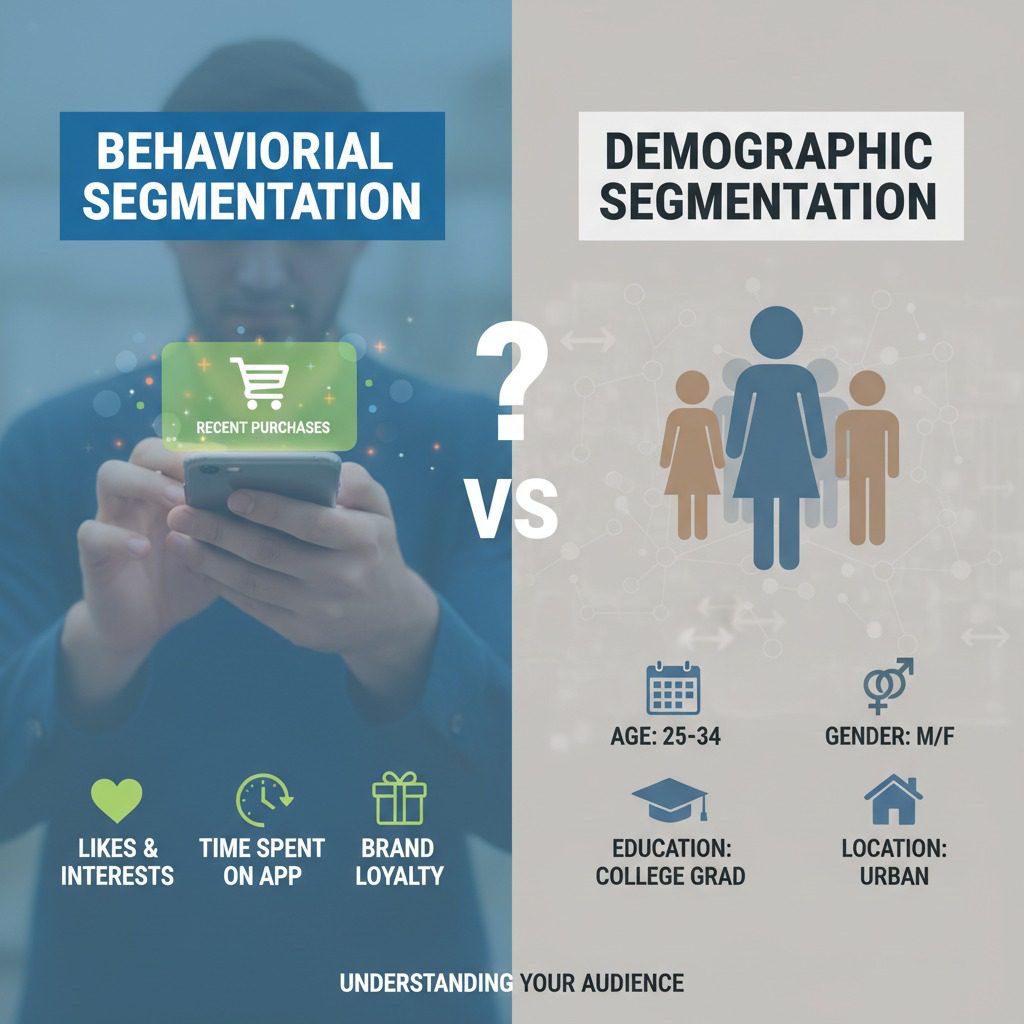
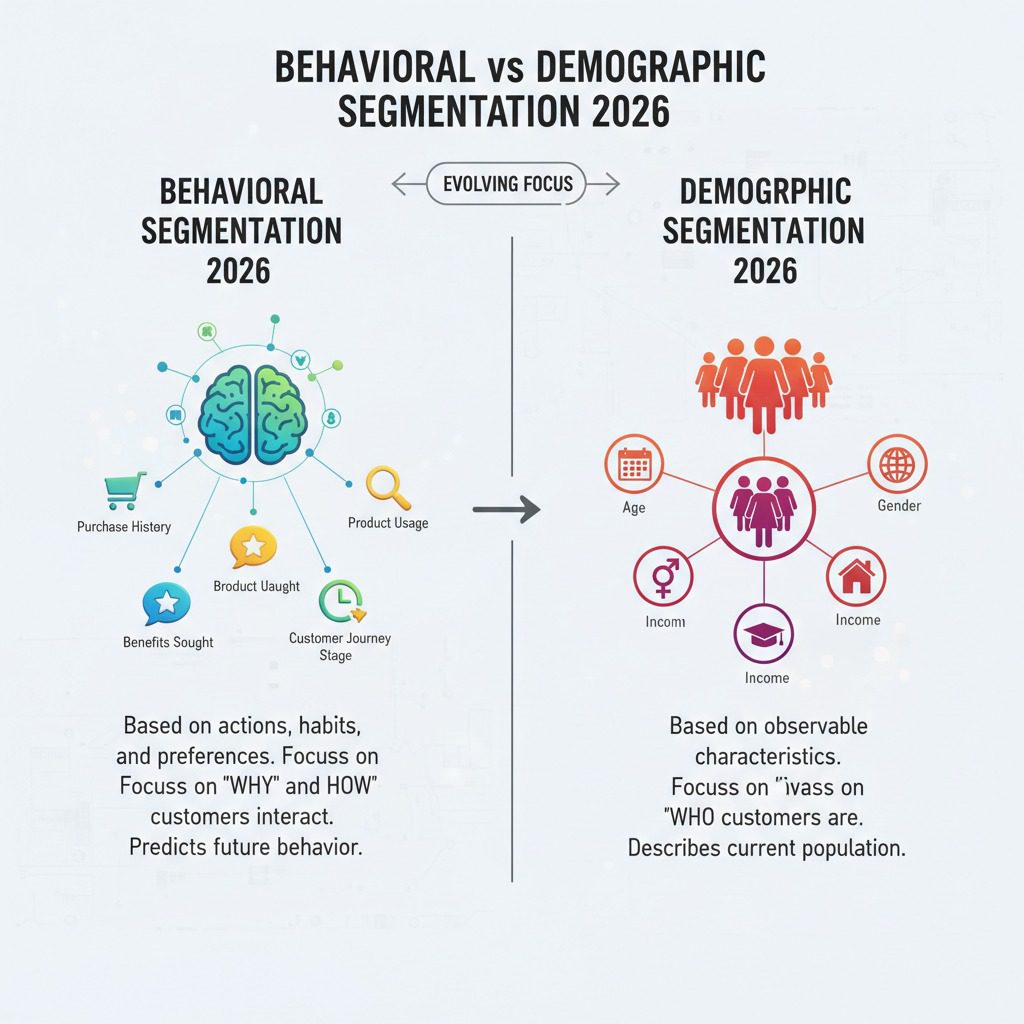
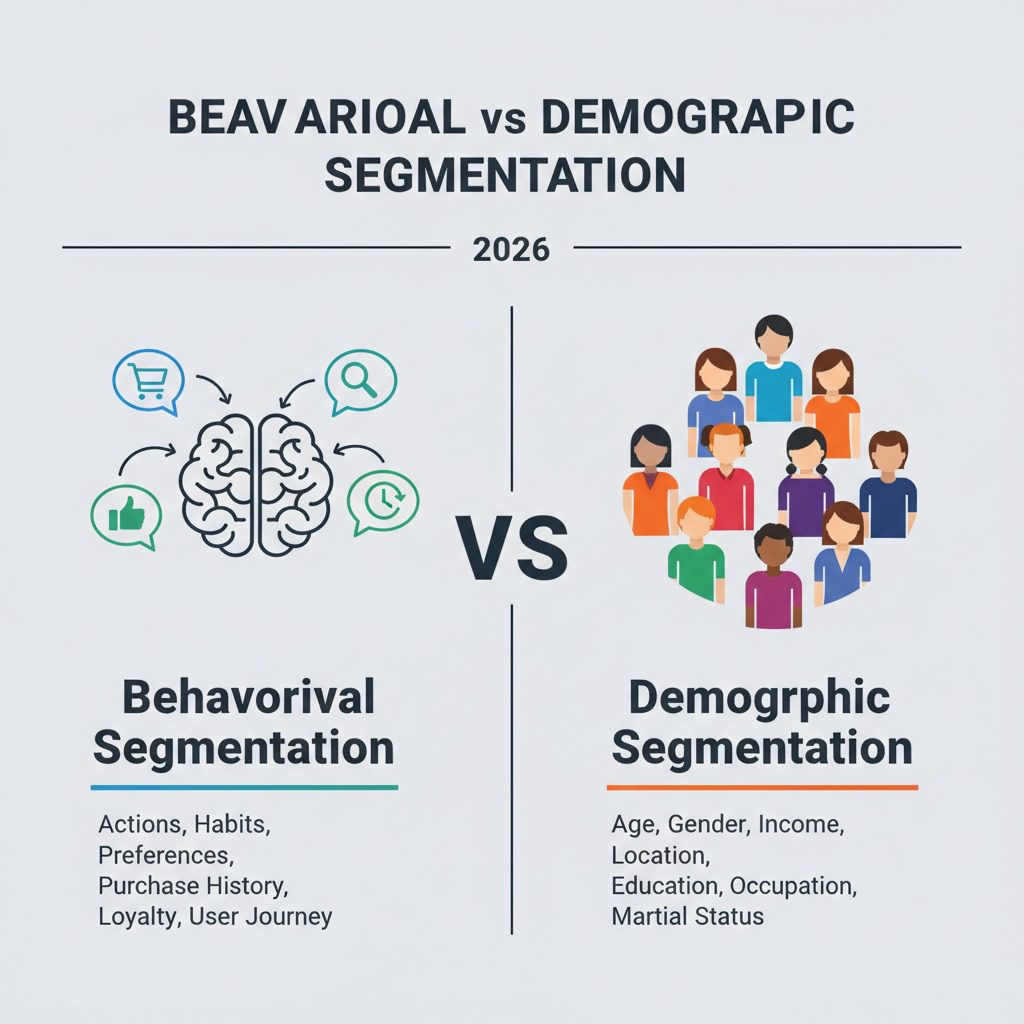
Behavioral
vs Demographic
Segmentation
Demographic data says who. Behavioral data says what. But neither one tells you why — and that gap is costing you more than you think. After twelve sources, one peer-reviewed Walmart study, and a cross-source synthesis that doesn’t exist anywhere else yet, here’s the full picture.
The Question Itself Was Wrong
For three years, the marketing industry has been debating “behavioral vs. demographic segmentation” like it’s a fair fight. It isn’t. But the reason it isn’t isn’t the one you’ve been reading about.
The standard argument goes: demographic data tells you who your customer is, behavioral data tells you what they do, and behavioral wins because intent beats identity. That’s correct. What the standard argument misses is the next level: most behavioral segmentation is also wrong — because it conflates two entirely different types of behavioral signal, and blending them destroys the precision that makes behavioral targeting worth the infrastructure investment.
This is the finding that came out of a peer-reviewed study presented at the ACM Web Conference 2025 by researchers working on Walmart’s promotion engine: when you segment by behavior alone, you’re still mixing two fundamentally different customer types — people who engage organically (they would have bought regardless) and people who engage because of your campaign (the only ones where your marketing actually moves the needle). arxiv.org/html/2602.12485 — ACM WWW ’25, DOI: 10.1145/3701716.3715243
When Walmart’s team built a two-stage model that separated these groups — and targeted only the prompted-intent segment — conversion success jumped over 100 basis points. Not by acquiring new customers. Not by expanding reach. By stopping the waste of marketing budget on people whose behavioral signals looked like high-intent but who were going to buy anyway.
A customer who spent 18 minutes on your product page and added to cart might buy because your email nudged them. Or they might have bought regardless — you just happened to send an email. Standard behavioral segmentation can’t tell the difference. The one that would’ve bought anyway still “converts” in your attribution model, making your campaign look successful while a meaningful chunk of your spend generated zero incremental revenue.
The behavioral-vs-demographic debate matters. But it’s been framed at the wrong level of resolution. The real question isn’t behavioral or demographic. It’s which behavioral signals, and what do they actually tell you about causation versus correlation?
Behavioral Segmentation’s Hidden Flaw
Here’s the thing nobody is writing about: behavioral segmentation has a measurement problem that looks identical to a success.
When you run an RFM-targeted email campaign and see a 9× repeat purchase rate compared to first-purchase conversion rates Envive.ai, 2026 — directional aggregate, that number includes both customers who bought because of your email and customers who bought despite never opening it. Your attribution model can’t tell the difference between the two. Both show up as conversions. Both get credited to the campaign. One of them is genuine lift. The other is statistical noise that happens to look like performance.
This is what the Walmart/ACM 2025 research team called the “missing label” problem: standard behavioral segmentation trains on customer behaviors without capturing the intent behind those behaviors. A customer who adds to cart and then converts in the same session might be organically motivated — they were going to buy regardless of any intervention. Or they might be campaign-responsive — the email or retargeting ad was the difference between converting and bouncing. These two customers look identical in a behavioral dataset. Walmart research, ACM WWW ’25 — peer-reviewed
A behavioral model trained only on what customers do — not why — systematically over-credits campaigns. It identifies “high-intent” behavioral signals (multiple product views, cart additions, return visits) as conversion predictors, then recommends marketing spend toward those signals. But some fraction of those signals already represent completed purchase intent — customers who converted organically. The campaign fires at them anyway, claims the conversion, and the model logs a win. You’re spending budget to confirm decisions that were already made. The return looks solid until you run a holdout test — and holdout tests are exactly what most marketing teams skip.
The practical implication is brutal: you are probably targeting some of your best customers the hardest, crediting those campaigns with conversions that would have happened anyway, and reporting inflated ROI. This isn’t a budget optimization problem. It’s a measurement architecture problem. And it happens specifically because standard behavioral segmentation conflates correlation with causation.
“Standard behavioral targeting finds customers likely to buy. Optimal targeting finds customers who need a reason to buy. Those are not the same group.”
Editorial synthesis — sources: Walmart/ACM WWW 2025 (DOI: 10.1145/3701716.3715243), Envive.ai (2026), ConvertCart practitioner analysis (2025)This matters even more because the fix exists. The Walmart model uses a two-stage architecture: first, separate active from inactive customers; then, separate organically-engaged from prompted-engaged customers via a label correction mechanism applied to customers who were exposed to campaigns outside their normal marketing window. The incremental precision — over 100 basis points on the platform’s success metric — came entirely from the second stage. From knowing why someone was engaged, not just that they were. arxiv.org/html/2602.12485
Demographic Targeting’s Slow, Invisible Death
Now for the case that behavioral targeting wins on — because the complication above doesn’t rescue demographic segmentation, it just exposes a flaw in naive behavioral segmentation.
Demographic targeting fails at the moment it matters most: predicting intent. A 34-year-old woman in Chicago with a household income over $80K can be in three completely different commercial states simultaneously — browsing casually, in active consideration, or never converting regardless of any intervention. The demographic profile is identical in all three states. The behavioral sequence is completely different. Acxiom, September 2025
The deeper problem is what Springer’s Information Systems and e-Business Management review (2023, updated with 2025 citations) identified: demographic data collected explicitly — age, income, lifestyle — is both difficult to obtain and inherently unstable. People change. Their demographic profile from two years ago is not their buying context today. Behavioral data, by contrast, is implicitly and continuously collected. It reflects the person’s actual current state, not their stated identity. Springer IS&eBM, 2023/2025
And then there’s the data infrastructure argument that’s been building since 2017 and is now definitive: the signal that powers demographic lookalike targeting is eroding from three directions simultaneously. Safari ITP blocks third-party cookies by default. Firefox does the same. Chrome reversed its forced deprecation in mid-2025 but still hosts an ecosystem where 33% of traffic already blocks cross-site tracking. leadgen-economy.com, Jan 2026 The UK’s CMA found publisher revenue running approximately 30% lower under Privacy Sandbox alternatives compared to traditional cookies. That differential accrues entirely against campaigns that depend on third-party behavioral data to build demographic profiles — which is exactly what most lookalike campaigns do.
The complication that keeps demographic relevant: When behavioral data comes from a small sample, demographic variables act as the bridge for scaling insights to larger audiences. Circana, November 2025 — an independent market research firm with no conflicting interest in this conclusion. Demographics also set category-level eligibility: a $4,000 watch campaign still needs to filter by income. The argument isn’t “demographics never” — it’s “demographics set the floor; behavior and intent do the work above it.”
| Method | What it tells you | Strongest use case | Evidence | ⚠ Critical limitation |
|---|---|---|---|---|
| Demographic | Who the customer is (identity proxy) | Category-level budget floor, audience universe definition | Strong | Can’t distinguish intent states. Lookalike pools degrade as 3rd-party signal erodes — invisibly over 12–18 months. |
| Behavioral — RFM | Purchase history patterns | Retention, reactivation, loyalty tiers | Strong | Cold-start problem for new customers. Mixes organic and prompted buyers — inflating apparent ROI without holdout testing. |
| Behavioral — session | Real-time on-site intent signals | Cart abandonment, on-site personalization | Moderate | 70%+ baseline abandonment. Signal window is narrow. Most signals don’t convert regardless of intervention quality. |
| Intent-layer (prompted vs. organic) | Whether marketing actually causes conversion | Promotion engine targeting, coupon allocation, retargeting budget | Strong — peer-reviewed (ACM 2025) | Requires holdout experiments to build the model. Operationally complex. Currently only practiced at enterprise scale. |
| Hybrid (demo + behavioral) | Scaled behavioral insights across large audiences | Large acquisition campaigns seeded by first-party behavior | Moderate | Inherits both method’s limitations. Lookalike degradation applies if seeded by 3rd-party behavioral data rather than 1st-party. |
The Third Thing: Intent Architecture
Three independent research threads converge on a finding that none of them states directly. Thread one: The Walmart/ACM 2025 model proves that separating organically-engaged from prompted-engaged customers — within the same behavioral segment — generates real incremental lift where standard behavioral targeting generates statistical noise. Thread two: The Springer IS&eBM systematic review identifies behavioral data as implicitly collected and continuously current, while demographic data is explicitly collected, static, and inherently dated. Thread three: The privacy infrastructure erosion documented across leadgen-economy.com, Ethyca, and eMarketer (2025–2026) shows that third-party signal — the foundation of demographic scaling — is degrading faster than first-party behavioral signal. The synthesis: The industry is converging on a three-tier hierarchy that nobody has named yet. Tier 1: demographic qualification (who is even eligible). Tier 2: behavioral targeting (what they’ve done). Tier 3: intent architecture (whether marketing will actually change what they do). Most companies are operating at Tier 1 or Tier 2. The competitive gap is opening at Tier 3 — and it’s a gap most marketing dashboards aren’t designed to measure.
The “prompted vs. organic” distinction from Walmart’s research is the clearest crystallization of what intent architecture actually means in practice. It’s not asking whether someone shows high-intent behavioral signals. It’s asking whether those signals indicate a customer at the margin — one where marketing intervention is the deciding factor — or a customer already past the decision point who will convert with or without you.
The downstream consequence is counterintuitive: your best-performing behavioral segments by conversion rate are likely your worst-performing segments by incremental ROI. The customers who look like they respond beautifully to your retargeting campaigns are often the ones who would have bought regardless. The customers who show moderate behavioral signals and get lighter marketing treatment are the ones where your spend actually changes behavior. Standard optimization algorithms can’t see this. They move budget toward apparent performance, which often means moving it toward organic buyers and away from prompted ones.
“The segment with the highest conversion rate isn’t necessarily the segment where your marketing mattered. It might be the segment where it was least needed.”
Editorial synthesis — sources: Walmart/ACM WWW 2025, ConvertCart practitioner analysis (Jul 2025), Springer IS&eBM 2023This finding has a practical corollary that most practitioners haven’t worked out yet: personalization engines that optimize only for conversion rate — rather than for incremental conversion rate — are potentially running in the wrong direction. They’re getting better at identifying people who were already going to buy, not better at changing outcomes. The gap between “optimized” and “actually optimized” is the entire size of the organic buyer population in your campaign audience. For mature e-commerce brands with strong retention, that can easily be 40–60% of a retargeting audience.
Attribution models are built to credit campaigns for conversions. They’re not built to ask whether the campaign caused the conversion. Multi-touch attribution, last-click attribution, even data-driven attribution — all of these answer “which campaigns touch converting customers?” They do not answer “which campaigns change behavior for customers who wouldn’t otherwise convert?” The second question is the one that determines actual ROI. Running on the first question while claiming the second is a widespread, expensive, and nearly invisible error — because the model produces credible-looking numbers regardless of which question it’s actually answering.
What to Actually Build
Three concrete priorities, ordered by available-now vs. requires-infrastructure.
Available now — holdout testing: You don’t need a two-stage neural network to start separating organic from prompted buyers. You need holdout groups. Before any retargeting or retention campaign, suppress a random 10–15% of the target audience from receiving it. After the campaign period, compare conversion rates between the holdout and the exposed group. The difference is your actual incremental lift. If the holdout converts at 4.2% and the exposed group converts at 4.8%, your campaign generated 0.6 percentage points of real lift on a much smaller base than you thought. This is the single most valuable thing most e-commerce teams aren’t doing. It also disproves bad campaigns faster than any optimization algorithm. ConvertCart, July 2025 — practitioner framework
6-month buildout — first-party behavioral infrastructure: The first-party data architecture question isn’t optional anymore. Session-level behavioral events (dwell time, scroll depth, search queries, cart interactions) captured in your own infrastructure — not through third-party pixels — are the foundation for everything above. Amazon expanded Marketing Cloud clean room access to SMBs in September 2025. eMarketer, January 2026 The tools exist at mid-market price points now. The 18-month data quality lag means starting in Q2 2026 gets you usable behavioral infrastructure by late 2027 — which is already behind competitors who started this in 2024.
12+ month buildout — intent-layer modeling: The Walmart model requires a specific data structure: customers exposed to campaigns outside their normal marketing window, so you can observe who converts organically. This is an experimental design question, not just an analytics question. You need persistent holdout groups, proper exposure tracking, and a label correction mechanism. This is enterprise-scale work at Walmart. It’s becoming mid-market work as ML tooling commoditizes. But it starts with the holdout discipline above — without clean holdout data, the label correction stage has nothing to correct against.
Stop Optimizing Conversion Rate. Start Optimizing Incremental Conversion Rate.
Here’s the painful audit to run on your best-performing behavioral campaigns: pull the last 90 days of your top retargeting segment. How many of those “converted customers” had already added to cart before your ad fired? How many had returned to the site twice without converting before the campaign touched them? Those customers were going to buy. Your campaign didn’t change their behavior — it just happened to be in the room when they converted.
What you do: Set up a persistent 10% holdout on your primary retargeting campaigns starting this week. No special tooling required — most ad platforms support holdout groups natively. Run it for 30 days minimum. Compare conversion rates. Then look at the revenue delta between holdout and exposed. That delta is your actual campaign value. If it’s close to zero, you have an organic buyer problem — and moving budget to lower-intent behavioral segments will likely outperform continuing to spend on people who didn’t need you.
The barrier: This feels like it’s going to make campaigns look worse. It is going to make campaigns look worse — in the short term. It will make them actually perform better in 6 months, because budget will flow to the segments where it genuinely matters. The conversation to have with leadership is about the difference between credited conversions and caused conversions. That’s a harder meeting than “here’s our 4.8% CVR.” Have it anyway.
The 18-Month Infrastructure Gap You Need to Explain to the Board Now
The strategic reality that doesn’t show up in quarterly planning: first-party behavioral infrastructure has a 12–18 month minimum lag between investment decision and usable data. If you haven’t made this investment yet, you’re not “behind” — you’re 18 months behind the companies that started in early 2025. The capability gap compounds. Every quarter they collect behavioral data, the precision of their intent models improves. Every quarter you operate on third-party demographic proxies, the signal degrades as privacy infrastructure tightens.
What you do: The budget ask isn’t for “data infrastructure.” It’s for a competitive response to a widening measurement gap. Frame it that way. The specific investment: server-side event tracking (bypasses browser restrictions), a CDP that unifies on-site behavioral events with purchase history, and the experimental infrastructure to run holdout groups at scale. None of this is exotic in 2026. The barrier isn’t tooling — it’s organizational will to admit that current attribution is measuring the wrong thing.
The 2028 scenario: Companies with intent-layer segmentation operational by 2027 will have two years of incremental lift data on their competitors. They’ll know which behavioral segments actually respond to marketing — and those are exactly the lookalike audiences that perform. Companies running demographic targeting in 2028 will be optimizing a signal that degrades automatically every time a privacy law passes or a browser updates its default settings. That divergence is already happening. It just hasn’t shown up as a visible competitive gap yet because reporting lags reality by 18 months.
The honest answer to “behavioral vs. demographic segmentation?” is: you’ve been asking the wrong question. The question isn’t which data type. It’s what your data actually tells you about causation versus correlation — and whether your measurement architecture is even capable of answering that question.
Demographic targeting is dying structurally because its data foundation is eroding faster than first-party alternatives. Standard behavioral targeting is performing below its apparent numbers because it can’t distinguish organic from prompted buyers. The companies operating at what we’re calling Tier 3 — intent architecture, holdout-validated incremental measurement, prompted vs. organic behavioral distinction — are building a competitive moat that’s almost invisible in current reporting and will be definitive in three years.
Most dashboards will keep showing solid numbers right up until they don’t. The decay is slow, invisible, and already underway.