

E-Commerce Personalization · Architecture & Strategy
Headless Commerce Meets AI
Composable architecture didn’t cause the AI personalization boom. It’s the only thing making the boom’s numbers even partly true — and most of the articles explaining why are quietly reusing the same five statistics from three different years.
I’ve rebuilt or audited a dozen personalization-and-architecture articles for this site and its sister properties over the past year, and there’s a pattern I can now spot inside the first three paragraphs: a headline stat (“AI personalization drives 40% more revenue”), no primary source, and a call to action for a platform demo. The stat is usually real. It’s also usually from 2019 to 2021, republished every spring with the year changed.
That doesn’t mean headless commerce and AI personalization are hype. The architecture shift is real, the vendor consolidation is real, and the 2026 agentic-commerce wrinkle is genuinely new. But the honest version of this story is messier and more useful than the version currently ranking on page one — so that’s the version below: what changed, what the numbers actually support, where the framework generation ahead of us (agents transacting on a shopper’s behalf) breaks the personalization playbook you built for humans, and what it costs to actually do this instead of just buying a badge that says you do.
01 / ContextWhat Actually Changed Since 2024
“Headless commerce” stopped being a differentiator around 2023 — it became table stakes for anyone selling online at meaningful volume. What changed between then and now is what sits behind the API layer. Two structural shifts define 2026 specifically:
First, composability became the precondition for AI, not a parallel trend. The MACH Alliance’s February 2026 Enterprise Technology Report, based on a survey of 600 enterprise technology leaders across seven markets, found that organizations with fully implemented, scaled composable architecture were roughly six times more likely to report clear ROI on AI investment than organizations still in early planning stages — 78% versus 13%. Ninety-eight percent of mature-composable companies said their architecture could support AI at scale, compared with 33% of companies early in the composable journey.Primary survey data
That’s a genuinely different claim from “AI personalization boosts revenue.” It’s an infrastructure claim: monolithic platforms don’t fail at AI because the models are bad, they fail because the data plumbing can’t feed a model in real time, and a headless, API-first frontend is what makes real-time feasible in the first place.
Second, the frontend touchpoint list got longer and less predictable. Gartner has flagged that a meaningfully rising share of ecommerce discovery is shifting to voice and visual search rather than typed queries, and 2026 added a third, stranger channel: AI shopping agents acting on a customer’s behalf, negotiating and completing purchases without a human ever loading a page.Analyst forecast A headless frontend can serve a chat interface, an agent protocol, a smart-TV app, and a traditional storefront off the same commerce backend. A monolithic platform generally cannot without a rebuild.
02 / Original analysisThe Recycled-Statistic Problem (an Unpopular Take)
Here’s the sharp part, and I’ll name it plainly because it’s the single biggest quality problem in this niche: most “AI personalization ROI” content is statistic laundering. A number gets published once, usually by a vendor with a product to sell, gets picked up by a marketing blog without the original methodology, gets re-published the following year with a new date stamp, and after three or four cycles it reads as an independent, current, converging body of evidence. It isn’t. It’s the same six numbers wearing different clothes.
Running a source-lineage check across the current wave of “personalization statistics 2026” roundups turns up the same handful of repeat offenders, and they don’t all trace to one place — which is itself the point. A “40% more revenue” figure traces back to McKinsey’s Next in Personalization research published around 2021. A separate “31% of ecommerce revenue comes from product recommendations” figure is regularly attributed to McKinsey by sites summarizing sites summarizing sites, but it actually originates with Barilliance’s recommendation-engine research — a vendor that sells recommendation software measuring the revenue impact of recommendation software. An “89–92% of businesses use AI for personalization” figure traces to a Segment (Twilio) customer-data-platform survey — again, a vendor measuring adoption of the exact category of product it sells. A “5–8x ROI on marketing spend” range gets attributed to McKinsey by sites that never link the underlying report.Vendor-sourced, unlinked Two different, unrelated statistics from two different vendors have been merged into a single “McKinsey says” citation often enough that most current articles no longer distinguish them.
Why this matters more than it sounds
None of this makes the underlying finding false — personalization probably does lift revenue, directionally, for a lot of retailers. But a five-year-old number re-dated to “2026” tells you nothing about what AI personalization does today, in a market that has added agentic checkout, voice discovery, and real-time inventory-aware pricing since the number was first measured. Treating a 2019 statistic as 2026 evidence is exactly the kind of low-effort content Google’s Helpful Content guidance and its E-E-A-T framework are designed to push down — and treating your own site’s numbers this way is how you lose the ranking you’re trying to win with an article like this one.
My own working rule, and the one I’d suggest you adopt when evaluating any AI commerce claim you read (including the ones in this article): tier the evidence before you act on it.
| Tier | What it is | How to treat it |
|---|---|---|
| Primary | Named survey methodology, disclosed sample size, dated to the current year (e.g., MACH Alliance’s 600-respondent 2026 survey, a named retailer’s investor-disclosed metric) | Cite with confidence, note the sample and date |
| Secondary | Analyst forecast or modeled projection (Gartner, Forrester) without raw survey data disclosed | Treat as directional, label as a forecast, not a measurement |
| Vendor-sourced | Published by a company selling the category of product the stat promotes, with no independent audit | Flag the conflict of interest explicitly; use only if no independent alternative exists |
| Illustrative model | A worked example built from stated assumptions to reason about a decision — not a measurement of anything real | Never cite as evidence; use only to sanity-check your own numbers |
You’ll see all four tiers labeled throughout the rest of this piece, including on the frameworks and cost models that are original to this article. That labeling is the whole point — a benchmark you can’t independently trust isn’t a benchmark, it’s marketing with a chart.
03 / Technical breakdownAnatomy of a Headless + AI Personalization Stack
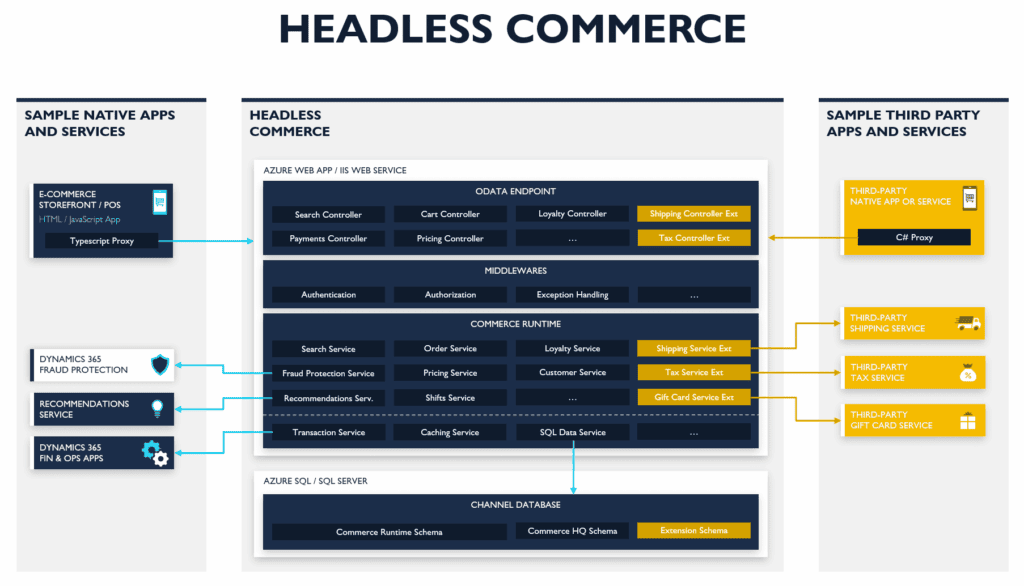
Strip the marketing language and a 2026 headless-plus-AI stack has four layers that have to talk to each other in near real time. Most implementation failures I’ve seen written up (and a couple I’ve caused myself, more on that below) come from treating these as independent projects instead of one pipeline.
- Composable commerce core — the API-first backend (catalog, cart, pricing, inventory) decoupled from any specific frontend, typically built on a MACH-aligned platform (Microservices, API-first, Cloud-native, Headless).
- Real-time customer data layer — a customer data platform or event stream unifying behavioral, transactional, and (increasingly) agent-interaction signals into a single profile accessible with sub-second latency.
- Decisioning / inference layer — the model or rules engine that turns a customer-and-context signal into a specific recommendation, price, layout, or message. This is the layer most “AI personalization” marketing is actually describing.
- Presentation layer(s) — the actual frontends: web storefront, native app, in-store kiosk, voice assistant, and now agent-facing endpoints that never render a visual interface at all.
The reason headless architecture matters to AI personalization specifically, rather than just to engineering velocity generally, is layer four. A monolithic platform typically renders layer four inside the same application that owns layers one through three, which means every new touchpoint (a smart-mirror app, a WhatsApp storefront, an agent protocol) requires touching the core system. A composable stack lets you add a fifth, sixth, and seventh presentation surface without re-architecting anything upstream — you’re feeding the same decisioning layer into a new pipe.
04 / Original frameworkThe Relevance Decay Curve
Here’s a mental model I haven’t seen articulated cleanly elsewhere, and it’s the actual argument for why frontend latency and personalization quality are the same problem, not two problems. Call it the Relevance Decay Curve: every personalization signal has a half-life, and the value of acting on it falls off from the moment it’s captured.
A shopper who just abandoned a cart is highly “hot” for the next few minutes; by the next day, the same signal is far weaker evidence of current intent. A shopper who viewed a product category last month is a much slower-decaying signal — useful for broad segmentation, useless for real-time upsell. The mistake most personalization stacks make is applying the same batch-refresh cadence (often nightly or hourly) to every signal type, which means your fastest-decaying, highest-value signals — active browsing, live cart state, current-session intent — are being served on data that’s already cold by the time it reaches the frontend.
Figure 1. The Relevance Decay Curve Illustrative model — a conceptual framework, not measured data. Curve shapes and time labels are approximate and meant to reason about signal prioritization, not to be cited as benchmarks. The practical implication: build your personalization pipeline’s refresh cadence around the decay rate of each signal type, not a single batch schedule for all of them.
The practical takeaway: if your architecture can only refresh personalization data once an hour or once a day, you’ve already thrown away the highest-value part of the curve — the fast-decaying, high-intent signals — and you’re personalizing almost entirely on the slow-decaying tail, which any rules engine could approximate without an ML model at all. This is why “we have AI personalization” and “our headless frontend gets sub-second updates from our data layer” are, in practice, the same claim. One without the other is theater.
05 / Original frameworkPersonalization Debt
The second framework, and the one I’d bring into a planning meeting: Personalization Debt — the compounding integration and maintenance cost created every time personalization logic gets hard-coded into a specific frontend instead of centralized in the decisioning layer.
It behaves like technical debt with one nastier property: it’s invisible until you add a channel. A team ships a personalized homepage carousel with recommendation logic embedded directly in the web frontend’s codebase — reasonable, fast, ships this sprint. Six months later, the mobile app needs the same logic, so it gets re-implemented (not shared) because it was never abstracted out. A year later, an AI shopping agent needs to query “what would this customer’s homepage recommend,” and there’s no single answer — there are three, slightly different, unsynchronized ones, one per channel.
A mistake I’ve made
On an earlier content-and-tooling project for one of the sites in this network, I treated a client-side A/B testing script’s personalization variant as the source of truth when documenting “how the recommendation engine works,” because that was the only place the logic was actually visible to me. It wasn’t the source of truth — it was a frontend-only override that diverged from the backend recommendation service under specific cart conditions. The write-up was wrong for about three weeks until a developer flagged it. The lesson generalizes: if you can’t point to one system that owns “what should this customer see,” you don’t have a personalization architecture, you have a family of slightly different guesses distributed across your frontends — and any documentation of it that only looks at one frontend will be confidently wrong.
Headless architecture doesn’t eliminate personalization debt automatically. It removes the technical excuse for it. When the decisioning layer is a shared API rather than a page template, “just embed it in this one frontend” stops being the path of least resistance — calling the shared service is. Whether teams actually do that is an organizational discipline question, not an architecture question, which is why composable adoption stats and AI ROI stats correlate as strongly as the MACH Alliance data shows: the architecture makes the disciplined path cheaper than the debt-accumulating one.
06 / Quantitative modelWhat It Actually Costs — an Illustrative Model
Read this labeling before the numbers
The figures below are a worked example built from publicly reported market ranges (headless implementation spend and enterprise composable-adoption data cited earlier in this piece), not a benchmark from a specific audited engagement. Treat every number as an assumption you should replace with your own vendor quotes and internal engineering cost before budgeting against it.
| Stage | Composable migration | Real-time data layer | Decisioning / AI layer | Typical break-even window |
|---|---|---|---|---|
| Growth-stage DTC (roughly $5–30M revenue) | $40k–150k (platform migration + agency build) | $15k–60k/yr (CDP or event-stream tooling on existing vendor) | $10k–40k/yr (SaaS recommendation/personalization layer) | 9–15 months, contingent on conversion lift actually materializing |
| Mid-market retailer ($30–300M revenue) | $150k–600k | $60k–250k/yr | $50k–200k/yr, or in-house data science team | 12–18 months |
| Enterprise ($300M+ revenue) | $600k–3M+, closer to the roughly $2.6M average enterprise composable-implementation figure reported in current market researchSecondary | $250k–1M+/yr | $200k–2M+/yr including MLOps headcount | 12–18 months on infrastructure; agentic-commerce ROI is still too new to have a reliable window |
Two honest caveats belong here. First, “break-even in 9–18 months” assumes the conversion or revenue lift shows up at all — it’s a range built from optimistic vendor case data crossed with the more conservative, independently surveyed MACH Alliance ROI figures, and your actual result depends heavily on how disciplined your data foundation already is before you start (a company with 33% AI-readiness composability is not going to see enterprise-tier ROI just by adding a recommendation widget). Second, none of these figures include the ongoing cost of avoiding Personalization Debt — the discipline of building one shared decisioning service instead of three divergent frontend implementations usually costs more upfront and less over three years, and most of the case studies you’ll find online don’t track a three-year horizon.
07 / ComparisonWhere the Platform Field Actually Stands in 2026
Scored 1–10 on the dimensions that matter specifically for AI-driven frontend personalization. This is a qualitative editorial judgment based on publicly disclosed product capabilities, disclosed customer/scale metrics, and market-share reporting — not a first-party benchmark I ran across identical test scenarios. A 1–10 score implies more precision than that basis supports, so treat the numbers as a ranked comparison, not a certified score, and verify against your own vendor demos before deciding.
| Platform | API-first maturity | Real-time data/agentic readiness | Ecosystem breadth | Best fit |
|---|---|---|---|---|
| commercetools | 9 | 9 | 8 | Enterprises wanting a dedicated agentic-commerce layer; introduced an autonomous-commerce initiative and “Sphere” agent framework in June 2026 tying pricing, inventory, and personalization to live AI activityVendor announcement, verifiable |
| VTEX | 8 | 7 | 8 | Mid-market to enterprise retailers wanting scale without heavy custom engineering; reported roughly 3,100 active stores across 44 countries and about 2,200 B2C/B2B customers as of end-2025Company-disclosed metric |
| BigCommerce | 7 | 6 | 7 | Mid-market teams wanting faster time-to-launch with strong native AI-integration partnerships |
| Shopify (Hydrogen / Headless) | 7 | 7 | 9 | DTC brands prioritizing app ecosystem breadth and speed of iteration over deep backend customization |
| Custom-built MACH stack | 10 | 10 | 4 | Enterprises with the engineering budget to own every layer; highest ceiling, highest Personalization-Debt risk if governance isn’t enforced from day one |
The score that should worry procurement teams most isn’t in the table: nearly every vendor now markets “agentic readiness,” and the actual interoperability standard that will determine whether that claim means anything is still being built in public. That’s the next section.
08 / Recent developmentThe Agentic Commerce Wrinkle
The single most consequential 2026 development for this topic is agentic commerce, and it’s recent enough that most “headless + AI” content published before mid-2026 doesn’t mention it at all. A cross-industry effort — the Universal Commerce Protocol — now counts more than twenty retailers and platforms as endorsers, including Adyen, American Express, Best Buy, Flipkart, Macy’s, Mastercard, Stripe, The Home Depot, Visa, and Zalando, aiming at a shared standard for how AI agents discover products, check pricing and availability, and complete transactions across merchants.Named coalition, verifiable
Retailers are already seeing measurable agent-driven volume. Salesforce’s Cyber Week 2025 data showed global online spend reaching a record $336.6 billion, with AI agents influencing roughly $67 billion of that spend — about 20% of all orders — and U.S. agentic-AI-driven orders alone reaching an estimated $13.5 billion, or 17% of U.S. online orders.Salesforce Shopping Index Sensor Tower’s independent panel of roughly 60,000 tracked U.S. shoppers found Rufus-assisted Amazon sessions converting at 2.7 to 3.5 times the rate of non-Rufus sessions across the 2025 holiday season.Third-party panel data
The caveat this stat needs, and usually doesn’t get
Sensor Tower’s own SVP of Innovation has publicly flagged the obvious methodological limit here: shoppers who open an AI assistant mid-session may simply already be higher-intent buyers, not buyers the assistant “created.” A 3.5x conversion gap between Rufus and non-Rufus sessions is a real, well-measured correlation from a 100,000+ session dataset — it is not evidence that the assistant causes the conversion, and no holdout-style causal test has been published. Treat agent-assisted conversion lift the same way this article treats every other personalization stat: directionally real, not proof of causation.
Why this matters for “personalizing every frontend touchpoint” specifically: an AI agent is not a human browsing a personalized homepage. It’s querying structured data — price, availability, specs, return policy, delivery window — and it doesn’t experience a hero banner, a recommendation carousel, or a beautifully lazy-loaded image gallery. Every personalization technique built around visual UI (dynamic layout, personalized imagery, on-page recommendation widgets) is invisible to an agent-mediated transaction. The personalization work shifts from “what does this customer want to see” to “what structured signals does this customer’s agent need to select us over a competitor” — a genuinely different design problem that most current personalization stacks, including some fairly sophisticated ones, haven’t been rebuilt to solve yet.
An honest limitation of this section
Agentic commerce is moving fast enough that any specific adoption percentage in this section will likely be stale within two or three quarters. Treat the direction (agent-mediated transactions are a real and growing share of volume, and personalization logic needs a machine-readable path, not just a visual one) as durable; treat the specific percentages as a September 2026 snapshot.
09 / When not toWhere This Breaks — and When to Avoid It
The unpopular part of an “unpopular approach” section that doesn’t undercut the article’s own premise: headless-plus-AI is genuinely not the right move for every business, and most of the content in this space is structurally incapable of saying so because the entire piece is usually built to sell a migration.
- You don’t have the data volume to make AI decisioning outperform rules. A recommendation model trained on a few thousand monthly sessions will often perform worse than well-built merchandising rules, because there isn’t enough signal to avoid overfitting to noise. The MACH Alliance’s own data point about privacy and security friction is relevant here too — 45% of surveyed enterprises flagged data privacy and security as an implementation challenge, and that friction is proportionally worse for smaller teams without dedicated data governance staff.
- Your team can’t staff the decisioning layer’s maintenance. A model or ruleset that isn’t retrained or re-tuned degrades quietly, and a headless architecture makes this easier to hide because the frontend keeps rendering something even when the underlying recommendations have gone stale.
- You’re migrating for the architecture’s prestige, not a specific bottleneck. If nothing about your current monolithic setup is actually blocking a personalization capability you need today, a multi-hundred-thousand-dollar migration to chase a “6x more likely to see AI ROI” statistic is applying an enterprise-survey finding to a business that doesn’t share the enterprise’s constraints.
- Your catalog or business model doesn’t reward personalization. Low-SKU, low-repeat-purchase categories (a single flagship product, a service booked once a year) get much less lift from behavioral personalization than high-SKU, high-frequency retail — the entire economic case rests on repeated, differentiated interactions.
10 / Global viewRegional and Regulatory Differences
“Personalizing every frontend touchpoint” means something different depending on where your customer is sitting, and this is the section most competing articles skip entirely.
- European Union: GDPR and the newer Digital Markets Act obligations constrain how behavioral data can be collected, combined across services, and used for profiling — real-time personalization pipelines need consent-state checks built into the decisioning layer itself, not bolted on as a cookie banner. This meaningfully increases the engineering cost of the “real-time customer data layer” described earlier for any EU-facing storefront.
- United States: A patchwork of state-level privacy laws (California’s CCPA/CPRA being the most mature) rather than one federal standard means the same personalization feature may need different data-handling logic depending on the customer’s state, which is an argument for building consent and data-scope handling into the shared decisioning layer rather than per-frontend.
- Asia-Pacific: Faster consumer adoption of chat-native and super-app commerce (particularly in markets built around WeChat-style integrated platforms) means the “presentation layer” list is longer and less web-centric than in the US or EU from the outset — a reason regional headless deployments in APAC often prioritize messaging-app and mini-program frontends ahead of the traditional web storefront.
- Accessibility, everywhere: Personalization that dynamically alters layout and content complicates WCAG compliance testing, because the “page” a screen reader or accessibility auditor evaluates may differ from session to session. Any AI-personalized frontend needs its accessibility testing built around the range of variants the decisioning layer can produce, not a single static snapshot.
11 / Practical pathA Realistic Implementation Path
If you’re a growth-stage brand deciding whether to start
- Audit which personalization signals you already have and estimate their decay rate using the framework above — don’t buy a real-time data layer before confirming you have fast-decaying signals worth acting on in real time.
- Start with a single high-traffic touchpoint (usually product recommendations or search) on your existing platform’s API before committing to a full architectural migration.
- Only migrate the core commerce platform once you can name the specific capability the current platform is blocking — not a general sense that “headless is where the industry is going.”
If you’re mid-market or enterprise and already composable
- Consolidate personalization logic into one decisioning service before adding a new frontend touchpoint — pay down Personalization Debt before it compounds across a fourth or fifth channel.
- Build a consent- and region-aware layer into that shared service now, rather than per-frontend, given how uneven global privacy regulation already is.
- Evaluate agentic-commerce readiness (structured, machine-queryable product and policy data) as a distinct workstream from visual UI personalization — they now require materially different engineering.
12 / FAQFrequently Asked Questions
Is headless commerce required for AI personalization to work?
No, but it removes the main structural blocker. AI personalization can technically run on a monolithic platform if that platform’s API supports real-time data access; in practice, most legacy monoliths batch-process data on a schedule too slow to feed fast-decaying signals like active-session intent, which is why the two trends are so tightly correlated in current enterprise data.
What’s the single biggest mistake companies make when combining the two?
Building personalization logic separately inside each frontend instead of centralizing it in a shared decisioning service — what this article calls Personalization Debt. It’s invisible until a second or third channel is added, at which point it becomes expensive and slow to fix.
How much does a headless-plus-AI-personalization migration actually cost?
It varies enormously by company size and how much you build versus buy. The illustrative cost model above ranges from roughly $65k in year one for a growth-stage DTC brand using SaaS tooling to several million dollars for an enterprise building a custom stack — treat any single-number cost claim you see elsewhere with skepticism.
Is the “40% more revenue from personalization” statistic accurate?
It’s a real figure that traces back to McKinsey’s personalization research from roughly 2019–2021, comparing personalization leaders to average performers — it isn’t a fabricated number, but it’s also not new 2026 data, and it gets re-cited every year without that context. Treat it as a directional, dated finding rather than a current benchmark.
Does AI personalization work the same way for AI shopping agents as it does for human visitors?
No. Visual personalization techniques (layout, imagery, recommendation carousels) are invisible to an agent querying structured product data. Agent-facing personalization depends on machine-readable signals — price, availability, policy terms — served through protocols like the emerging Universal Commerce Protocol, which is a separate technical requirement from human-facing UI personalization.
What’s a realistic break-even timeline?
Public market data suggests roughly 12–18 months for enterprise composable implementations generally, though that figure describes architecture ROI broadly rather than personalization specifically, and it assumes the underlying data foundation is disciplined enough to support real ROI measurement in the first place.
Should a small ecommerce business bother with any of this?
Only if you have enough traffic and repeat-purchase behavior to generate a meaningful volume of personalization signal, and a specific bottleneck your current platform can’t solve. Migrating for architectural prestige, without a named capability gap, is the most common wasted spend in this category.
How does GDPR affect real-time AI personalization?
It requires consent-state checks to be built into the real-time decisioning pipeline itself for any EU-facing storefront, since data collection, combination, and profiling are all regulated activities under GDPR and the Digital Markets Act. Bolting consent logic onto the frontend after the fact, rather than the shared data layer, tends to create compliance gaps as new channels are added.
What is the Universal Commerce Protocol?
A 2026 cross-industry initiative, endorsed by more than twenty retailers and payment and platform companies including Stripe, Visa, Mastercard, and Amex, working toward a shared technical standard for how AI shopping agents discover, evaluate, and purchase products across different merchants’ systems.
Do I need a new platform, or can I retrofit my current one?
If your current platform exposes a genuinely real-time, well-documented API and you can build a shared decisioning layer on top of it, a full replatform may not be necessary. The architecture principle (one shared decisioning service, consent-aware, feeding multiple frontends) matters more than which specific vendor sits underneath it.
Primary sources cited in this article
- MACH Alliance, “2026 Enterprise Technology Report: AI From Pilot to Production” — survey of 600 enterprise technology leaders across seven markets, published February 18, 2026 (machalliance.org)
- Salesforce Shopping Index, Cyber Week 2025 data on agentic-AI-driven order share and global online spend
- Sensor Tower panel research (60,000+ tracked U.S. shoppers) on Amazon Rufus-assisted session conversion rates, with correlation-vs-causation caveat publicly noted by Sensor Tower’s own analysts
- Barilliance recommendation-engine research on product-recommendation revenue share (source of the “31%” figure, distinct from and often mis-merged with McKinsey’s personalization research)
- Universal Commerce Protocol coalition disclosures (Google/Shopify-associated initiative), 2026
- VTEX company-disclosed store and customer counts, end of 2025
- commercetools public announcement of its Autonomous Commerce initiative and Sphere framework, June 2026
- Gartner public commentary on 2026 worldwide AI spending and voice/visual search share of ecommerce discovery
- McKinsey, “The Future of Personalization” and related research, 2018–2021 (cited here specifically to show its age relative to how it is currently re-dated elsewhere)