

9 Predictive Customization Strategies That Actually Work — Ranked by Real Results
Anticipating user needs before they’re expressed isn’t a feature. It’s becoming the baseline expectation — and the gap between companies that do it well and companies that don’t is growing faster than most realize.
- Why predictive customization is no longer optional
- How we ranked these strategies
- Behavioral Intent Modeling
- Contextual Signal Fusion
- Next Best Action Engines
- Propensity-Triggered Content
- Zero-Party Preference Architecture
- Collaborative Filtering at the Individual Level
- Temporal & Lifecycle Pattern Recognition
- Predictive Search & Navigation Shaping
- Churn-Predictive Retention Personalization
- Three mistakes that kill predictive systems
- Where to start
There’s a story that circulates in product circles — probably apocryphal, but instructive — about a shopper who once called Amazon’s customer service to complain that a recommended product had nothing to do with her interests. The rep checked her account and pointed out she’d spent 47 minutes examining similar items six weeks earlier without buying. She’d forgotten. The algorithm hadn’t.
That story captures something important about where we are. The best predictive systems don’t just remember what users did — they model why, then surface the right thing at the moment it becomes relevant again. That’s a fundamentally different problem from personalization as it was practiced five years ago, which mostly meant “show people content similar to what they clicked before.”
The commercial urgency is no longer debatable. McKinsey’s research consistently finds that companies excelling at personalization generate 40% more revenue from those activities than average performers — and that personalization most often drives 10–15% in revenue lift, with some sectors seeing up to 25%.
What’s changed more recently is the expectation gap. Contentful’s 2025 analysis found that 85% of companies believe they deliver personalized experiences, but only 60% of customers agree. That 25-point disconnect is where brands bleed loyalty without understanding why.
Predictive customization — specifically, the ability to surface the right thing before a user consciously forms a request — is the next layer above reactive personalization. It’s harder. It requires more data discipline, better modeling, and a genuine tolerance for being wrong sometimes. But the results, when done properly, are not incremental. They’re structural.
How these strategies are ranked
The nine strategies below are ordered by a combination of three factors: documented revenue or retention impact from verified cases, implementation complexity (inversely — simpler execution at equivalent results ranks higher), and how broadly applicable the strategy is across different industries and company sizes.
Where I’ve cited specific numbers, they come from published research, company disclosures, or verified case studies — not vendor marketing claims. Where the evidence is directional rather than precise, I’ve said so.
A note on the word “predictive”: I’m using it to mean systems that surface recommendations, content, or actions before a user explicitly requests them — based on behavioral patterns, contextual signals, or inferred intent. This is distinct from basic “you might also like” reactive recommendations, though the line between them blurs as systems mature.
Behavioral Intent Modeling
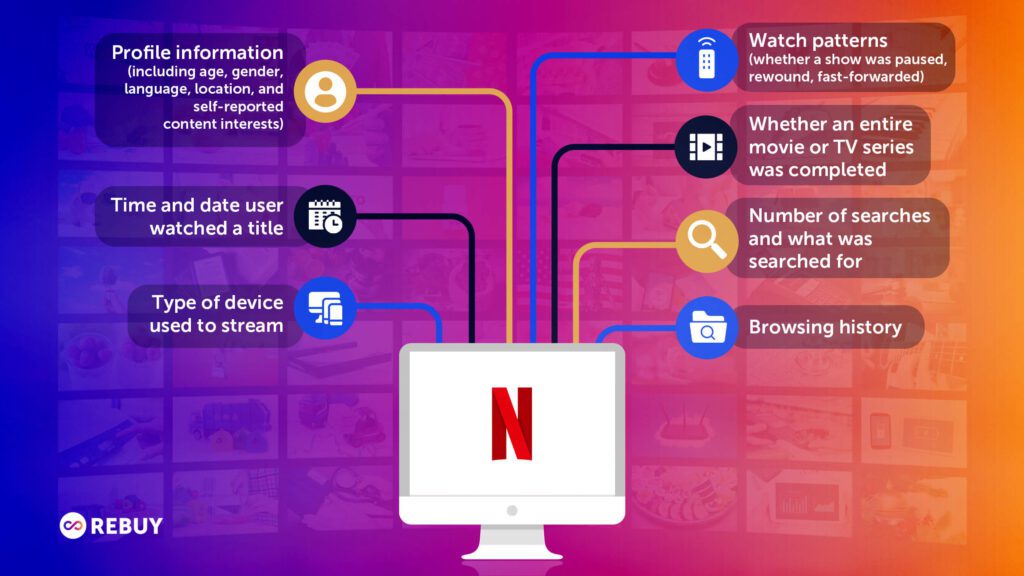
Behavioral intent modeling is the practice of analyzing micro-behavioral signals — dwell time, scroll depth, hover patterns, search query sequences, abandonment points — to infer what a user is likely to want next, even when they haven’t expressed it yet. It’s not about what someone bought; it’s about what their behavior pattern suggests they’re about to want.
Netflix is the most studied example. As of 2024, over 80% of content watched on the platform comes through its recommendation engine — a system built on over two decades of behavioral modeling. The engine processes signals like which thumbnails a user lingers on, which scenes cause pause-and-rewind behavior, and which genres they binge versus graze. None of this requires a user to say anything. It’s all inferred.
Amazon’s implementation is arguably even more commercially impactful. The company analyzes billions of customer interactions daily — purchase history, browsing sequences, wish lists, time-of-day patterns, and what other products customers examine before and after viewing a given item. The resulting recommendation engine generates an estimated 35% of Amazon’s total revenue.
What makes intent modeling rank first is its compounding nature. Better data creates better models; better models generate more engagement, which creates more data. It’s a genuine flywheel rather than a one-time investment.
The hard requirement: you need volume. Intent modeling becomes accurate at scale — typically after several hundred thousand user sessions at minimum. Companies without that data volume are better served by starting with strategy #5 (zero-party data) while building toward the dataset that makes intent modeling viable.
How thumbnail personalization demonstrated the power of behavioral intent
Netflix runs one of the more elegant illustrations of predictive customization in practice: it shows different thumbnail images for the same title to different users. Someone with a demonstrated preference for comedies sees a stills highlighting humor; someone with a drama preference sees something more emotionally charged. Neither user sees a generic marketing image.
The system works because it’s modeling not just what users watch but what visual signals predict a click from this particular person. The company found that if a user doesn’t find something engaging within 90 seconds of opening the app, they tend to disengage — so the thumbnail serves as the first predictive intervention, before a single word is read.
Contextual Signal Fusion
Contextual signal fusion means pulling together data sources beyond behavioral history — location, time of day, weather, device type, local events, calendar context — and using them to modulate what you show someone in real time. The premise is that the same user wants different things in different contexts, and a model that ignores context will underperform one that uses it even with identical historical data.
Starbucks’s Deep Brew platform is the most thoroughly documented example of this at scale. Deep Brew fuses weather forecasts, local event data, historical sales patterns, and individual order history to generate personalized drink suggestions and store-level promotions that vary by location and moment. In a now-frequently-cited example, the system predicted a heatwave in Memphis and proactively launched a regional frappuccino promotion — before any customer had requested something cold.
The business results from Deep Brew’s deployment are measured in specifics: a 12% average increase in ticket size and a 4% rise in same-store sales in Deep Brew-heavy locations, plus a 30% improvement in ROI on key AI-enabled initiatives. Mobile orders, now driven by predictive suggestions, account for over 30% of U.S. transactions.
The practical lesson from Starbucks is that contextual fusion doesn’t require proprietary data on every dimension — it requires thoughtful API integrations (weather, events, location) layered onto the behavioral baseline you already have. That combination tends to outperform either alone.
Next Best Action (NBA) Engines
Next Best Action engines take behavioral modeling a step further by recommending not just content or products, but the specific action a brand should take toward a customer at a given moment. Should we send an email? Make an offer? Surface a tutorial? Stay silent? The engine decides, in real time, based on predicted conversion probability, lifetime value impact, and churn risk.
The B2B world calls this “account-based intelligence.” In consumer markets, it’s the logic behind why your streaming app knows to send a “we miss you” discount exactly three days after you’ve stopped opening it (not two days, not five). The timing isn’t arbitrary — it’s the output of a propensity model trained on the historical success rates of different intervention timing windows.
McKinsey’s work with telecom operators found that analytics-driven NBA frameworks could increase revenues by up to 10% and customer satisfaction between 20–30%, with one operator achieving a 10% revenue uplift by reorganizing around 12 customer lifecycle squads each optimizing their own NBA logic.
NBA engines are expensive to build properly. They require clean, unified customer data, decision orchestration infrastructure, and ongoing experimentation. But companies that get them right tend to see the effects compound over time in ways that simpler personalization approaches don’t.
Propensity-Triggered Content Delivery
Propensity modeling — training a model to predict the probability that a specific user will take a specific action — is one of the more accessible entry points into predictive customization. Unlike full NBA engines, propensity-triggered content systems tend to focus on a defined set of high-value behaviors: purchase probability, churn probability, upsell acceptance probability.
The practical application is straightforward: once you know who is 70%+ likely to buy Product X in the next 30 days, you show them Product X prominently (or offer a time-limited incentive), rather than showing everyone a generic promotion and hoping for the best.
The evidence for this approach is well-documented. Research across multiple implementations shows lead scoring improvements averaging 20–30% in conversion rates. More specifically, Salesforce reports that companies using Einstein Scoring see 30% higher conversion rates.
Propensity models degrade over time as user behavior evolves, which means they require regular retraining. The teams that treat them as living systems — continuously updated against fresh outcome data — consistently outperform teams that train once and deploy indefinitely.
Zero-Party Preference Architecture
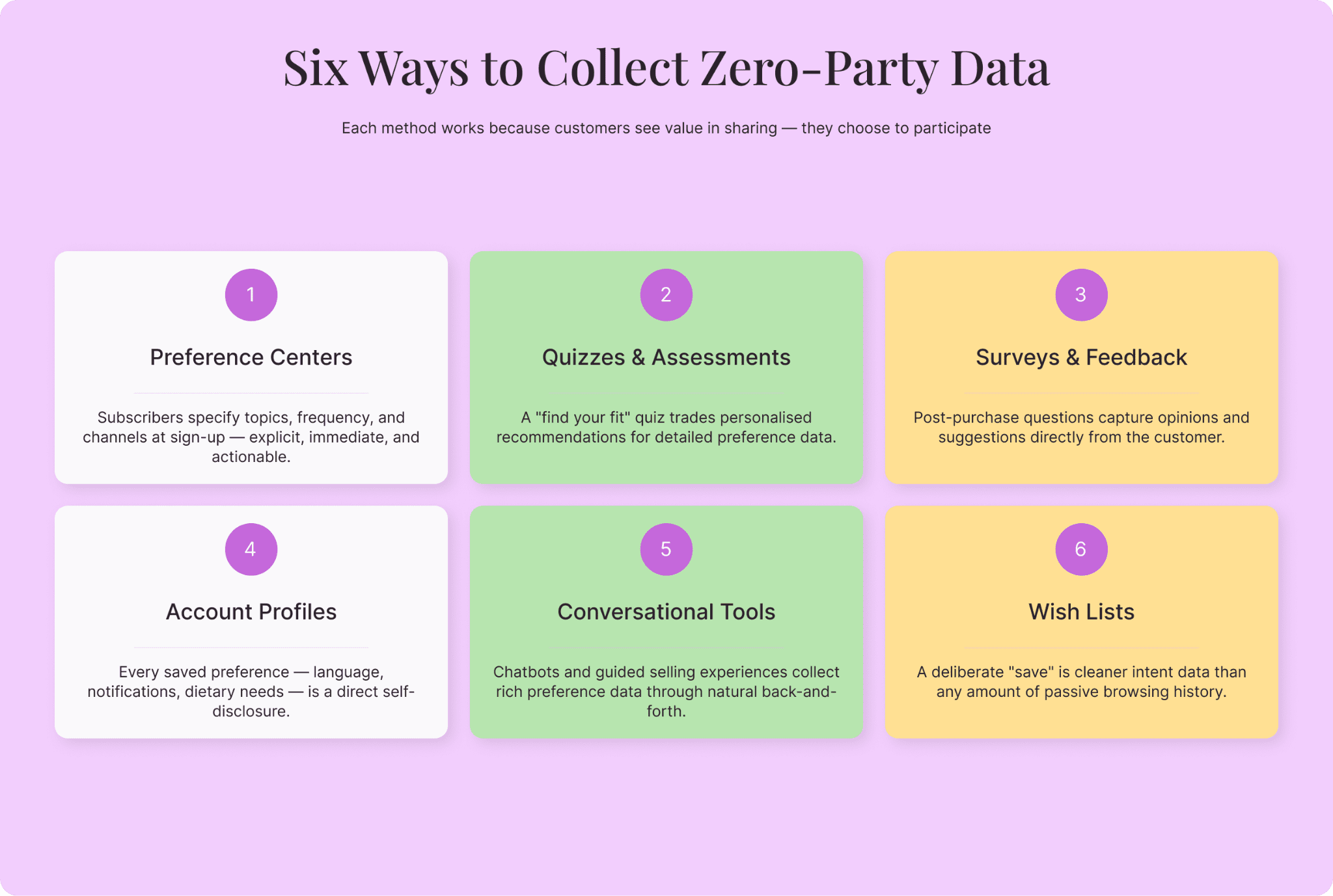
Zero-party data — preferences that users explicitly share with you — is the one predictive strategy that doesn’t require inferring anything. You just ask, and then you use the answer. The reason it remains underused is that most companies ask badly: long preference forms nobody fills out, or generic onboarding surveys with abstract questions.
The effective approach is designing micro-moments of preference capture that feel like part of the product experience rather than data collection. Spotify’s annual “Wrapped” engagement and its mid-session “tell us if this fits your mood” prompts are good examples. The data gathered is qualitatively different from behavioral inference because it’s intentional — the user is telling you something they consciously know about themselves, not something an algorithm deduced.
Gartner research suggests that by 2025, 80% of marketers will have abandoned third-party data in favor of first-party and zero-party strategies. That shift makes zero-party architecture not just a nice-to-have but foundational infrastructure. It’s also the strategy that, executed well, builds the most trust — users who volunteered their preferences know their experience reflects what they said they wanted.
One practical note: zero-party data needs maintenance. Preferences stated in a product onboarding form 18 months ago may no longer reflect reality. The best implementations build in periodic refresh prompts, triggered by behavioral signals that suggest drift between stated and actual preferences.
Strategy performance at a glance
| Strategy | Data Required | Typical Lift (Revenue/Retention) | Best Fit |
|---|---|---|---|
| Behavioral Intent Modeling | Large behavioral dataset (1M+ sessions) | 35–80% of revenue influenced | High-traffic platforms |
| Contextual Signal Fusion | Behavioral + real-time context APIs | 4–12% ticket size / same-store lift | Location-aware services |
| Next Best Action Engine | Unified CRM + behavioral data | Up to 10% revenue lift | Telcos, financial services |
| Propensity-Triggered Content | Conversion history, CRM | 20–30% conversion improvement | E-commerce, SaaS |
| Zero-Party Architecture | User-declared preferences | 10–20% engagement lift | Any stage / all sizes |
| Collaborative Filtering (individual) | Usage patterns across user base | 26% session revenue increase (engaged sessions) | Content platforms, retail |
| Temporal Pattern Recognition | Time-stamped behavioral logs | 15–25% churn reduction | Subscription services |
| Predictive Search Shaping | Search logs + intent data | 10–20% search-to-conversion lift | E-commerce, media |
| Churn-Predictive Retention | Engagement + subscription data | 15–25% churn reduction | Subscriptions, apps |
Sources: McKinsey & Co.; Barilliance; Amazon; Starbucks internal / analyst reports; Salesforce research. Ranges reflect variation across sectors and implementation quality.
Collaborative Filtering at the Individual Level
Collaborative filtering — the technique behind “users like you also enjoyed X” — is nearly 30 years old. But its modern implementation at the individual level is substantially different from its origins. Early collaborative filtering worked at the segment level: cluster users into groups, surface what the group liked. Modern collaborative filtering works at the user-of-one level, treating each person’s behavioral fingerprint as distinct enough to model individually.
The commercial impact is significant. Barilliance’s research shows that when customers actively engage with recommendation engines, revenue increases can reach up to 26% for those specific sessions. More broadly, product recommendations driven by collaborative filtering account for up to 31% of e-commerce site revenues according to the same analysis.
The technique’s practical advantage for mid-market companies is accessibility. Open-source collaborative filtering libraries are mature, and cloud-based recommendation services (AWS Personalize, Google Recommendations AI) have commoditized much of the infrastructure. The differentiation now comes from signal selection — which behavioral signals you feed into the model — rather than algorithmic novelty.
One thing worth noting: collaborative filtering is notorious for filter bubbles. Users who get only more of what they’ve already shown interest in can disengage when their taste evolves. The best implementations mix in a controlled “exploration” layer — surfacing items slightly outside a user’s established pattern — to keep recommendations feeling fresh rather than repetitive. Spotify Research has published useful work on this exploration-exploitation balance.
Temporal & Lifecycle Pattern Recognition
Temporal pattern recognition means modeling when users engage, not just what they do. A user who opens your app every weekday at 7:15 AM is displaying a habitual pattern. A user who hasn’t opened your app in 11 days when their average session gap is 3 days is displaying drift. Both signals are predictive — the first tells you when to serve something (and what kind of something: quick, low-friction), the second tells you something may need a re-engagement intervention.
Lifecycle pattern recognition extends this to broader customer journey stages: the “about to churn” pattern, the “ready to upgrade” pattern, the “exploring a new category” pattern. Each implies a different optimal action. The challenge is that lifecycle stages aren’t self-labeled — they have to be inferred from behavioral sequences, which requires enough historical data to build reliable transition models.
Churn prediction, when coupled with proactive retention campaigns, can reduce customer attrition by 15–25%. That’s a substantial figure — for a subscription business with high gross margins, a 20% reduction in churn is often worth more than a comparable percentage improvement in new customer acquisition.
The underappreciated application of temporal modeling is suppression: knowing when not to contact a user. Over-messaging drives opt-outs faster than almost any other factor. Temporal models that identify users in “low receptivity” windows — recently onboarded and still figuring out the product, or in a post-purchase rest phase — are as valuable as models that identify high-receptivity moments.
Predictive Search & Navigation Shaping
Most search implementations are reactive: a user types, the system retrieves. Predictive search shaping inverts this by modifying the search experience based on who is searching before they finish their query. Autocomplete suggestions weighted toward items that convert well for users with a similar behavioral profile. Category navigation reordered to surface the sections a particular user is most likely to want. Zero-query results — content or products shown before a user types anything — based on their history and context.
The impact on conversion is consistent in the literature. Query auto-complete powered by behavioral data (rather than just frequency) tends to lift search-to-conversion rates by 10–20% in documented implementations. The mechanism is friction reduction: anything that gets a user to a relevant result faster reduces the probability of abandonment.
For e-commerce specifically, Acxiom’s CX trends report shows that 51% of consumers like receiving tailored recommendations, while only 13% of brands currently use predictive personalization. That gap represents genuine competitive opportunity for companies willing to invest in search intelligence while most peers have not.
A practical starting point: analyze your existing search logs for sessions where users searched, didn’t convert, tried a second query, and then converted on that second attempt. The gap between search 1 and search 2 is often a predictive signal problem — the first query could have been better served if the system had predicted what the user actually wanted from their behavioral context rather than treating them as a first-time visitor.
Churn-Predictive Retention Personalization
Churn prediction is listed ninth not because its impact is small — it’s often enormous — but because its ROI calculation is different from the others. Rather than generating new revenue directly, it preserves existing revenue by identifying at-risk customers early enough to intervene effectively. For many subscription businesses, this is actually the highest-leverage application of predictive modeling available.
The general principle: most subscription customers don’t churn suddenly. They drift. Engagement frequency drops, session depth decreases, they stop using features they previously depended on. These behavioral signatures appear in the data before the cancellation, sometimes weeks in advance. A well-trained churn model can flag customers entering these patterns and trigger personalized retention interventions — not generic “we want you back” campaigns, but personalized content or offers based on what the user valued most when they were most engaged.
Netflix’s approach to churn prediction is worth examining specifically. The company enhanced transparency and user control after a measured 3% churn increase related to privacy concerns in 2024 — which illustrates an important truth about churn models: if they become visible in ways that feel manipulative, they can backfire. The intervention needs to feel helpful, not desperate.
The intervention needs to feel like the product understands you — not like the product is afraid of losing your subscription fee. Users are better at detecting the difference than most product teams assume.
— Observed across multiple SaaS and streaming retention studiesDocumented churn reduction from predictive retention programs consistently falls in the 15–25% range when interventions are personalized to individual value drivers rather than sent as blanket campaigns. The key variable is the specificity of the intervention: a user who primarily used your product for feature X should receive outreach that highlights feature X (or surfaces a new feature that complements it), not a generic discount.
Three mistakes that kill predictive systems before they deliver results
1. Dirty data treated as a model problem
The single most common failure mode in predictive customization — and the one most rarely acknowledged in vendor conversations — is poor data quality. Duplicate customer profiles. Events tracked inconsistently across mobile and web. Purchase data that doesn’t reconcile with behavioral data. CRM records full of incomplete fields.
A predictive model trained on this kind of data doesn’t just underperform. It learns the wrong patterns with high confidence, which is meaningfully worse than having no model at all. One retail brand case study described in Marketing Rewired captures this well: the company had all the right tools — a CDP, personalization engine, automation flows — but customer data riddled with duplicates and untracked events. The tools couldn’t save them.
The fix is unsexy but non-negotiable: data governance has to come before model sophistication. Start with a rigorous audit of your customer data quality before adding any predictive layer.
2. Over-personalization that feels surveillance-like
There’s a well-documented phenomenon in personalization research sometimes called the “creepiness threshold” — the point at which an experience that should feel helpful starts feeling like being watched. The specific trigger varies by user, but the pattern is consistent: when personalization surfaces information a user didn’t consciously share and didn’t expect a brand to have, the reaction is frequently negative regardless of how accurate the prediction is.
Data point worth knowing: Only 37% of customers trust brands with their personal data, according to Contentful’s 2025 research. Predictive systems that feel invasive can actively erode the trust foundation required for sustained engagement. Effective personalization should feel like the product understands you — not that it’s been reading your mail.
The practical implication is that personalization should be anchored to signals users understand they’ve created: their searches, their clicks, their stated preferences. Inferring things from third-party data sources or cross-device behavioral profiles without clear disclosure tends to produce exactly the trust deficit that makes the entire personalization investment counterproductive.
3. Building for the average case rather than the edge
Predictive models optimize for the median user. That’s by design — they’re trying to maximize accuracy across the distribution. But users at the edge of that distribution — the ones with genuinely unusual behavior patterns — get significantly worse predictions than average. Worse, they often get worse predictions with high model confidence, which can produce experiences that feel aggressively wrong rather than just slightly off.
Teams that measure only aggregate lift metrics (average CTR, average conversion rate) from their personalization systems often miss this. The right measurement framework includes performance segmented by user behavioral type, with specific attention to whether atypical users are being served appropriately or driven away by confidently wrong predictions.
Where to actually start: a practical framework
The nine strategies above aren’t a menu to pick from arbitrarily. They have a logical sequence based on data maturity, which is why some work for companies at any scale and others require significant investment before they become viable.
- Months 1–3: Audit data quality. Instrument behavioral tracking properly across all surfaces. Implement zero-party preference capture at onboarding. These create the foundation everything else depends on.
- Months 3–6: Deploy propensity-triggered content for your highest-value conversion event. Implement basic temporal pattern recognition to suppress over-messaging and identify high-receptivity windows.
- Months 6–12: Move toward individual-level collaborative filtering for product/content recommendations. Begin building a churn early-warning system. Start collecting the data infrastructure needed for contextual fusion.
- Months 12–24: With sufficient data maturity, move toward behavioral intent modeling at the micro-signal level. Begin integrating contextual signals (weather, location, time). Plan for NBA engine architecture if the business model justifies it.
- Ongoing: Establish a governance cadence for model retraining. Measure personalization performance by user segment, not just aggregate. Build feedback loops that feed user outcomes back into model training.
One honest caveat: the timelines above assume competent teams with access to clean data and organizational buy-in. In practice, the biggest delays in predictive customization programs are organizational rather than technical — getting data engineering, product, and marketing working toward the same modeling objectives takes longer than the modeling itself. Budget for change management as much as for technology.
On the privacy dimension
This can’t be an afterthought. With 80% of marketers moving away from third-party data by 2025 and privacy regulation continuing to tighten across the EU, UK, and increasingly in US states, the long-term trajectory of predictive customization is toward first-party and zero-party data foundations.
This is actually good news for companies willing to build the infrastructure. First-party behavioral data, collected transparently and with user understanding, is a genuine competitive moat. It can’t be scraped, can’t be purchased from a data broker, and improves with every additional user interaction. Companies that build this properly now will have structural advantages over competitors who relied on third-party data and are now scrambling to replace it.
The practical implication: every predictive customization investment should be evaluated against the question “does this work in a cookieless, consent-first data environment?” If the answer is no, it’s a short-term fix, not a durable strategy.
The direction of travel
Predictive customization in 2026 is in an interesting position: the techniques are mature, the evidence is strong, and the infrastructure is increasingly accessible. What’s still scarce is the discipline to implement it properly — with clean data, realistic expectations about what models can do, genuine attention to privacy, and the organizational alignment to sustain it past the initial deployment.
The companies that are executing this well right now — Netflix, Amazon, Starbucks, Spotify — share a common trait that isn’t really about technology. They treat user behavior as a signal to be understood rather than just exploited. Their predictive systems feel good to users because they’re genuinely trying to be useful, not just to optimize a conversion metric.
That orientation — building predictive systems in the service of the user’s actual needs, not just the business’s short-term goals — turns out to be the one strategic decision that determines whether the whole thing compounds positively or creates the backlash that undermines it. The nine strategies above can all be implemented in either spirit. The results are very different depending on which one you choose.
The predictive analytics market is expected to cross $100 billion by 2034, growing at over 21% annually. The companies building that foundation now, with the right data discipline and user orientation, will be the ones who own the compound advantage at the other end.
— MediaNews4U, November 2025More from AI Personalization Cloud
Deep-dive resources on predictive experience design, AI strategy, and personalization implementation
How to build, train, and validate intent models on first-party behavioral data — with architecture patterns for different traffic volumes.
Designing preference capture that users actually engage with — without disrupting the product experience or triggering privacy concerns.
A practical breakdown of NBA engine design, infrastructure requirements, and how to measure whether yours is actually working.
Why most churn models underdeliver and how to design interventions that feel helpful rather than desperate — with SaaS and streaming case templates.
Modern approaches to individual-level collaborative filtering, the exploration-exploitation tradeoff, and how to avoid the filter bubble problem.
What infrastructure you actually need — CDPs, event tracking, feature stores, and model serving — and what you can skip at different maturity stages.
Breaking down the “40% more revenue” finding and translating the research into sector-specific benchmarks that are actually comparable to your situation.
How to build robust predictive systems that work without third-party cookies, comply with GDPR and US state privacy law, and still deliver strong results.
Why aggregate lift metrics mislead and how to build a measurement framework that catches underperformance in specific user segments before it compounds.
Ethical AI Personalization: How Companies Protect Data While Enhancing User Experience
The 15 Hyper-Personalization Principles That Separate Good From Great
AI That Evolves With You — Adaptive Intelligence and What High Performers Are Doing Right Now
GDPR and AI Personalization: What Every Business Must Know Before Using Customer Data
From Chaos to Clarity: How Workflow Efficiency Systems Are Transforming Companies
Async Doesn’t Break Anything—It Just Stops Hiding Incompetence
From Data to Decisions: How AI Integration Transforms Business Intelligence
15 AI Personalization vs Data Privacy Mistakes Silently Destroying Your Results