
AI That Evolves With You — Adaptive Intelligence and What High Performers Are Doing Right Now
Most AI deployments freeze the moment they go live. The 6% of organizations actually seeing transformative returns are doing something fundamentally different: they’ve built systems that keep learning long after launch, shaped by every individual they touch.
1. What Adaptive Intelligence Actually Means
There’s a word that gets attached to almost every AI product right now: personalized. But personalized and adaptive are not synonyms, and confusing them is costing companies a lot of money.
Personalization, in the way most enterprise software uses the term, means segmenting users into buckets and serving each bucket a slightly different experience. Demographic targeting. Rule-based logic. Static preference profiles. It’s not nothing, but it does freeze at the moment of configuration.
Adaptive intelligence is something more specific and honestly more demanding. It describes AI systems capable of modifying their own behavior, weights, and outputs in direct response to the continuous, individual-level behavior of each user — without manual retraining cycles. A January 2026 Perspective in Nature Neuroscience draws the analogy explicitly: adaptive intelligence envisions AI that, like animals, learns online, generalizes, and adapts quickly. The paper reviews brain-inspired approaches — things like online meta-learning, continual learning, and predictive coding — as templates for building systems that can genuinely respond to novelty rather than just pattern-match against historical data.
The practical upshot is that an adaptive system does something a personalized system doesn’t: it gets measurably better for you specifically the longer you use it. And that distinction is now showing up clearly in revenue data.
That last figure — the Gartner 25% performance advantage — has been cited so often it risks becoming wallpaper. But the mechanism behind it matters. It’s not magic. It’s the compounding effect of a system that improves for every user interaction, versus one that sits still between quarterly model updates.
Adaptive Intelligence: an AI system architecture that continuously ingests user-level behavioral signals, updates its inference or reward model accordingly, and modifies its outputs without requiring manual retraining — doing this per-individual rather than per-population segment. The key distinction from standard ML: the feedback loop closes at the individual level, not the population level.
2. The Mechanics: How AI Actually Learns From Individual Users
When people ask how adaptive AI works, they often get a hand-wavy answer about machine learning and feedback loops. Let’s be more precise, because the specific mechanisms matter enormously for deciding what to build.
The five-layer adaptive loop
Adaptive systems in practice tend to operate through five distinct processes, even when they’re described differently by different vendors:
- Behavioral signal ingestion
Every interaction becomes data: clicks, scroll depth, time-on-element, query phrasing, sequence of actions, dismissals, micro-hesitations before a decision. Not just explicit ratings — implicit signals are often richer. A user spending 90 seconds on a product page before leaving tells you something explicit thumbs-up/thumbs-down ratings never could.
- Individual preference modeling
The system builds a latent representation of each user’s preferences — what researchers at the University of Washington call a “latent variable” approach. Their 2024 paper on Variational Preference Learning (VPL) formulates this as a Bayesian inference problem: given a few observed interactions, infer the hidden user context, then condition all outputs on that inferred context. This is far more powerful than segment-based approaches.
- Dynamic output adjustment
The model adjusts its next output based on that inferred preference state. In a recommendation system this means re-ranking candidates. In an LLM interface this means adjusting tone, depth, and framing. In a UI it means reorganizing elements. The adjustment happens in inference, not training — which is why it can happen in real time.
- Outcome monitoring and reward signal extraction
Did the adjusted output work? Did the user engage more, complete the task, return the next day? These outcomes feed back as reward signals. Online Iterative RLHF — now standard practice at the frontier model level — runs this cycle continuously rather than in discrete training batches.
- Model evolution with drift detection
User preferences change. A good adaptive system detects when its current model of a user has drifted from their actual behavior — seasonal changes, life events, evolving tastes — and adjusts its confidence accordingly. Systems that lack drift detection eventually become confidently wrong, which is worse than being uncertain.
Collaborative vs. individualized: an important tension
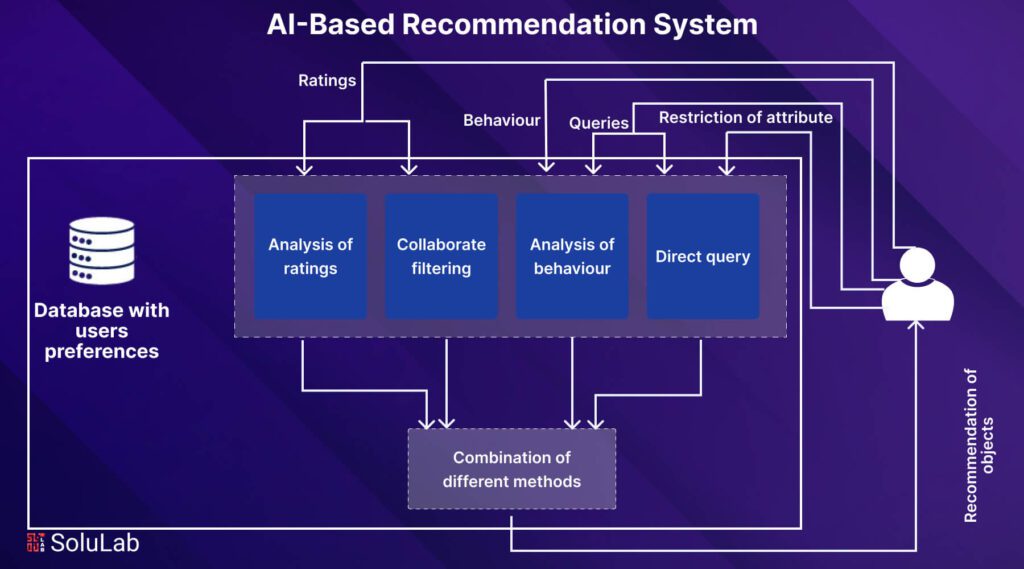
Most production recommendation systems still use collaborative filtering — finding similar users and borrowing their signal. It works well at scale but has a known failure mode: it regresses individual preferences toward the mean. You stop getting recommendations for genuinely niche tastes and start getting whatever 80% of people with a vaguely similar profile tend to like.
The frontier in 2026 is hybrid architectures that blend collaborative signals with per-user latent models — running shared low-rank adaptation layers (LoRA-style fine-tuning at the user level) alongside a shared backbone. You get the data efficiency of population-level training with the specificity of individual preference modeling. Computationally expensive, but increasingly feasible as inference costs drop.
This is one of the more honest admissions in recent ML research. The dominant training paradigm — optimize for an aggregate human preference signal — is structurally incapable of serving individual users well. Adaptive intelligence is, in part, a correction to that original design limitation.
3. What the Top 6% Are Doing — and the Rest Aren’t
McKinsey’s 2025 State of AI survey covered 1,933 organizations. Of those, only 109 — roughly 5.5–6% — reported generating more than 5% EBIT impact from AI while simultaneously describing “significant” value creation. This cohort is small enough that its behavior patterns are legible. Here’s what actually separates them.
| Behavior | High Performers | Everyone Else | Multiplier |
|---|---|---|---|
| Senior leadership engagement in AI initiatives | Strong | Weak | 3× more likely |
| Fundamentally redesigned workflows (not bolt-on AI) | Yes, 79%+ | 21% of all orgs | 3× more likely |
| Digital budget allocated to AI | >20% | <10% | Top third invest 20%+ |
| Sets growth/innovation as AI objective (not just cost) | Yes | Efficiency only | Significantly higher |
| Scaling AI agents across functions | Active | 73% not using agents | Early adoption edge |
| Transformative change ambition | 50%+ intend to transform | Incremental | 3.6× more likely |
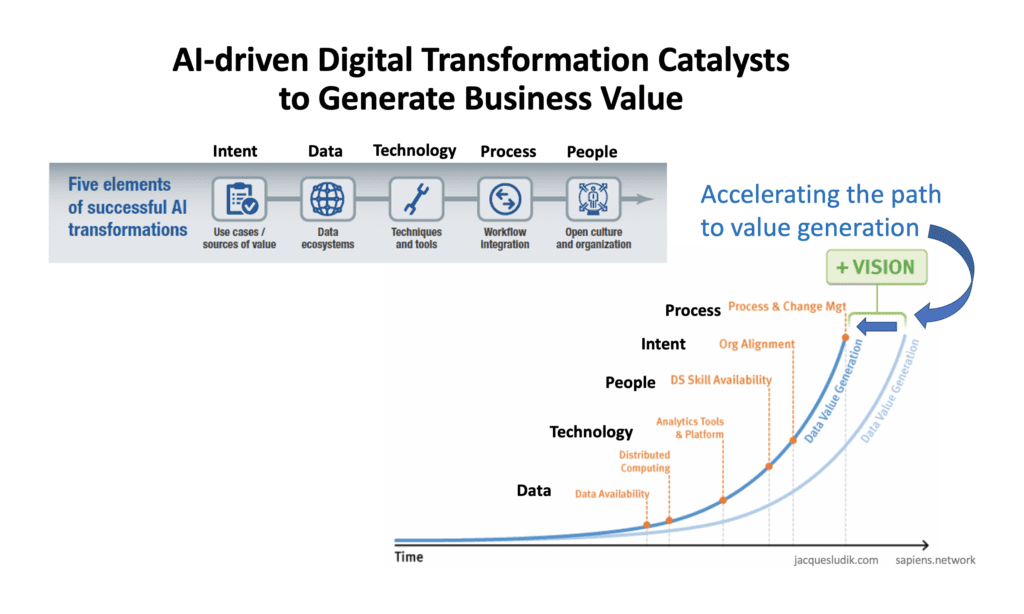
The data pattern is unambiguous: high performers are not using better algorithms. They’re making different organizational choices. The technology is largely available to everyone. The differentiator is whether leadership is willing to actually rebuild how the organization works around AI capabilities — including adaptive, continuously learning systems — rather than layering them on top of existing processes.
The McKinsey data is emphatic: the single strongest predictor of enterprise-level AI impact is whether an organization fundamentally redesigned its workflows when deploying AI. Not model sophistication. Not data size. Not budget. Workflow redesign. This applies directly to adaptive AI: you cannot deploy a continuously learning personalization system and expect it to thrive if the surrounding processes still assume static model behavior.
What “workflow redesign for adaptive AI” actually looks like
It’s worth being concrete here because the phrase “redesigned workflows” gets thrown around as if it means switching from Excel to a dashboard. For adaptive AI, it means something more structural:
- The feedback loop from user behavior to model update is part of the product spec, not an afterthought in an engineering ticket.
- Data pipelines are built to capture individual-level behavioral signals in real time — not batch-aggregated for periodic model retraining.
- There are explicit humans-in-the-loop for monitoring model drift, bias amplification, and cases where the system is confidently wrong.
- Success metrics track user-level outcomes (did this individual achieve what they came for?) not just aggregate engagement rates.
- Privacy architecture is decided before data collection begins, not retrofitted afterward.
4. Real Cases: Where Adaptive Intelligence Is Actually Working
Abstract data is useful. Concrete examples are more useful still. Here are four well-documented cases, with honest descriptions of what they’re actually doing and what the results look like.
Spotify’s Hybrid Adaptive Architecture
Spotify’s recommendation infrastructure — the engine behind Discover Weekly, Daily Mixes, and now Daylist — represents one of the most studied adaptive personalization systems outside of academic research. The architecture combines collaborative filtering (comparing your listening patterns against a graph of 700+ million users) with per-user temporal modeling that tracks how your preferences evolve over weeks and months.
The detail that most coverage misses: Spotify doesn’t just recommend based on what you’ve liked. It models the context of your listening — commute patterns, workout sessions, late-night focus sessions — and develops separate preference models for each context. Adaptive here means the system progressively refines its understanding of which context you’re in based on behavioral cues (time of day, consecutive track skips, session length) rather than requiring you to explicitly set a mode.
In Q3 2025, Spotify reported 713 million monthly active users and 281 million premium subscribers growing 12% year-over-year. Their SEC filing explicitly identifies “our ability to provide personalized content” as a core business risk factor — which, in corporate disclosure language, is an admission that personalization is existentially important to the business model.
Netflix: 80% of Watch Time Driven by Adaptive Recommendations
Netflix’s recommendation system is perhaps the most frequently cited example in this space, and for good reason: it reportedly accounts for more than 80% of what subscribers actually watch. The architecture behind this is not a single algorithm but a layered ensemble — collaborative filtering to understand genre and format preferences, content-based filtering to match specific attributes (director, cast, pacing, narrative structure), and a ranking layer that adjusts in real time based on session-level signals.
What’s adaptive rather than merely personalized: Netflix continuously updates its model of your preferences based on viewing completions, pause points, and rewatch behavior — not just star ratings, which users rarely provide. If you habitually abandon thrillers after 40 minutes but finish every documentary regardless of length, the system encodes that. And it encodes it at a granular level that segment-based personalization cannot achieve.
The business case is stark: Netflix estimates that this saves roughly $1 billion annually in subscriber retention. That figure, from their own research, has been widely cited in the academic literature on recommendation systems and has held up to scrutiny.
Adaptive Clinical Decision Support
Healthcare is where adaptive AI gets genuinely difficult and genuinely high-stakes. The challenge is that a system learning from individual clinician behavior can encode bad habits as well as good ones. Microsoft Research’s 2025 paper on AI in clinical environments is unusually candid about this: agentic behavior introduces new risks that must be mitigated through “clinician-in-the-loop validation” — you cannot let the adaptive loop run fully unsupervised in high-stakes clinical settings.
Where adaptive clinical AI is proving valuable: adaptive testing protocols in chronic disease management, where the system adjusts the frequency and focus of patient assessments based on individual response patterns rather than population-average schedules. Patients whose blood glucose data shows particular volatility get more frequent check-ins; stable patients are flagged less often. The system learns each patient’s baseline. This is the right scope for clinical adaptive AI in 2026 — incremental, supervised, with clear human override.
Adaptive Risk Modeling in Lending
Financial institutions are deploying adaptive models for credit risk in ways that would have been implausible five years ago. Traditional credit scoring is a one-shot snapshot — it looks at your financial history at a point in time and produces a static score. Adaptive lending models update their assessment of borrower risk continuously as new behavioral signals come in: payment timing patterns, account balance trajectories, and for some models, consented behavioral signals from mobile devices.
The key regulatory constraint, which is shaping this sector’s adaptive AI adoption more than any technical limitation: in most jurisdictions, adaptive models must be explainable. If your credit line changes because the model learned something about your behavior, you have a right to know why. This is pushing lenders toward model architectures that are adaptive but interpretable — gradient boosted trees with dynamic feature weighting rather than opaque neural networks.
5. The Technology Stack Enabling This in 2026
You can’t understand what high performers are doing without understanding the technical infrastructure they’re building on. The components that didn’t exist at commercial scale three years ago are now table stakes for serious adaptive AI deployments.
Online learning and continual fine-tuning
Traditional ML training happens offline: collect data, train, evaluate, deploy, repeat monthly or quarterly. Online learning closes that loop dramatically — models update their weights or parameters from streaming data without being retaken offline for full retraining. The practical version most organizations use is continual fine-tuning: a pre-trained base model is kept frozen while lightweight adapter layers (LoRA, adapters, or prefix tuning) update continuously from user interaction data. This is computationally feasible at scale in 2026 in a way it simply wasn’t in 2021.
Retrieval-Augmented Generation (RAG) with user-scoped retrieval
For LLM-based adaptive systems, RAG is becoming the primary mechanism for per-user adaptation. Rather than fine-tuning model weights per user — expensive and slow — the system maintains a user-scoped knowledge store: preferences, past interactions, expressed constraints, inferred context. Every generation call retrieves from this store first. The “learning” happens in the store, not the model. This is a pragmatic trade-off: less powerful than true per-user fine-tuning, but deployable at scale and far easier to audit.
Vector databases and real-time embedding updates
The underlying infrastructure for adaptive personalization at scale is the vector database — systems like Pinecone, Weaviate, and Chroma that store dense numerical representations of user preferences and item characteristics, and retrieve the most semantically relevant matches in milliseconds. In 2026, these systems are increasingly running real-time embedding updates: as a user interacts, their preference vector is updated in-place, and subsequent recommendations reflect that update within seconds.
Feature stores with low-latency serving
Adaptive AI is only as good as the signals it has access to at inference time. Feature stores — systems like Tecton, Feast, or Hopsworks — have become critical infrastructure for organizations serious about personalization. They maintain up-to-date, pre-computed feature representations of each user that can be retrieved in under 20 milliseconds at serving time. Without this, you’re either serving stale features or computing them on-demand, both of which undermine the value of real-time adaptation.
The most common failure in enterprise adaptive AI deployments isn’t the model — it’s the data pipeline. Organizations underestimate the infrastructure required to deliver fresh, complete, individual-level behavioral signals to inference endpoints at production latency. A state-of-the-art adaptive model fed stale batch features will underperform a simpler model with real-time signal access.
6. Privacy, Federated Learning, and the Trust Equation
There’s a version of adaptive AI that should make you uneasy: a system that learns intimate behavioral patterns from millions of individuals, centralizes all that data on cloud servers, and uses it to increasingly influence each person’s decisions. That version exists, and several large platforms are running it.
There’s also a version that’s genuinely privacy-respecting, and the technology for it is now mature enough to be practical. The relevant concept is federated learning.
What federated learning actually does
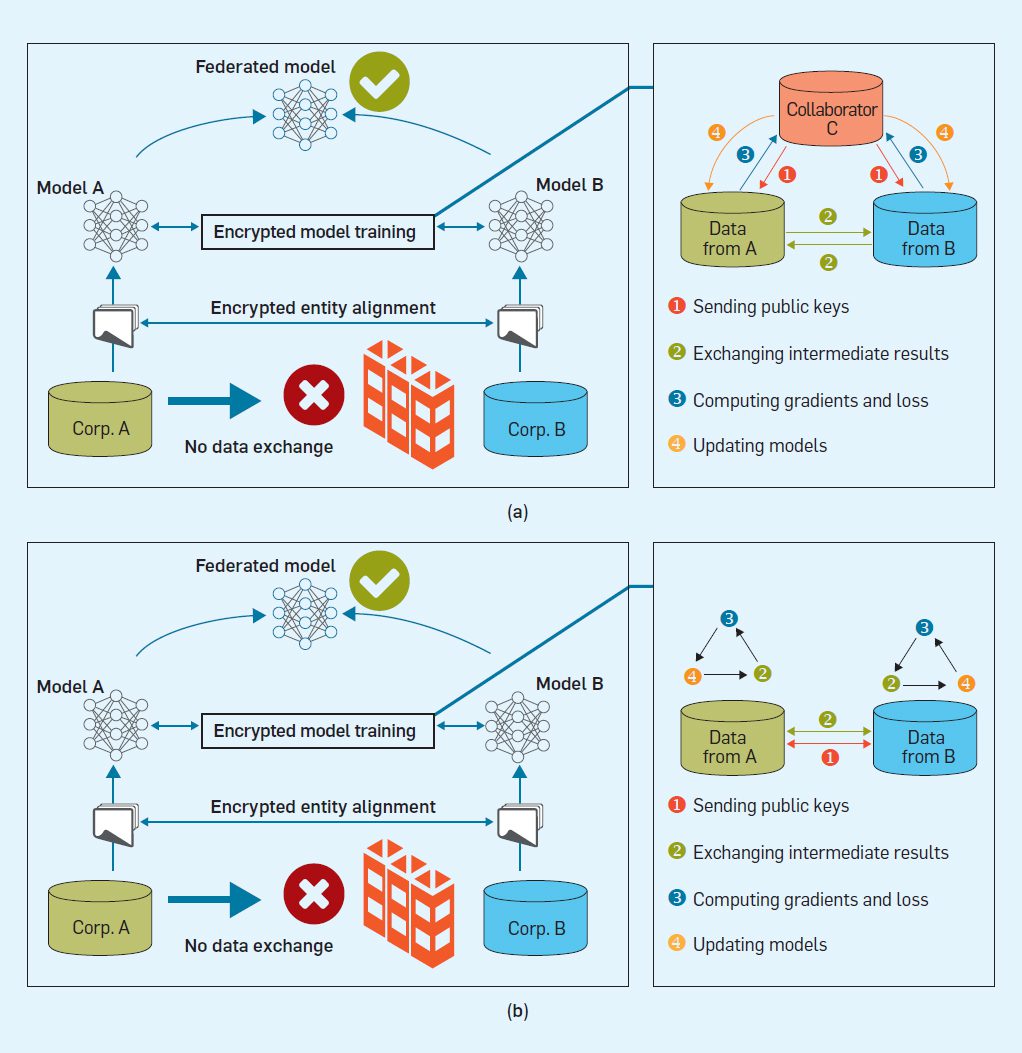
Federated learning inverts the standard training paradigm. Instead of sending user data to a central server for training, the model is sent to the device. Training happens locally. Only the model updates — gradient changes, not raw data — are transmitted back to a central aggregator, which combines them across many users without any individual’s data ever leaving their device.
Apple has used federated learning for keyboard suggestions and Siri personalization since 2017. Google deploys it for next-word prediction in Gboard. The production track record is solid. But federated learning for more complex adaptive AI — LLM personalization, nuanced behavioral modeling — is still at the research frontier. FedRLHF, presented at the International Conference on Autonomous Agents and Multiagent Systems in May 2025, shows convergence guarantees for privacy-preserving personalized RLHF — a meaningful step toward making federated adaptive AI production-viable for sensitive applications.
| Approach | Privacy Level | Personalization Depth | Compute Cost | Maturity |
|---|---|---|---|---|
| Centralized adaptive ML | Low | High | Low | Production |
| Federated learning (global model) | High | Medium | Medium | Production |
| Personalized federated learning | High | High | High | Research/Early |
| On-device RAG with user store | Very High | Medium | Medium | Emerging |
| Differential privacy + centralized | Medium | Medium | Medium | Production |
The trust dimension
Beyond the technical privacy mechanisms, there’s a harder question: do users actually want AI to learn from their individual behavior? The answer is nuanced and depends heavily on transparency. Research consistently shows that users are more accepting of personalization when they understand what’s being learned and have meaningful control over it. The platforms that are getting this right in 2026 are building explicit preference controls — not dark patterns that bury data collection in 47-page privacy policies, but genuine real-time controls that let users see what the system thinks it knows about them and correct it.
Spotify’s “taste profile controls,” launched in fall 2025, are a reasonable early example. The ability to see and edit the preference model changes the dynamic from surveillance to collaboration.
7. Honest Assessment: The Risks and Failure Modes
Any honest treatment of adaptive AI has to spend time on what goes wrong, because a lot does go wrong. The high performer data is real, but so is the 94% who aren’t seeing transformative returns.
Feedback loop amplification and filter bubbles
A system that learns from user behavior and then shapes subsequent behavior is a feedback loop. Feedback loops can be virtuous or vicious. If your adaptive music recommendation system learns that you like a particular artist and keeps showing you that artist, it may be giving you what you explicitly want — but it’s also gradually narrowing your discovery surface. At the individual level, this might be fine. At population scale, it creates the filter bubble problem: people end up in progressively more isolated preference spaces. This isn’t a theoretical concern; it’s been documented empirically in content recommendation systems across multiple platforms.
Bias amplification over time
Adaptive systems that learn from historical behavior can encode and amplify historical biases. A hiring tool that adapts to recruiter behavior will learn recruiter biases — and potentially optimize for them. A loan approval system that adapts to credit officer decisions will replicate patterns of discriminatory decision-making if those patterns exist in the training data. As documented in recent analyses of adaptive AI systems, data bias can amplify over time if feedback loops are not audited. The technical fix — bias audits, debiasing regularization, fairness-constrained optimization — exists. Most deployments skip it.
Cold start is still unsolved
Every adaptive system faces a cold start problem: new users have no behavioral history, so the system has nothing to learn from. Most production systems fall back to popularity-based recommendations for new users, which is the opposite of personalization. The gap between the experience of a new user and a 2-year user of the same adaptive system is often dramatic — which means high churn risk in the early sessions that matter most for retention. This is an active research area, but there’s no clean solution deployed at scale yet.
Instability from continuous updates
Models that update continuously can update in ways that are hard to predict. A small shift in user behavior patterns — a viral trend, a news event, a platform policy change — can cause cascading updates across adaptive models that interact with each other. This is the “catastrophic forgetting” problem: systems optimized aggressively for recent behavior can lose learned patterns from longer history. Managing this requires careful regularization and human monitoring that most teams underinvest in.
The most expensive adaptive AI failure mode: a system that is confidently, consistently wrong about a specific user because it locked in an incorrect early inference and never corrected it. This is worse than a cold start. It’s a confident misalignment that actively degrades the user experience while the system believes it’s optimizing. Detecting this requires explicit monitoring of cases where user behavior contradicts the model’s prediction — a metric most teams don’t track.
8. A Practical Implementation Roadmap
For organizations that want to move from “we have AI” to “our AI actually adapts to individuals,” here’s a grounded sequence. Not a vendor pitch. Not a methodology framework. A sequence based on what the organizations that got this right actually did.
Phase 0: Before you build anything
Define what “adaptive” means for your specific product and what business outcome it should move. Reduce churn? Increase conversion? Improve task completion rate? The answer determines what behavioral signals matter, what feedback the model should optimize for, and how you’ll know if it’s working. Organizations that skip this step build technically impressive systems optimizing for the wrong thing.
Phase 1: Signal infrastructure (weeks 1–8)
Build the data pipeline before the model. This means: event tracking at the individual level (not just aggregate analytics), a feature store capable of low-latency serving, and a clear taxonomy of the behavioral signals you’re collecting and why. This phase is unsexy but it’s where most production failures originate.
Phase 2: Baseline personalization (months 2–4)
Start with collaborative filtering or a simple content-based approach. Establish baseline metrics for what you’re trying to improve. This gives you a performance floor to measure adaptive improvements against, and it forces you to confront the cold start problem while the stakes are still low.
Phase 3: Adaptive layer (months 4–8)
Introduce the individual-level learning loop. Start narrow: pick one behavioral signal, one outcome metric, one product surface. Measure the impact on that surface before expanding. This is where the workflow redesign matters — the team needs to be set up to monitor and respond to the live adaptive system, not just deploy it and move on.
Phase 4: Governance and monitoring (ongoing)
Set up bias audits on a regular cadence. Monitor for drift between model predictions and actual user behavior. Build explicit user controls for their personalization profile. Establish an incident response process for when the adaptive system does something unexpected — and it will.
9. Where This Is Heading by 2027–2028
Predicting the next 18 months in AI is an exercise in controlled humility. But there are a few developments that seem genuinely likely given current research trajectories.
On-device adaptation will become the norm for personal AI
As inference hardware improves — Apple’s Neural Engine, Qualcomm’s AI chips for Android — running meaningful adaptive models on personal devices becomes feasible without sending behavioral data to servers. This resolves the privacy-personalization tension in a way that federated learning approaches only partially address. The user’s device becomes their personal adaptive AI engine. The next generation of smartphone AI assistants will almost certainly work this way.
Multimodal behavioral signals
Current adaptive systems learn primarily from click-stream data — what you interact with and for how long. The next generation will incorporate voice pattern analysis, reading behavior (eye tracking via camera on consumer devices), and ambient contextual signals. This is more powerful and more ethically fraught in equal measure. The organizations that navigate this well will be those that made transparency and user control foundational from the start, not those trying to retrofit ethical guardrails onto systems designed for maximum data extraction.
Compositional personalization across AI systems
Right now, every adaptive AI system learns about you in isolation. Your Spotify model doesn’t talk to your Netflix model. That’s partly good (privacy) and partly limiting (redundant cold starts, inability to use rich cross-domain signals). What’s emerging — slowly, with significant regulatory tension — is the concept of user-controlled preference graphs: portable representations of your preferences that you own and selectively share with adaptive systems. The EU’s digital identity infrastructure is laying some of the groundwork here, even if the AI-specific applications are still years away.
Adaptive AI and the attention economy problem
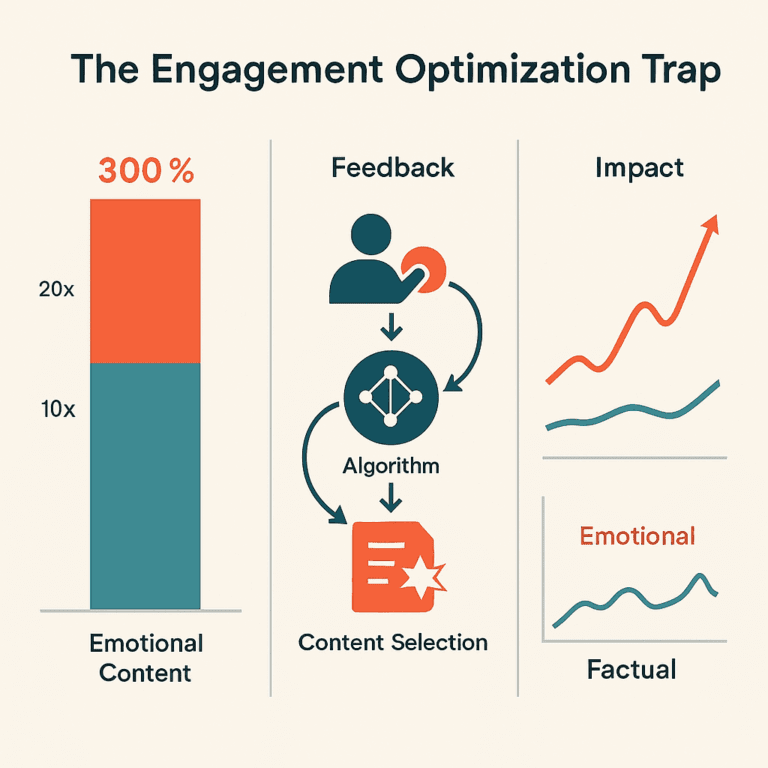
There’s a structural tension in consumer adaptive AI that doesn’t get discussed enough in business coverage: the systems being optimized for engagement are not always aligned with user wellbeing. A system that learns you’re susceptible to outrage content and serves you more of it is technically successful at its optimization objective and genuinely harmful to you. The shift toward outcome-based objectives — not “time spent” but “goals achieved,” “questions answered,” “tasks completed” — is the direction that thoughtful practitioners are pushing. Whether the economics of advertising-supported platforms allow that shift is a different, harder question.
Adaptive intelligence isn’t a feature you add — it’s an architectural commitment. The organizations generating real returns from it have done three things the majority haven’t: rebuilt their workflows around continuous learning systems, invested in real-time signal infrastructure before worrying about model sophistication, and established governance for what the adaptive loop is and isn’t allowed to optimize for. The technology is mature enough to act on. The organizational discipline required to make it work is the actual scarce resource.
The gap between the 6% who are doing this and the 94% who aren’t won’t stay this wide. Adaptive AI infrastructure is getting cheaper and more accessible every quarter. But the organizations building the habits, pipelines, and cultural norms for working with continuously learning systems now will have a structural advantage that compounds over time. Because that’s what adaptive systems do — they compound.
Behavioral Targeting Strategies: The Hidden Tactics Top Brands Use to Skyrocket ROI in 2025
Conversational AI and Customer Retention: The Secret Weapon Behind Modern Loyalty
The 0.94 Confidence That Cost $28,800
Sustainability Through Tech: Environmental AI Strategy Case Studies Pioneering Green Transformations in Global Industries
The 15 Hyper-Personalization Principles That Separate Good From Great
9 Predictive Customization Strategies That Actually Work — Ranked by Real Results
Top 7 Adaptive Algorithm Strategies for Hyper-Personalization
15 Individual AI Models — Personalized AI Instances Shaped Uniquely Around Each User’s Identity