

Conversational AI and Customer Retention: The 2026 Playbook That Actually Works
Most companies chase retention with loyalty points and email blasts. The ones actually winning are letting AI see the warning signs before any human could — and acting before customers even think about leaving. Here’s the honest, data-backed breakdown of how.
Here’s a number worth sitting with: improving customer retention by just 5% can deliver profit increases between 25% and 95%.[1] Most companies chase that gain with loyalty points and email campaigns. The ones actually hitting it are doing something fundamentally different — they’re letting conversational AI spot the warning signs before any human could, and acting on them before a customer even thinks about leaving.
This isn’t a prediction. It’s operational in 2026. And the gap between companies that understand this mechanism and those still treating AI as a chat widget? It’s widening by the quarter.
I want to be clear upfront: this article isn’t going to tell you AI is magic. The Klarna story alone — which we’ll get into — should make anyone skeptical of pure hype. What I will tell you is exactly where the signal is real, where deployments fall apart, and what the top 6% of AI high-performers actually do differently. Let’s get into it.
The retention economics are brutal right now
Acquiring a new customer costs 5 to 25 times more than keeping one — a ratio that’s only worsened as digital ad costs surge and organic discovery gets harder to sustain.[2] Meanwhile, customer service costs are projected to drop by $80 billion globally through AI automation in 2026 alone.[3]
The math isn’t subtle. A SaaS company losing 12.5% of its customers annually — roughly the sector average in 2025 — needs to replace every customer it has within eight years just to stand still.[4] Meanwhile, 73% of B2B revenue comes from existing customers.[5] Those two facts together should make retention the first budget conversation, not the last.
50% of decision-makers admit their organization faces poor customer experience — including low CSAT, abandoned channels, and churn they can’t explain.[6] Only 7% of businesses report no challenges when implementing AI customer service tools.[7] The problem isn’t the technology. It’s deployment discipline.
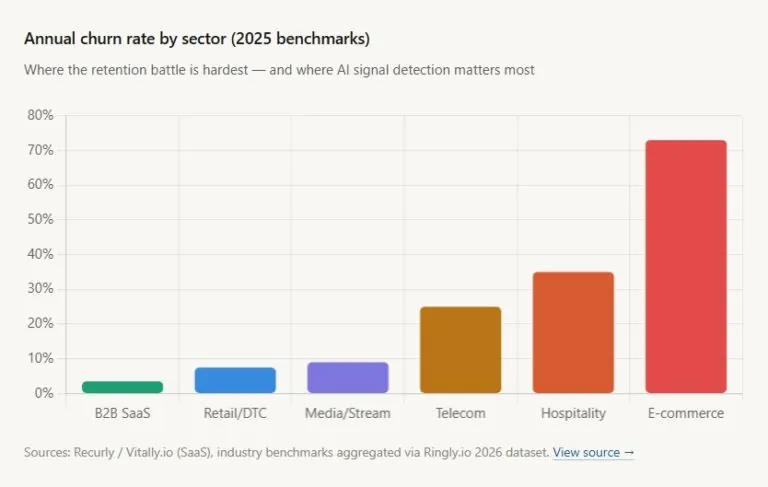
Annual churn rate by sector — where the battle is hardest
Before you can deploy AI against churn, you need to know what you’re fighting. These benchmarks shape how aggressively you need to act:
| Sector | Avg. Annual Churn | Visual | AI Signal Priority |
|---|---|---|---|
| SMB SaaS | ~31–58% | Critical | |
| Mid-Market SaaS | ~11–14% | High | |
| Enterprise SaaS | ~6–8% | Medium | |
| Telecom | ~15–25% | High | |
| eCommerce / Retail | ~20–40% | Critical | |
| Financial Services | ~15–25% | High |
Sources: Recurly / Vitally.io (SaaS), industry benchmarks aggregated via Ringly.io 2026 dataset.
What “conversational AI” actually means for retention
Let’s be precise, because the term gets stretched dangerously thin. For retention purposes, conversational AI isn’t just a chatbot answering FAQ questions at 2 a.m. — though that matters too. The full retention stack operates across four distinct layers:
Instant responses to common queries — order status, password resets, policy questions. Frees human agents for emotionally complex or high-stakes conversations. This is where most companies start, and most companies stop.
Real-time analysis of tone, frustration signals, and — critically — how a customer’s sentiment has changed over time. Not just whether they’re angry today, but whether they were happy last month. That temporal shift is where the real signal lives.
ML models trained on behavioral data — login frequency, feature engagement, support call volume, payment patterns — that identify at-risk customers days or weeks before they actually churn. Peer-reviewed accuracy rates: 70–96%, depending on data richness.
Automated sequences triggered by risk signals — personalized outreach, exclusive assistance offers, escalation to senior account managers — before the customer has raised a complaint. This is the layer that turns data into revenue.
The data behind the hype — and where it’s still just hype
The aggregate numbers are striking. AI correlates with a 24.8% increase in customer retention and a 31.5% boost in satisfaction scores at organizations that implement it well.[8] On average across deployments, AI lifts retention rates by 10–15% and delivers $5.44 per dollar invested in automation.[9]
But those averages conceal a sharp performance distribution. McKinsey finds that only 6% of companies qualify as “AI high performers” — those attributing more than 5% of EBIT directly to AI outcomes. The rest are running isolated pilots that don’t compound.[11]
What do the top performers actually do differently? They’re 2.8× more likely to report fundamental workflow redesign — 55% versus 20% of others. They don’t bolt conversational AI onto a broken support process. They redesign the process around the AI’s capabilities.
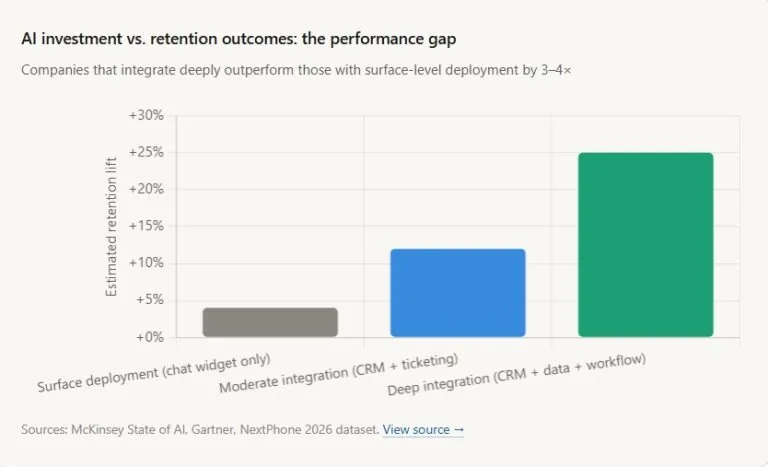
AI investment vs. retention outcomes: the performance gap
Sources: McKinsey State of AI 2025–2026, Gartner, NextPhone 2026.
The three mechanisms that actually drive retention
1. Predictive churn modeling — knowing before they know
The most powerful thing conversational AI does for retention isn’t the conversation itself. It’s what happens before one is needed.
Modern churn prediction models — trained on behavioral signals like login frequency, support call volume, feature engagement, and payment patterns — identify at-risk customers with accuracy rates between 70% and 96%, depending on data richness and model architecture.[12]
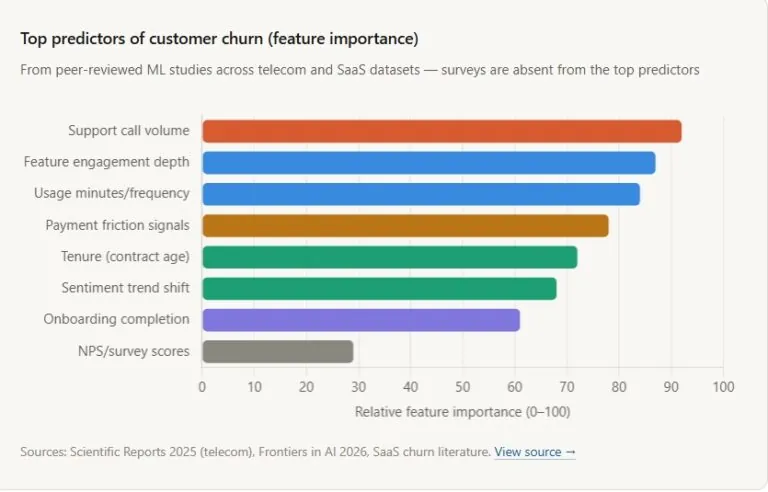
A peer-reviewed 2025 study in Scientific Reports on telecom churn found that a Random Forest classifier achieved 95.13% accuracy and an AUC of 0.89. Crucially, the strongest predictor wasn’t a satisfaction survey. It was support call volume. Every time a customer had to call for help, dissatisfaction accumulated invisibly. The model saw what the NPS survey missed.[13]
A 2026 explainable AI study on telecom data (n=7,043) confirmed the pattern — XGBoost ensemble models hit 96.44% accuracy and an AUC-ROC of 0.932, with SHAP analysis surfacing which features drove each prediction, enabling targeted retention actions rather than generic campaigns.[14]
For B2B SaaS specifically, Slack’s experience is instructive: predictive analytics analyzing usage patterns triggered proactive retention campaigns that reduced churn by 30%.[15] The signal was usage metrics — not customer satisfaction scores, not renewal conversations. What customers actually did with the product.
Top predictors of customer churn — behavioral, not attitudinal
The strongest churn predictors in peer-reviewed research are all behavioral signals, not attitudinal ones. Yet most retention programs are built around surveys. This explains the persistent gap between “our customers say they’re satisfied” and “why are we churning 15% annually?”
- 1Support call volume & frequencyBehavioral
- 2Total usage minutes / sessionsBehavioral
- 3Feature engagement depthBehavioral
- 4Payment friction eventsBehavioral
- 5Login frequency declineBehavioral
- 6Onboarding completion rateBehavioral
- 7NPS / CSAT scoreAttitudinal
Sources: Scientific Reports 2025 (telecom), Frontiers in AI 2026, SaaS churn literature.
2. Sentiment-driven conversation intelligence — catching the tone shift
Modern AI platforms can analyze customer sentiment during conversations, identifying frustrated customers before they churn. By tracking sentiment across interactions and measuring temporal change — not just current tone, but how tone has shifted over weeks — systems build customer health scores that predict churn risk with a precision no manual review process can match at scale.[16]
The temporal dimension is underrated. A customer who was previously enthusiastic and now posts repeated negatives is a much stronger churn signal than someone who has always been mildly critical. Baseline matters. A customer venting about a one-time billing glitch is completely different from one whose tone has fundamentally darkened over six weeks. Only AI can track this at scale without a dedicated analyst per account. Frankly, that’s a superpower most companies haven’t unlocked yet.
3. Proactive intervention at the right moment — timing is everything
Most retention “saves” fail not because the offer was wrong, but because it arrived after the customer had already mentally checked out. Conversational AI collapses the lag between signal detection and outreach from days to minutes.
A customer who’s had three frustrating support interactions in a week gets a proactive check-in before they start a competitor evaluation. That’s not loyalty magic — it’s logistics.
When churn models flag a customer as at-risk, automated workflows can trigger personalized retention sequences, exclusive assistance offers, or escalation to a senior account manager — all before the customer has raised a complaint.[17] Automated post-purchase emails alone reduce 90-day churn by 14%; first-time buyers receiving personalized post-purchase communications show 45% higher second-purchase rates.[18]
Case study: Klarna’s AI odyssey — the full, unvarnished story
No case study better illustrates both the promise and the pitfalls of conversational AI in customer service than Klarna’s. The naive version — “Klarna deployed AI and saved $40M” — is half the truth. Here’s all of it.
In February 2024, Klarna launched an OpenAI-powered assistant that handled 2.3 million customer service conversations in its first month — two-thirds of all interactions, equivalent to 700 full-time agents. Resolution times dropped from 11 minutes to under 2 minutes. Repeat inquiries fell 25%. The company projected a $40 million profit improvement.[19] The headlines wrote themselves. Everyone wanted to replicate it.
By mid-2025, Klarna reversed course — rehiring human agents and bringing work in-house. CEO Siemiatkowski’s admission was direct: “Cost unfortunately seems to have been a too predominant evaluation factor… what you end up having is lower quality.”[20] Forrester’s Kate Leggett was blunter: “They overpivoted to cost containment, without thinking about the longer-term impact of customer experience.”[21]
The core problem: Klarna hadn’t invested in FAQs and IVR systems before AI deployment, meaning the AI’s baseline was unusually low. Many companies trying to replicate Klarna’s numbers failed precisely because they were already further ahead on basic self-service infrastructure.[22]
Today, Klarna operates a mature hybrid model: AI handles two-thirds of chats (roughly 1.3M/month as of mid-2025), with seamless escalation to human agents for complex or emotional situations. The company maintains an NPS of 73 and continues to invest in both AI and human capacity.[23] The lesson is simple and hard: AI for speed, humans for empathy — not AI instead of humans.[24]
“Cost unfortunately seems to have been a too predominant evaluation factor… what you end up having is lower quality.” — Sebastian Siemiatkowski, Klarna CEO, mid-2025[20]
Where conversational AI gets it wrong — the parts most articles skip
This section exists because most articles on this topic don’t write it. That omission should make you suspicious.
The handoff failure is the most common retention liability. A customer who successfully resolves a simple query with AI, then has to repeat their entire context to a human agent for a complex issue, loses more trust than they gained. The retention benefit flips into a liability. Carrying full conversation context, sentiment history, and prior actions into every human escalation is understood but rarely implemented cleanly.
Premature deployment is a documented failure mode. Forrester predicts roughly one-third of AI self-service rollouts will fail from premature deployment driven by cost pressure rather than readiness.[25] Moving fast because competitors are moving fast is how you train your customers to call those competitors instead.
The trust calibration problem is real. Proactive outreach triggered by behavioral scoring needs to feel like care, not surveillance. The difference is in the framing, timing, and sincerity of the offer — none of which AI can fully solve without deliberate design. If customers feel monitored rather than served, retention efforts backfire. Hard.
The scaling gap doesn’t fix itself. More than 80% of organizations report no tangible effect on enterprise-level EBIT from gen AI investments — even as the technology matures.[26] The problem isn’t the AI. It’s workflow integration, data quality, and change management.
The “cost-as-north-star” trap. Klarna’s story makes this concrete. Measuring AI success by containment rate or cost-per-interaction optimizes for the wrong outcome. The organizations winning on retention measure customer health score trends, time-to-intervention after risk signals, and net retention rate before and after AI-mediated interventions.
Primary barriers to AI-driven retention success
Sources: Forrester, Gartner, McKinsey, aggregated 2025–2026.
What the 6% of AI high-performers actually do
Based on verified data, the organizations extracting real retention value from conversational AI share a clear playbook. None of it is magic:
They start with high-volume, high-friction journeys. Password resets, order status, appointment changes — not because these are exciting, but because automation here builds trust and frees agents for conversations that genuinely require human judgment. Lyft reduced resolution times by 87% this way; AI-powered triage reduces average resolution times by 52% across deployments.[27]
They connect AI to live data. Deep integration with CRMs, billing systems, ticketing platforms, and knowledge bases allows AI to take real action — updating records, issuing credits, escalating with context — not just answer questions. A chatbot without CRM access is an expensive FAQ. A chatbot with full customer history is a retention instrument.
They treat every interaction as a data point. Organizations compounding retention improvements use conversation data to identify patterns, fix products, and close the loop with operations. Customer service AI shouldn’t just solve problems — it should surface the systemic causes of those problems so the problems stop recurring.
They measure what actually matters. Not just deflection rate. Customer health scores, sentiment trend lines, churn rate before and after AI-mediated interventions, and time-to-intervention after risk signal detection. If you’re only measuring cost-per-interaction, you’ll end up where Klarna did in mid-2025.
Customer-focused organizations achieve 49% faster profit growth and 51% higher retention rates than their competitors.[28] That’s not because they have more AI. It’s because they deployed AI in service of the customer, not in service of the cost center.
The practical implementation ladder
For teams not yet at the high-performer tier, the entry point isn’t a full transformation. It’s a disciplined pilot — and honestly, this is where most companies should focus in 2026 rather than trying to replicate the Klarna scale-play from day one.
Identify your top three churn drivers from existing support data. What are customers asking about in the 72 hours before they cancel? Deploy conversational AI specifically on those journeys. This is not a full chatbot rollout — it’s a targeted intervention on known friction points. Start narrow and measure obsessively.
Enable agents to see full customer history and prior AI conversations at handoff. Measure handoff quality scores separately from deflection rates. A botched handoff destroys more trust than the AI saved — instrument for it explicitly. This step alone separates the 6% from everyone else.
Build a basic churn risk score using behavioral signals (logins, feature usage, ticket frequency, payment behavior). Set one automated outreach trigger at the 70th-percentile risk threshold. Measure the save rate against a control group. This gives you the ROI number that unlocks budget for the next phase.
Use conversation data to identify systemic issues — not just to respond to them. Every churn signal is a product bug or process gap made visible. The AI surfaces it. Fixing it is still a human job, but the AI makes it impossible to pretend you don’t see the pattern. That accountability is the real long-term value.
The verdict: speed, signal, and the compounding flywheel
Conversational AI’s relationship to customer retention isn’t a story about chatbots answering questions faster. It’s a story about the speed of signal detection, the quality of intervention timing, and the compounding effect of treating every customer conversation as a data point in a living health model.
The Klarna story is instructive precisely because it shows what happens when you optimize for cost containment instead of customer experience. The companies getting this right aren’t the ones with the most sophisticated AI — they’re the ones that asked the right question first: what does this customer need right now, and how quickly can we act on it?
By 2026, AI-powered churn prediction isn’t futuristic. It’s operational. The signals are already flowing through your CRM. Support ticket patterns are already visible. Feature engagement is already logged. You probably already have enough data to build a meaningful churn prediction model.
What’s missing isn’t technology. It’s the organizational commitment to act on what the data is already showing you. Conversational AI closes the gap between signal and action. But only if the organization on the other end is ready to move when the signal fires. That’s still a human problem. AI just makes it harder to pretend you don’t see it.
- [1]Ringly.io — 45 Customer Retention Statistics for 2026 (citing Bain & Company)
- [2]Oscar Chat — How to Improve Customer Retention with Live Chat in 2026
- [3]ChatMaxima — 55+ AI Customer Support Statistics and Trends for 2026
- [4]Frederik Jakobsen / Medium — AI for B2B Churn Prediction (citing Recurly / Vitally.io)
- [5]Lucid Financials — How SaaS Startups Use AI to Predict Churn
- [6]Master of Code — State of Conversational AI: Trends and Statistics (2026 Updated)
- [7]Nextiva — 50+ Conversational AI Statistics for 2026
- [8]
- [9]Ringly.io — 45 Customer Retention Statistics for 2026 (citing Gartner via Envive)
- [10]Ringly.io — 45 Customer Retention Statistics for 2026 (Gartner)
- [11]Master of Code — Conversational AI Trends 2026 (citing McKinsey)
- [12]Frederik Jakobsen / Medium — AI for B2B Churn Prediction
- [13]
- [14]ScienceDirect — XAI-Churn TriBoost: Explainable AI for telecom churn (2025)
- [15]Frederik Jakobsen / Medium — Slack case study (citing industry reports)
- [16]Oscar Chat — Customer sentiment monitoring and health scores
- [17]Funnelstory — Predicting Churn & Retention in B2B SaaS: A 101 Guide
- [18]Ringly.io — Post-purchase email automation stats (Marketing LTB)
- [19]OpenAI — Klarna’s AI assistant does the work of 700 full-time agents
- [20]CX Dive — Klarna changes its AI tune and again recruits humans (May 2025)
- [21]Yahoo Finance / CX Dive — Klarna says its AI agent is doing the work of 853 employees (Nov 2025)
- [22]
- [23]Yahoo Finance / CX Dive — Klarna Q3 2025 earnings and NPS data
- [24]CX Dive — “AI gives us speed. Talent gives us empathy.” — Klarna
- [25]Ringly.io — AI rollout failure rate (citing Forrester)
- [26]Master of Code — McKinsey: 80%+ of orgs report no measurable EBIT from gen AI
- [27]Dante AI — AI customer service statistics 2026 (citing Lyft, Gorgias)
- [28]Bayelsawatch — AI in Customer Support Statistics (citing Forrester 2024)