
AI Sentiment Analysis in Customer Support: What the Evidence Supports (and What It Doesn’t)
Updated September 30, 2026 · About 12 minutes · Every figure below links to the place I found it, with its weaknesses stated.
The short answer
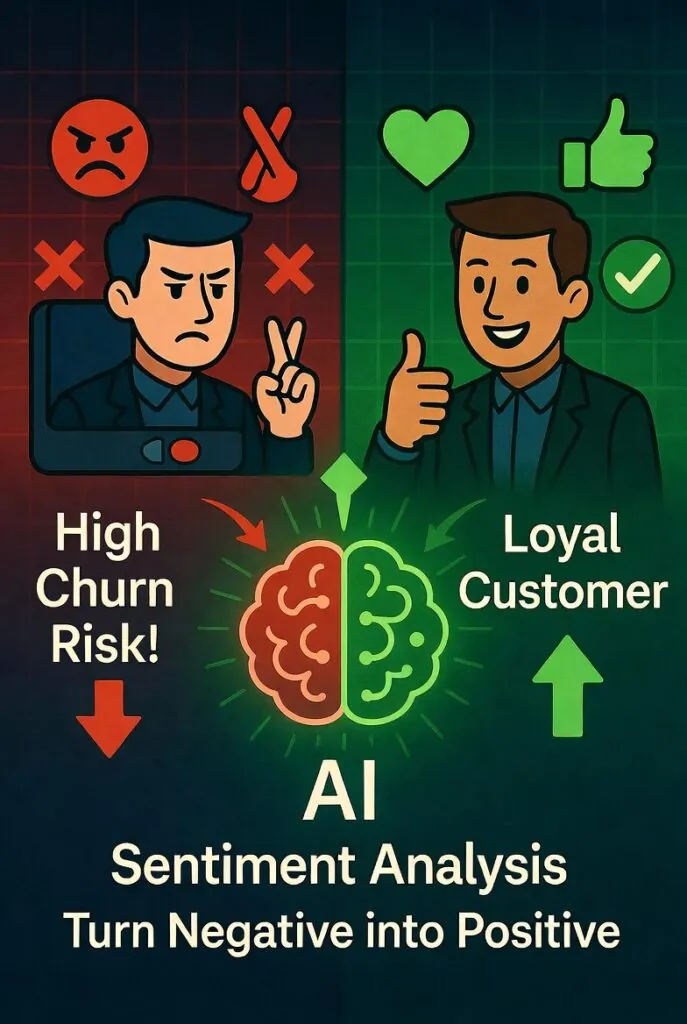
Sentiment analysis is a cheap, noisy sensor. It produces money only when it is wired to a specific action and tested against a holdout group. I found no independent, controlled study showing that sentiment scoring alone reduces churn.
The figures most often quoted in its favor come from vendor case studies, or from churn-prediction research that does not use sentiment at all. Meanwhile, the customer-side evidence has hardened: in Gartner’s 2026 survey, 87% of customers said access to a human is essential when a company uses generative AI for service.
Three consequences follow:
- Judge the workflow, not the classifier. A sentiment score on a dashboard has no ROI until something happens because of it.
- Expect most alerts to be wrong. Base rates make even a good detector mostly noisy (worked example in section 3).
- Architecture is also a legal decision in the EU. Text-only analysis of customers sits in a different legal category from voice-based emotion inference on agents, and the second is banned.
How I checked this. I went back to Gartner’s own press releases rather than trade-press summaries, read the full text of the Nature Scientific Reports churn paper instead of its abstract, and read the vendor’s published case study for the best-known retention claim. I ran no product tests of my own. Where a number is a vendor’s claim, a survey result, or my own arithmetic, the text says which.
1. What “sentiment” actually measures
Support sentiment tools do three different jobs that vendors bundle under one name:
| Job | What it outputs | Who acts on it | Failure cost |
|---|---|---|---|
| Per-message scoring | Positive/negative/neutral per ticket or chat turn | Agents, routing rules | Low per error, high in aggregate |
| Trajectory tracking | Change in mood across several contacts | Retention teams, supervisors | Medium (wrong customer gets an offer) |
| Topic-level tagging | Which issues correlate with unhappy language | Product and ops teams | Low (used in batches, human-reviewed) |
My judgment: topic-level tagging is the most defensible use, per-message scoring the weakest. Tagging tolerates error because it aggregates thousands of tickets and a human decides what to fix. Per-message scoring asks a noisy classifier to drive individual customer treatment.
2. The evidence ladder: what each claim is actually worth
I grade each claim by how it was produced, strongest first.
| Claim | Source | What it is | Grade |
|---|---|---|---|
| 87% of customers say a human-agent option is essential when GenAI is used; 50% say GenAI makes interactions easier | Gartner press release, Aug 4, 2026 (n=3,566, fielded Feb–Mar 2026) | Survey, stated sample | Strong (stated attitudes, not behavior) |
| Only 27% would try a chatbot again after a bad experience | Gartner, Sept 2, 2026 | Survey | Strong |
| 64% of customers would prefer companies not use AI in service; 53% would consider switching | Gartner, Jul 9, 2024 (n=5,728, fielded Dec 2023) | Survey, now ~2.75 years old | Dated. Use as history, not as a current headline |
| Akool cut subscriber churn 26.4% in month one, with 40x+ ROI | LiveX AI case study | Vendor-published | Weak (first-party, no baseline or control disclosed) |
| Random Forest churn model: 95.13% accuracy, AUC 0.89 | Abdelhady & Mohamed, Scientific Reports, Dec 2025 | Peer-reviewed, single public dataset | Real, but not about sentiment |
Two corrections to claims that circulate widely:
The 64% figure is older than it looks. Trade coverage still presents it as current. Gartner’s own release says the fieldwork was in December 2023. The 2026 survey is the better anchor, and its message is sharper: customers will use AI, but they revolt when it blocks access to a person.
The Akool number describes a retention workflow, not sentiment scoring. By the vendor’s own account, the system educated users early and intervened when someone started to cancel. That is a cancellation-flow intervention. Also note that the vendor’s own page carries a “35% reduction” subheading alongside the 26.4% figure, and I could not find a definition of the baseline or whether the reduction is relative or absolute. Treat it as a vendor claim that the product works in one subscription business, nothing more.
3. The base-rate problem nobody puts in a demo
Why a 90%-specific detector still sends mostly false alarms. This is my own arithmetic on assumed inputs, not a measured result.
Assume 10,000 tickets a month, with 10% (1,000) from customers genuinely at risk. Give the detector 80% sensitivity and 90% specificity, which is generous for real tickets.
- True positives: 1,000 × 0.80 = 800
- False positives: 9,000 × 0.10 = 900
- Precision: 800 ÷ 1,700 = 47%
More than half the alerts land on customers who were fine. Raise specificity to 97% and false positives fall to 270, lifting precision to 75%. That is why I’d ask vendors for precision at your base rate, not “accuracy.”
The money test, per flagged customer:
Expected value = precision × probability the intervention saves the customer × value of a retained customer − cost of the intervention
With 47% precision, a 20% save rate and €300 of retained value, each flag is worth about €28 before costs. If the intervention is a €15 discount handed to every flagged customer, including the 53% who weren’t leaving, a large part of that margin is gone. The inputs are assumptions; the structure is what matters.
A real-world illustration of the accuracy trap
The Nature paper deserves a careful read because it shows the trap in published form. In the test set of 534 customers, the confusion matrix shows 53 true positives, 25 false negatives, 1 false positive and 455 true negatives. From those:
| Metric | Calculation | Result |
|---|---|---|
| Accuracy | (53 + 455) ÷ 534 | 95.1% |
| Accuracy of “predict nobody churns” | (455 + 1) ÷ 534 | 85.4% |
| Precision (churn class) | 53 ÷ 54 | 98.1% |
| Recall (churn class) | 53 ÷ 78 | 67.9% |
The headline accuracy beats a model that never flags anyone by under ten points, and the model misses about a third of actual churners. The authors say so themselves. One more caution from my reading: the prose in one section cites 11 false negatives while the matrix shows 25. Recall of 0.68 only works with 25, so I used the matrix. The study is also a structured-data churn model built on one public telecom dataset, not a sentiment study.
One finding in that paper is useful for buyers. Among the strongest predictors was the number of customer-service calls, and churn rose sharply at about four or more. A counter like that costs nothing to compute.
Recommendation that bites: before you pay for sentiment, build a dumb baseline from contact counts in 30 days, reopened tickets and repeat contacts on the same issue. Any sentiment product that cannot beat that baseline on your own data is charging you for a worse signal.
4. Sarcasm: why benchmark scores don’t transfer
Vendors love sarcasm accuracy figures. The academic numbers vary wildly, and the cause is worth understanding:
| Study | Dataset and label type | Reported result |
|---|---|---|
| Hybrid auto-encoder model, Electronics, 2022 | Reddit SARC, news headlines, Twitter | 83.92% / 90.8% / 92.80% accuracy |
| RoBERTa/DistilBERT study, Computers, 2025 | News Headlines, MUStARD, Reddit SARC | Up to 98.5% accuracy with metadata, per authors |
| SemEval-2022 Task 6 participant (iSarcasmEval) | Sarcasm labeled by the authors who wrote it | One team’s BERT system scored F1 ≈ 0.23 on the sarcastic class |
These numbers are not comparable, and that is the point. The high scores come from datasets where sarcasm is labeled by hashtags, self-annotation or editorial source, often with extra metadata. The low score comes from a task where the writer’s own intent defined the label. A 2025 PLOS ONE study on SARC notes that transformer models still struggle with low-resource languages and subtle context.
My reading: sarcasm accuracy depends on how the labels were made at least as much as on the model. Support tickets have neither hashtags nor clean labels, so a benchmark figure tells you little about your queue.
What to ask instead. Request a proof-of-concept on 60–90 days of your historical tickets, labeled by your own senior agents, reporting precision and recall per language on the negative class. If a vendor won’t run it, you have your answer.
The more dependable signal is deterioration across contacts: a customer whose tone worsens over three contacts on the same unresolved issue. It needs no sarcasm detection and maps directly to an action.
5. The trust constraint: escalation is a design requirement
The 2026 Gartner data changes how I’d frame deployment. In that survey, customers who didn’t want to engage with AI named the ability to switch to a human as the most common thing that would change their minds. Gartner’s analyst also advised against making GenAI a mandatory first step for every issue, and the survey found customers about three times more likely to use third-party GenAI tools than a company’s own chatbot.
The operational implication is one many teams resist. A sentiment system that detects anger and then keeps the customer in a bot flow is working against the evidence. The right default is that negative-sentiment detection shortens the path to a person.
| Metric | Why it matters |
|---|---|
| Containment rate | Flatters you when escalation is hard |
| Resolution rate | Tells you whether the problem actually went away |
| Escalation-to-human rate | Reveals whether customers find the exit |
| Repeat-contact rate (7–14 days) | Catches “resolved” tickets that weren’t |
Track all four on one dashboard. Optimizing containment alone rewards exactly the behavior 87% of customers say they reject.
6. The legal line in the EU
If you serve EU customers or employ agents there, the architecture choice carries legal weight. Here is the structure as I understand it from the AI Act text and commentary. This is not legal advice; confirm with counsel.
- Agent-facing emotion inference is prohibited. Article 5(1)(f) of Regulation (EU) 2024/1689 bans AI that infers emotions in the workplace, with narrow medical and safety exceptions. It has applied since February 2, 2025, and the top fine tier is €35M or 7% of global turnover. Scoring agents for “negative tone” or feeding inferred emotion into QA and performance decisions is the exposure.
- Customer-facing voice analysis is treated differently. The Commission’s guidelines, as summarized by Oliver Patel, give a call-centre tracking customers’ anger or impatience as an example that is not prohibited. It still falls under other AI Act obligations.
- Text-only sentiment is generally outside the definition. Emotion recognition under the Act is defined through biometric data, and the same guidelines say text-based sentiment analysis doesn’t fall within the prohibition. GDPR and employment law still apply.
| Modality | Subject | Status in the EU (my summary) |
|---|---|---|
| Text | Customers | Outside the emotion-recognition ban; GDPR applies |
| Voice | Customers | Not banned; other AI Act duties apply |
| Voice or text used for emotion inference | Agents | Prohibited in the workplace (narrow exceptions) |
Timelines for the high-risk and transparency layers have been subject to EU-level adjustment proposals. Verify current application dates before building a compliance plan.
7. Three deployment patterns, and what each needs
| Pattern | Signal | Latency | Integrations | Best fit | Evidence quality |
|---|---|---|---|---|---|
| Trajectory-triggered retention | Sentiment + behavior across contacts | Seconds to minutes | CRM, billing | Subscription, SaaS, telco | Vendor claims only (see Akool) |
| Topic tagging for product | Aggregate ticket tags | Batch, daily | Ticketing, product backlog | Software, e-commerce | Plausible; mostly qualitative |
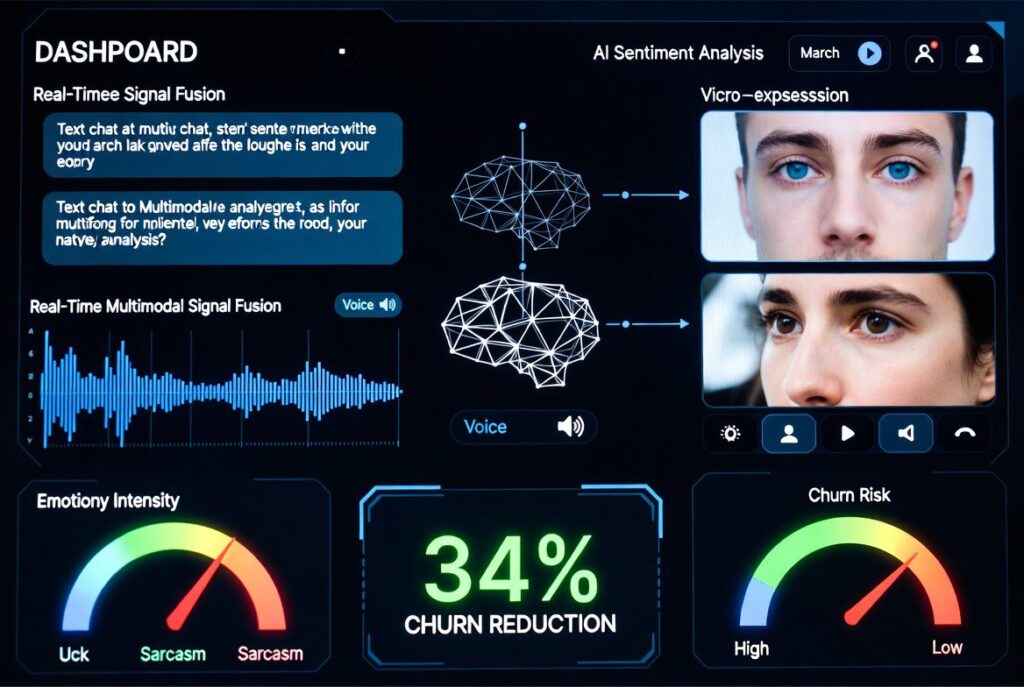
| Agent assist (customers’ text) | Per-message score shown to agent | Real time | Contact-center platform | High-volume support | No independent ROI study found |
I’ve taken the pattern names from the structure of the published cases and my own grouping; this is an organizing device, not a finding.
8. A 30-day test that settles the ROI question
The question the evidence can’t answer is whether your deployment reduces churn or raises satisfaction. What would answer it is a randomized holdout. I’d run it like this:
- Week 0, baseline. Compute the dumb baseline (contact count, reopen rate) and current churn and CSAT for the segment.
- Weeks 1–2, shadow mode. The tool scores tickets but triggers nothing. Have your senior agents label a sample of 300–500 flagged and unflagged tickets. Compute precision and recall at your base rate.
- Weeks 3–4, randomized action. Randomly assign flagged customers to intervention or no change. Hold out at least a third.
- Decision rule set in advance. For example: proceed only if the intervention group’s 60-day retention beats the holdout by a margin that covers the cost of the intervention (section 3 formula).
If your volume is too low for a meaningful test, say so and treat the tool as a product-intelligence purchase rather than a retention engine.
9. Vendor questions that separate evidence from marketing
- Per-language precision and recall on the negative class, for your top three languages.
- Training data: customer-support text, social media or generic corpora?
- Baseline: what did the “26%” or “40x” figure compare against, and was there a control group?
- Action layer: does the platform trigger escalations and offers, or only produce scores?
- Agent data: can every emotion-inferring feature be disabled for EU agents?
- Human override: who reviews high-stakes actions (refunds, closures, retention discounts)?
- Disclosure: how are customers told that AI analyzes their messages?
- Exit: can you export your tags and scores if you leave?
Frequently asked questions
Does AI sentiment analysis reduce customer churn? There is evidence that workflows built around it can, in vendor-reported cases such as Akool’s. I found no independent, controlled study isolating the effect of sentiment scoring itself. A randomized holdout on your own data is the only reliable way to know.
How accurate is AI sentiment analysis on support tickets? It depends on language, domain and how “negative” is defined, and published benchmark scores don’t transfer to your queue. Ask for precision and recall on your own labeled tickets.
Can AI detect sarcasm in customer messages? Sometimes, and reported accuracy ranges from a high 90s benchmark score to an F1 near 0.23 on intent-labeled data. Don’t buy on a sarcasm number.
Do customers accept AI in customer service? Mixed. Gartner’s 2026 survey found half say GenAI makes interactions easier, while 87% say a human option is essential.
Is sentiment analysis legal under the EU AI Act? Emotion inference on employees is prohibited. Text-only sentiment analysis of customers falls outside the Act’s emotion-recognition definition according to the Commission’s guidelines. Confirm your specific setup with counsel.
What this leaves unresolved
- No independent effect size. Whether sentiment scoring adds retention value beyond simple contact-count rules is unmeasured in anything I could find. A replicated randomized study, or vendor-disclosed holdout data, would resolve it.
- Stated attitudes aren’t behavior. Gartner’s results report what customers say, and customers do use AI when it solves their problem.
- Secondary-source drift. Several widely repeated 2026 statistics differ across summaries on fieldwork dates and sample sizes. I’ve used only figures I could trace to a primary release or paper.
Sources
- Gartner, 87% of customers say companies using GenAI must provide access to a human agent, Aug 4, 2026.
- Gartner, Only 27% would try a chatbot again after a negative experience, Sept 2, 2026.
- Gartner, 64% of customers would prefer companies didn’t use AI for customer service, Jul 9, 2024.
- Abdelhady, M.G. & Mohamed, K.A., Predictive customer churn modeling in telecommunications, Scientific Reports 15, 43826 (2025).
- LiveX AI, Akool case study (vendor-published).
- Sarcasm research: Computers 2025; Electronics 2022; PLOS ONE 2025; SemEval-2022 Task 6 participant paper.
- EU AI Act: Regulation (EU) 2024/1689; commentary by Oliver Patel and Technology’s Legal Edge.
No vendor paid for inclusion or favorable coverage. Figures labeled “illustrative” are my own arithmetic on stated assumptions. Last reviewed September 30, 2026.