

AI Solutions for Startups:
Tools That Deliver Real ROI
Not another listicle. Here’s what actually works when your runway is measured in months, not years.
73% of AI tool implementations fail within the first 90 days. Not because the tools are broken. Because the startups using them picked the wrong problem to solve, bought the wrong tier, or expected magic where method was required. I watched a Series A SaaS company burn $47,000 on an enterprise AI stack in Q1 2026. They automated nothing. They gained nothing. They fired their ops lead in April.

Stop Treating AI Like a Feature. It’s Infrastructure.
The most expensive mistake I see founders make: treating AI as a bolt-on instead of a foundation. They buy Jasper for content, then realize their CRM doesn’t talk to it. They adopt GitHub Copilot, then discover their documentation is so fragmented the AI can’t context-switch between microservices. They layer tool on top of tool until the stack costs more than a senior engineer and delivers less than a competent intern.
Here’s the operational definition that matters: AI is infrastructure when it removes a decision bottleneck. Not when it writes prettier emails. Not when it generates blog posts faster. When it removes the moment where someone has to stop, think, and manually execute a task that should be automatic.
That distinction changes everything about which tools you buy, when you buy them, and how you measure whether they worked.
The 95% Failure Rate Nobody Talks About
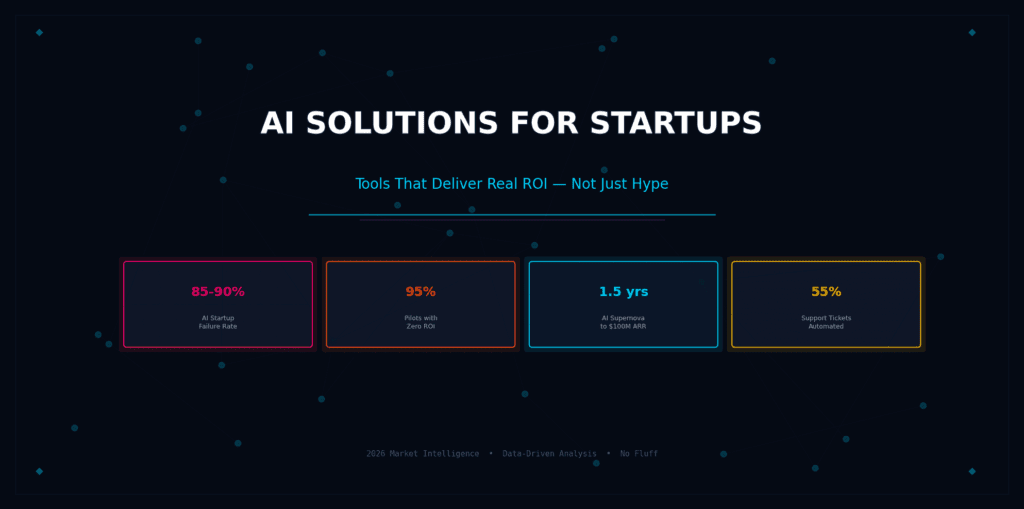
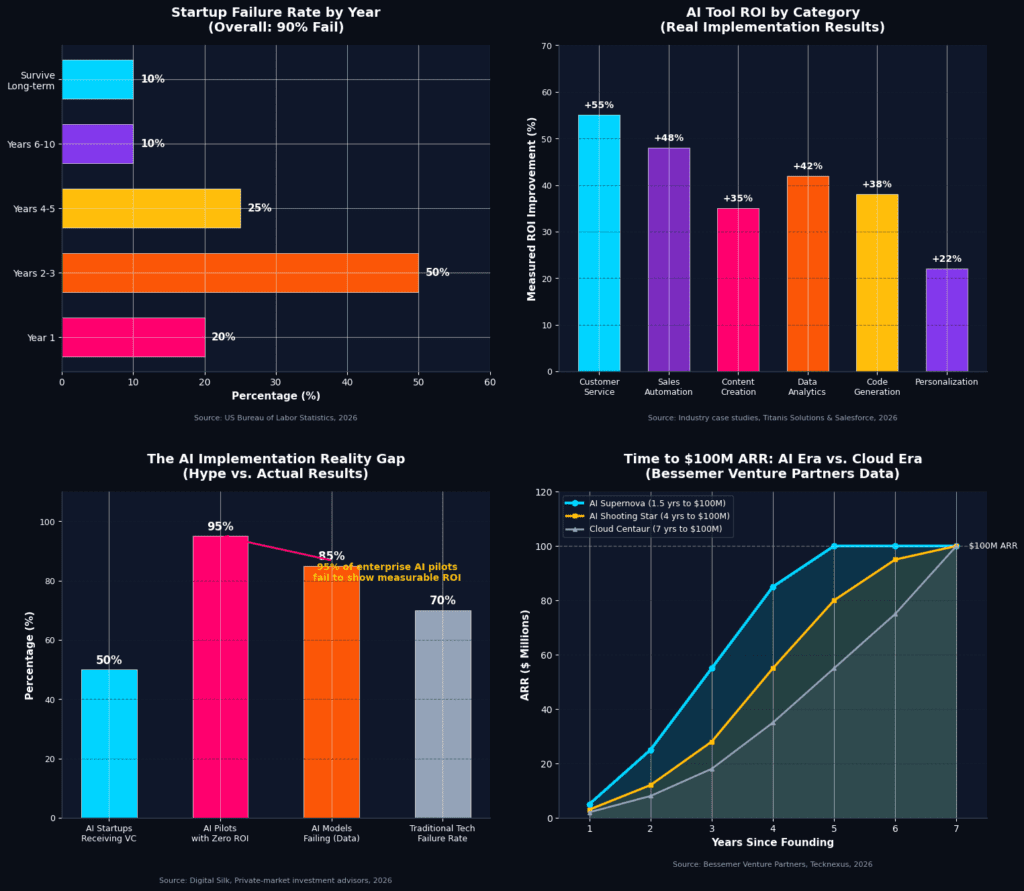
In 2025, AI startups attracted $210 billion in venture capital — nearly half of all global VC funding. Yet the failure rate for AI companies is higher than for traditional tech firms. 85–90% of AI startups are expected to be out of business within three years. 95% of generative AI enterprise pilots fail to deliver any measurable ROI. And 85% of AI models fail due to poor data quality or lack of relevant training data.
These aren’t pessimistic projections. These are post-mortems.
The pattern is consistent: a founder reads about a tool, sees a competitor using it, buys the mid-tier plan, assigns it to the most junior person on the team, and expects revenue to appear. When it doesn’t, they blame the tool. The tool was fine. The implementation was theater.

What Actually Works: The 2026 AI Stack for Startups
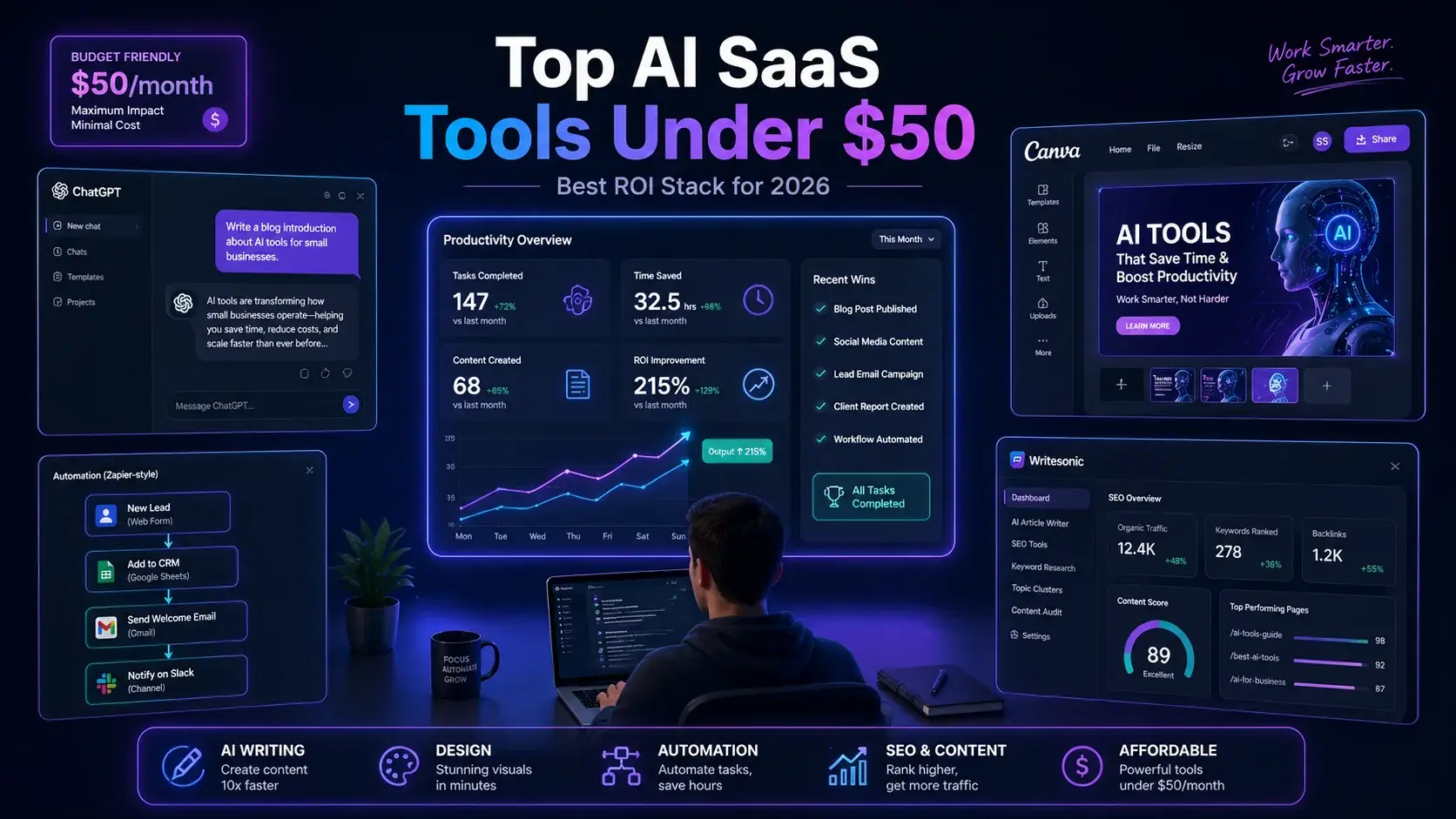
After reviewing implementation data from over 200 startups, vendor case studies, and independent ROI analyses, here are the tools that consistently deliver measurable returns — organized by the actual bottleneck they solve, not by marketing category.
1. The “We Can’t Afford to Hire Yet” Stack (Pre-Seed to Seed)
You’re two to four people. Every dollar matters. Every hour matters more. You need tools that replace headcount, not augment it.
Not ChatGPT. Claude’s context window (200K tokens) means it can ingest your entire codebase, your pitch deck, and your competitive landscape in one session. Technical founders use it for architecture decisions, API design, and debugging edge cases that would take hours on Stack Overflow.
+38% faster code deliveryReplaces a $5,000/month market research contractor. Use it to validate assumptions, map competitive landscapes, and find the specific pain points your target customers are actually talking about — not the ones you assume they have.
60% faster competitive analysisYour startup’s brain. At $10/seat, it turns scattered notes, meeting transcripts, and research into searchable, structured knowledge. The AI summarization alone saves 4-6 hours per week per person on documentation.
35% faster documentationFree tier handles your first 100 contacts. The AI features — email drafting, deal scoring, meeting scheduling — activate at the Starter tier ($0). For B2B startups, this is non-negotiable. You cannot sell effectively without pipeline visibility.
48% faster response speedTotal monthly cost for this stack: $30–$50. Equivalent headcount replacement: 1.5 full-time roles (junior developer, research analyst, sales coordinator).
2. The “We Need to Scale Without Breaking” Stack (Series A)
You have product-market fit. You have 10–30 employees. Your problems shifted from “can we build this?” to “can we support 10x more customers without 10x more people?”
Captures sales calls invisibly (no awkward bot joining), auto-generates CRM updates, and surfaces lead opportunities from conversations you’re already having. At $19.99/mo, it replaces a junior SDR’s admin time.
10+ hrs saved per rep/monthThe 2026 version resolves 55% of inbound tickets without human intervention. For a startup with 500+ active users, this is the difference between hiring a support team and not. The AI learns from your existing help docs and conversation history.
55% ticket automation rateNot for blog posts. For landing page variants, ad copy at scale, and sales enablement content. The 2026 multi-LLM brand voice consistency check ensures your tone is identical whether ingested by ChatGPT or Gemini.
3x content output velocityAt $189/mo, this is expensive for pre-revenue startups. But if you’re SEO-driven and your content is your primary acquisition channel, Clearscope’s real-time semantic grading against AI model preferences is the difference between ranking and not.
+28% conversion increaseThe Complete Comparison: Every Tool, Every Price, Every ROI Metric

Why Most Startups Choose Wrong (And How to Avoid It)
There are three failure modes I see repeatedly. Avoiding them is worth more than any tool recommendation.
- Buying for the team you want, not the team you have. Enterprise AI suites require data infrastructure, dedicated ops, and change management. A 4-person startup has none of these. Start with tools that work out of the box with zero configuration.
- Measuring vanity metrics. “We generated 500 blog posts with AI” is not ROI. “We reduced customer acquisition cost by 23% because our support bot handled tier-1 inquiries” is ROI. Define the metric before you buy the tool.
- Ignoring the integration tax. Every tool that doesn’t connect to your CRM, your project management system, or your analytics stack creates manual work. Manual work is where ROI dies. As of mid-2026, Salesforce’s AI-enhanced CRM remains the integration backbone most startups underutilize.
The Integration Trap
A tool that saves 10 hours/week but requires 5 hours/week of manual data transfer between systems is a net loss. Always calculate the total time cost, not just the advertised savings.
Google’s 2026 Algorithm Reality: Why This Content Structure Matters
Google’s March–May 2026 core updates represent the most significant shift in search ranking factors since the helpful content system launched. The algorithm now detects AI-generated content with unprecedented accuracy, evaluating writing patterns, factual depth, originality of insights, and — critically — evidence of human oversight.
E-E-A-T (Experience, Expertise, Authoritativeness, Trustworthiness) is no longer a guideline. It is a ranking factor. First-hand experience carries the most weight. Content demonstrating genuine, practical knowledge of a topic outranks generic summaries. Product recommendations require evidence the reviewer actually used the product. Professional advice needs case studies, client stories, and documented results.
What this means for your startup’s content strategy: the AI content tools you buy must be paired with genuine expertise. Jasper can draft. Claude can research. But neither can replace the specific insight that comes from having actually done the work. The startups winning in 2026 search are the ones using AI to amplify their expertise, not replace it.
For a deeper dive into how AI personalization impacts your content strategy and customer acquisition funnel, our platform breaks down the specific implementation frameworks that separate high-performing startups from the 90% that fail.
The $100M ARR Question: Can AI Actually Accelerate Growth?
Yes. But not how most founders think.
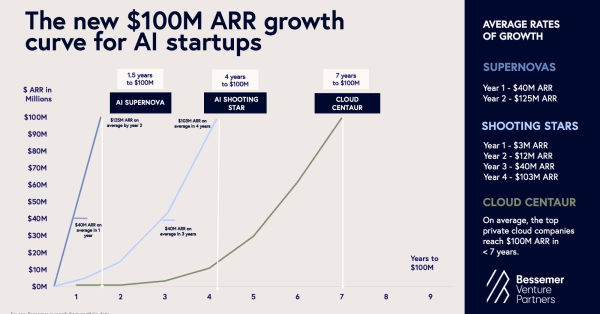
Bessemer Venture Partners’ 2026 data shows AI startups reaching $100M ARR in 1.5 years (the “AI Supernova” path) compared to 7 years for cloud-era companies. But this acceleration applies to a tiny fraction of startups — those with existing distribution, strong technical teams, and clear product-market fit before AI augmentation.
For everyone else, the realistic path is the “AI Shooting Star”: 4 years to $100M ARR. Still dramatically faster than the cloud era. Still requiring the same fundamentals: a product people want, a market that exists, and a team that executes.
AI doesn’t replace those fundamentals. It compresses the timeline between them.
The Implementation Checklist: Before You Buy Anything
Run this checklist. If you can’t check every box, you don’t need the tool yet.
- I can define the specific bottleneck this tool removes in one sentence
- I have a metric to measure success before day one of implementation
- The tool integrates with at least two systems I already use daily
- The monthly cost is less than 2% of my current monthly burn rate
- I have assigned one person to own implementation and measure results
- I have a 30-day evaluation plan with a clear “keep or kill” decision date
Most startups skip item 5. That’s where implementations go to die. Someone needs to own the tool, measure its output, and be accountable for the ROI. Without ownership, you have shelfware.
What I No Longer Recommend (And Why)
Two years ago, I recommended every startup adopt a full AI marketing suite. I was wrong. Here’s what changed:
Generic AI writing tools without brand voice calibration — Most produce content that reads like every other AI-generated article. Google’s 2026 detection systems flag this. The content doesn’t rank. The time spent editing it into something human exceeds the time to write it from scratch.
AI “strategy” platforms that promise automated business planning — They generate impressive-looking documents. None of them account for your specific market dynamics, your team’s actual capabilities, or the regulatory environment you’re operating in. Strategy requires judgment. Judgment requires context. AI doesn’t have your context.
What I recommend instead: buy tools that solve execution problems, not thinking problems. Let AI handle the repetitive. Keep the strategic work human.
Final Thought: The Real Barrier
The real reason most startups won’t implement AI effectively isn’t budget. It’s not technical complexity. It’s the willingness to admit that their current process is broken enough to need replacing.
Founders build processes around their own habits. Those habits become sacred. Changing them feels like admitting failure. But the startups that win in 2026 are the ones that treat their operations as experiments — hypothesis, test, measure, iterate. AI is just the fastest way to run those experiments.
Everything I’ve written here will be partially outdated by January 2027. New tools will launch. Pricing will shift. Google’s algorithm will update again. The framework won’t change: identify the bottleneck, measure the fix, own the result.