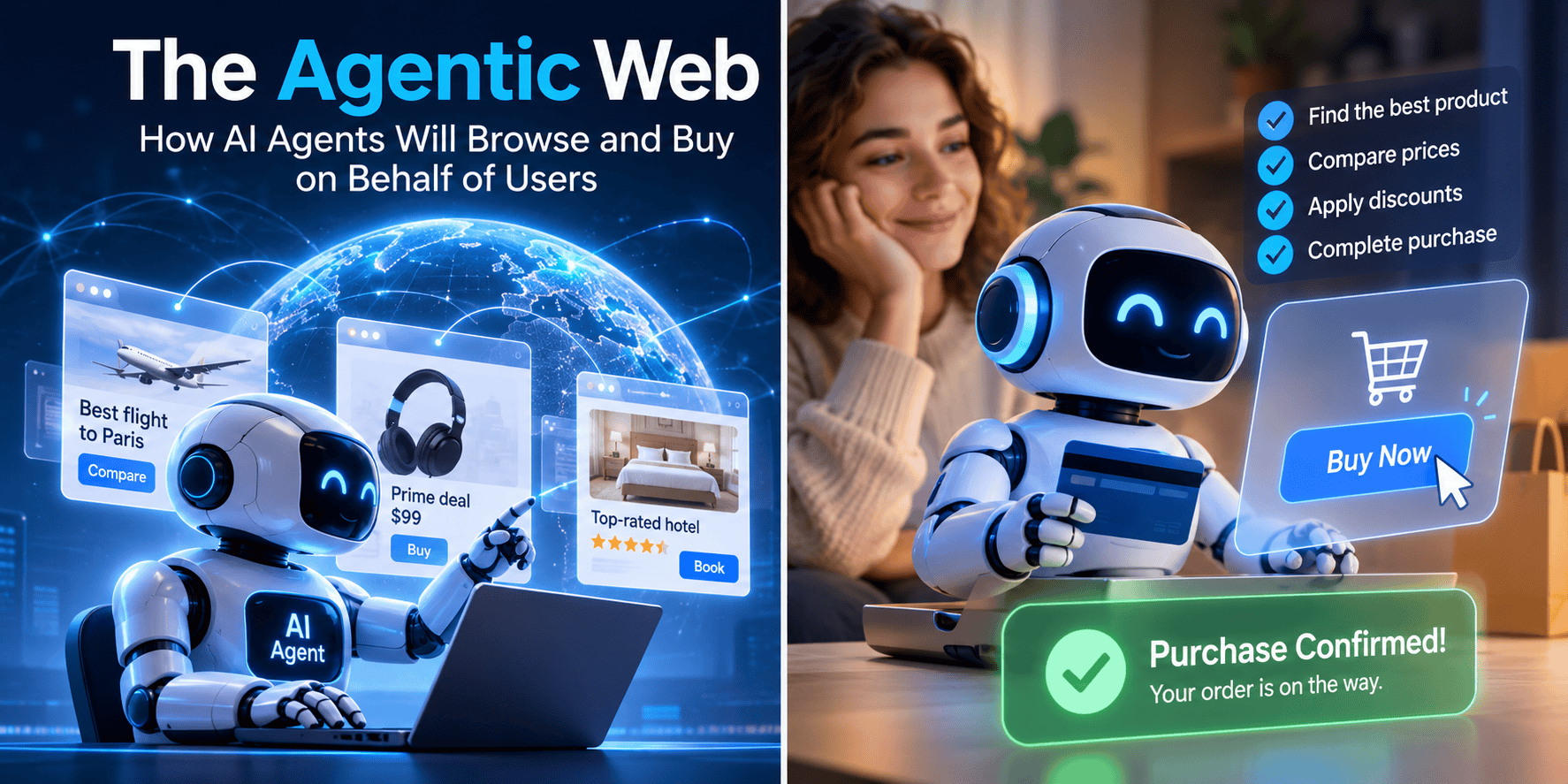

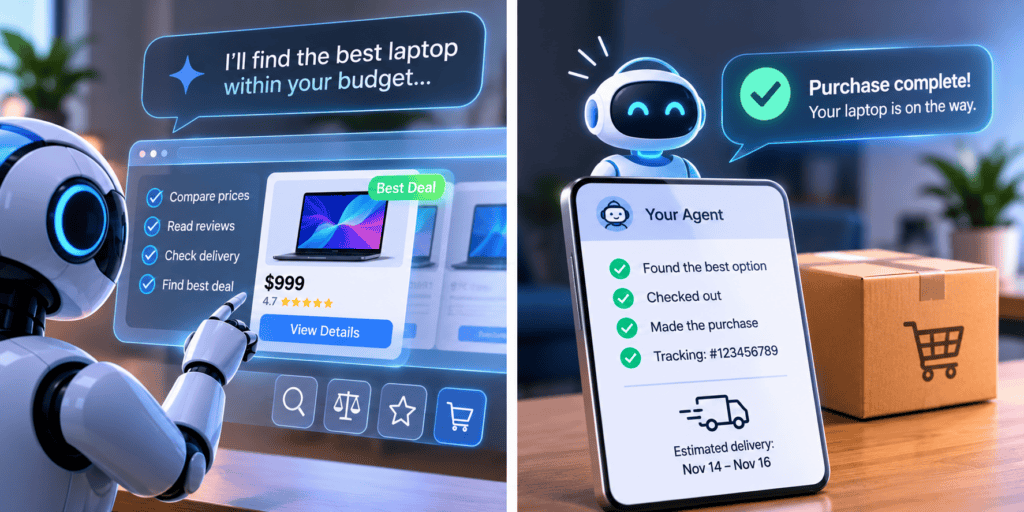
Short answer: AI agents already shape what people buy, but they seldom complete the purchase themselves. The 2026 evidence points to two layers that decide the outcome: product data (can an agent read your catalog and policies?) and payment authorization (who proves the customer said yes?). The checkout button matters far less than either.
Last verified: November 14, 2026. This is a fast-moving topic, so claims that may age quickly carry a date.
Start with the gap between two numbers
In September 2026, AI-referred visitors to U.S. retail sites converted 90% better than other traffic and produced 83% more revenue per visit, according to Adobe’s analysis of more than 1 trillion visits. A year earlier, they converted 9% worse.
In the same weeks, Uber’s CFO said third-party AI agents booked four rides in a week of roughly 320 million trips, plus about 500 Uber Eats orders (Fortune, Beri). DoorDash’s CEO put outside-agent orders at “maybe several hundred” in total since those agents launched in September.
Both facts are true. Agents are very good at sending a shopper who has already narrowed the choice. They are almost absent where an agent must complete the order. Most coverage blurs this, and the blur is the main analytical error in the field.
Agent-assisted and agent-executed are different markets
| Agent-assisted | Agent-executed | |
|---|---|---|
| What happens | The AI researches, compares, recommends | The AI places the order with a credential the human delegated |
| Who pays and where | The human, on the merchant’s site | The agent, inside a chat or wallet |
| 2026 signal | Adobe: +71% YoY AI traffic, 90% better conversion (Sept) | Uber: 4 rides in a week; DoorDash: several hundred orders total |
The survey data splits along the same line. McKinsey’s consumer survey of about 21,000 people in 11 markets, fielded in June and published October 28, found:
- 53% of consumers had used AI for shopping in the past three months (48% in the U.S.).
- 14% of AI users globally had completed a purchase directly inside an AI tool. In the U.S., that share rose from 10% to 17% compared with the prior year’s research.
- In the top six categories, 21–30% of AI users said they would let AI complete a purchase, roughly 1.5 times the share who actually had.
Two cautions. These are self-reported figures, and McKinsey’s definition of “AI tool” includes retailer assistants, so the survey is not directly comparable with the order logs Uber and DoorDash cited. Those logs cover only third-party agents. My reading: the survey captures a real but mostly retailer-hosted behavior, while the logs show that independent agents have not yet earned the order. I can’t prove that split from published data.
What the Instant Checkout post-mortem shows
OpenAI launched Instant Checkout on September 29, 2025, and announced on March 24, 2026 that retailers could use their own checkout while it focused on product discovery. The clearest evidence came from Walmart. Its EVP of AI acceleration, Daniel Danker, told Wired that purchases completed inside ChatGPT converted at about one-third the rate of shoppers who clicked through to Walmart.com, after Walmart had listed around 200,000 products.
Walmart then put its own assistant, Sparky, inside ChatGPT and later Gemini (The Paypers). The structure inverted: discovery stays in the AI platform, and the transaction stays with the retailer.
The data supports a narrower reading than “consumers don’t trust AI to buy.” People accepted an agent finding the product. They did not complete the purchase when a chat window owned the transaction. Those are separate problems:
- Conversion. One merchant’s figure, relayed by trade press, but the strongest datapoint available.
- Thin participation. Roughly 30 Shopify merchants ever turned the feature on, per analyst reporting summarized here.
- Lost control. Retailers still carry fulfilment, returns, and support. They will not hand the surrounding experience to a platform unless it brings demand they can’t get elsewhere.
The third is the structural one, and it is my judgment rather than a sourced finding.
Update: ChatGPT Wallet (November 13, 2026)
OpenAI has now come back with a different design. ChatGPT Wallet launched on November 13 for a limited group of U.S. Pro subscribers aged 18+ with a U.S.-issued Visa, Mastercard or American Express. Four design choices stand out:
- The agent pays with a payment token, not the card number, and the merchant never sees card details.
- The user reviews items, total, and card, then approves each purchase with Face ID or a fingerprint.
- Card rewards and dispute rights are preserved, and the merchant still handles orders and returns.
- Spending limits and pre-approved purchases are described as a future option, not a launch feature.
Notice what this is not: it is not an agent buying on its own judgment. The human authorization step sits between agent and payment. It is also too new to have any performance data, so treat it as a design signal, not a result.
Execution is a retailer’s game so far
Amazon says more than 400 million customers used Alexa for Shopping in the past 12 months, and it blocked Meta’s Muse agent in September. Its CEO has said he expects to work with outside agents, but wants Alexa to be the main way people shop Amazon.
McKinsey adds the detail that matters here: AI platforms dominate discovery, but at the purchase step retailer assistants are used about as often (15%) as stand-alone AI tools (14%). Retailers already hold live inventory, payment and delivery infrastructure, which is exactly what an agent needs at the last step.
The protocol stack: layers, not a single race
The acronyms are often written up as rivals. They mostly do different jobs.
| Protocol | Backer | Job | Status (verified Nov 2026) |
|---|---|---|---|
| ACP (Agentic Commerce Protocol) | OpenAI and Stripe | Checkout conversation between agent and merchant | Open specification, still maintained by OpenAI and Stripe after Instant Checkout ended |
| UCP (Universal Commerce Protocol) | Google, with Shopify, Etsy, Wayfair, Target, Walmart | Discovery, catalog, cart, checkout, identity linking | Launched January 11, 2026; cart and identity linking added in March |
| AP2 (Agent Payments Protocol) | Google-initiated, now at the FIDO Alliance | Proving that a user authorized a payment | v0.2 in April 2026; donated to FIDO on April 28 alongside Mastercard’s Verifiable Intent |
One correction to common coverage: it was AP2, not UCP, that Google donated to the FIDO Alliance. Google’s Universal Cart, announced at I/O on May 19, 2026, is a consumer product built on UCP and Google Wallet, not a protocol of its own.
Why capability declarations matter: a merchant publishes what an agent may do before it does anything. A shopper whose agent filters on “free returns within 30 days” never opens your returns page. Either your terms are machine-readable, or you drop off the shortlist.
Where trust has to live
An agent that reads the open web ingests text from parties it cannot vet. OpenAI said in December 2025 that prompt injection, meaning hidden instructions in pages or emails, is unlikely ever to be fully solved. The UK’s National Cyber Security Centre gave similar guidance: reduce risk and limit impact rather than expect a cure.
If you accept that, the design consequence is blunt: the agent’s reasoning cannot be the control.
| Layer | Can it be fooled? | What bounds the damage |
|---|---|---|
| User intent | No, it is the source | Limits the user sets |
| Agent judgment | Yes, via hostile page content | Nothing, by itself |
| Payment credential | Not by text | Token scope, per-purchase approval, expiry |
| Merchant | Not by the agent | Seller-of-record duties: fulfilment, refunds |
A hidden line on a product page can tell an agent to switch sellers. A model-level defense may catch it. A credential scoped to one merchant and one amount, or a biometric approval the agent cannot perform, limits the harm when the defense misses. The cost is friction: more approval steps for multi-item or multi-merchant baskets, which is where cross-merchant carts will be tested. I found no published data on how often scoped flows force a human step, so their conversion cost is unknown.
The courts have, for now, treated the agent as the user
Amazon sued Perplexity in November 2025 over its Comet browser agent. A district court granted a preliminary injunction on March 9, 2026. On August 4, a unanimous Ninth Circuit panel vacated it in Amazon.com Services LLC v. Perplexity AI, Inc. (No. 26-1444), reasoning that the user, not Perplexity, is the party accessing Amazon under the federal CFAA and California’s analogue. Amazon petitioned for rehearing en banc on August 18, and the court denied it on September 10.
Limits on that ruling: it reviewed a preliminary injunction on a preliminary record, the case returned to the district court, and I found no report of a Supreme Court petition as of today. Law firms note it leaves open whether platforms can restrict agents through terms of service. I have not read the full opinion beyond the excerpts in these summaries.
The strategic reading: if hacking law is a weak tool against user-directed agents, platforms are left with technical blocking, as Amazon’s treatment of Muse shows, or a better-sanctioned path. Protocols are the merchant-controlled version of that path: opt in, declare capabilities, set terms.
Who wins: gatekeepers or the open web?
In the short term, the gatekeepers. Amazon is closing its store to outside agents while scaling its own, and McKinsey’s checkout data shows retailer assistants holding their ground at the final step.
The open-web case depends on agents optimizing price and value over convenience. No one publishes agent-executed sales by retailer, so that claim can’t be tested today.
The distinction I would defend, and have not seen made plainly elsewhere: the contest is not “agents versus websites.” It is over who holds the authorization of record, the entity whose approval the payment network treats as the customer’s consent. ChatGPT Wallet puts it in the user’s device and card network. AP2 puts it in signed, verifiable mandates. Retailer assistants put it in the retailer’s own account. Whoever holds it keeps the relationship regardless of which agent did the browsing. This is my analysis, not a sourced finding.
Personalization moves upstream, to the machine reader
Today a retailer personalizes for a person. With agents, the preference model (budget ceiling, return tolerance, brand exclusions) lives in the agent, and the retailer is read by a machine applying those constraints. Two data points show how far retailers are from ready:
- Shopify says AI searches hitting its structured catalog convert at roughly twice the rate of those relying on scraped or stale data (reported in the McKinsey piece above, so treat it as a vendor figure).
- Adobe scored the average U.S. retail homepage at 63% in September, meaning more than a third of its content is not visible to the AI systems sending shoppers.
What to do on Monday
If you run a store
- Fix the catalog before touching a protocol. Complete attributes, current price and stock, and policies written so a machine can parse them. Every route depends on this.
- Keep checkout on your domain until you have measured. Walmart’s one-third figure is the warning.
- Tag agent-referred and agent-executed orders separately. Without that split, you can’t tell the 90%-better visitor from the four-rides buyer.
- Set an agent-access policy on purpose. Decide which agents you allow and what you rate-limit. Blocking through terms alone looks shaky after the Perplexity ruling.
If you build agents
- Put limits in the credential, not the prompt: per merchant, per amount, per currency, with expiry.
- Require human confirmation for first-time merchants and for any basket that changes after approval.
- Treat every page the agent reads as hostile input, and log the content that preceded each purchase action for post-incident review.
If you must pick one protocol today, don’t. Build the data layer protocol-neutral and keep the adapter thin. Instant Checkout ended in March, AP2 changed hands in April, and Wallet arrived in November.
Frequently asked questions
Can AI agents buy things for you right now? Yes, in limited form. ChatGPT Wallet (limited U.S. Pro rollout, November 13), Amazon’s Alexa for Shopping and Walmart’s Sparky can complete purchases, usually with the user approving. Fully autonomous buying is not yet an offered feature at scale.
Do shoppers trust AI to complete purchases? Stated willingness exceeds behavior. In McKinsey’s survey, 21–30% of AI users said they would let AI buy in top categories, against 14% who had done so. Weight behavior over stated intent.
Why did ChatGPT Instant Checkout fail? Walmart reported in-chat purchases converting at about one-third the rate of click-throughs; few merchants joined, and retailers wanted to keep control of checkout. OpenAI moved to merchant-owned checkout in March 2026.
What is the difference between ACP, UCP, and AP2? ACP handles the agent-to-merchant checkout conversation, UCP covers discovery, catalog, and cart, and AP2 proves that a user authorized a payment.
Is it legal for an AI agent to shop on a site that doesn’t want it? Unsettled. The Ninth Circuit held in August that Amazon was unlikely to win its hacking-law claim against Perplexity’s agent, but the case is ongoing and terms-of-service questions remain open.
How strong is the evidence?
From strongest to weakest: court orders (the order and summaries read, not the full opinion); company statements on earnings calls and to the press (Uber, DoorDash, Walmart, Amazon); large consumer surveys, which measure intent and self-reported behavior; vendor telemetry such as Adobe’s, which reports relative rather than absolute conversion; analyst forecasts. I ran no tests of agents or checkouts for this piece, and every figure is reported from the linked sources.
What would change this analysis: published agent-executed sales by retailer; first performance data from ChatGPT Wallet; Amazon petitioning the Supreme Court, or a district-court ruling on the remaining claims; evidence that scoped-token flows don’t depress conversion.
Update log: Nov 14, 2026. Added ChatGPT Wallet (Nov 13), Uber and DoorDash agent-order data, McKinsey’s October publication, Adobe’s September figures, and the denied rehearing in Amazon v. Perplexity. Corrected the AP2/UCP donation attribution. Removed unverifiable figures from earlier drafts.