

How AI Is Changing Personalized Shopping
— And What It Means for You
TL;DR — What You Need to Know in 2 Minutes
AI-driven personalization is no longer a background feature on e-commerce sites. It is now the primary mechanism through which products find buyers — and increasingly, the mechanism through which buyers find products, before they ever open a retailer’s website.
- The scale is staggering. Amazon attributes 35% of its total revenue to AI recommendations. Amazon’s Rufus AI shopping assistant served over 300 million customers in 2025 alone, generating an estimated $12 billion in incremental sales.
- AI chatbots are becoming storefronts. Traffic to US retail sites from AI sources grew 693% during the 2025 holiday season (Adobe Analytics). Shoppers who arrive via AI convert 31% more and bounce 33% less than those from other sources.
- Most consumers now expect it. 71% of shoppers expect personalized experiences, and 76% are frustrated when brands fail to deliver them. At the same time, 53% have experienced at least one negative outcome from poor personalization (Gartner, 2025).
- Privacy is the unresolved tension. 82% of consumers say they’ll share data for better experiences — but 43% of UK businesses suffered a breach in 2024, and 76% of new generative AI products carry privacy or data risks.
- This is not all upside. Personalization done poorly is now measurably worse than no personalization at all. Customers who receive bad recommendations are 3.2× more likely to regret their purchase.
- What you should actually do: Understand what data you’re sharing. Use AI shopping tools deliberately. Know when to opt out. And don’t confuse relevance for manipulation — they’re different things, and the line matters.
There’s a moment most online shoppers recognize. You look at a pair of running shoes, close the tab, and then — across three different apps and a news site — those exact shoes follow you around the internet for a week. That feeling, somewhere between impressed and unsettled, is what early AI personalization felt like.
That was five years ago. What’s happening now is meaningfully different, and it deserves a clearer explanation than the usual breathless “AI is transforming shopping” coverage provides.
This piece tries to do that: explain honestly what AI personalization in shopping actually is, show where it works and where it fails, lay out the privacy trade-offs with real numbers, and give you practical ways to navigate it as a consumer. No hype in either direction. Just what the evidence actually shows.
1. How We Got Here: A Brief History of Retail Personalization
Amazon introduced its collaborative filtering recommendation engine in 2003 — publishing the algorithm in a now-famous IEEE paper that described “customers who bought this also bought that.” It was crude by today’s standards, but it worked. Within a few years, Amazon reported that recommendations drove a meaningful fraction of its sales.
Netflix ran its famous $1 million prize competition from 2006 to 2009, challenging researchers to improve its recommendation algorithm by 10%. The winning team did it — but Netflix never actually deployed the winning solution, partly because the computational costs were too high and partly because the world had shifted to streaming by then. Still, the prize spurred a generation of machine learning researchers to focus on recommendations, and its effects rippled through the entire industry.
Spotify built Discover Weekly in 2015, which remains one of the most beloved personalization products ever made. The key wasn’t just the algorithm — it was the weekly cadence, the playlist format, and the genuine sense of discovery it created. People shared it. They talked about it. It felt human.
What changed between then and now isn’t just the sophistication of the algorithms. It’s three things working together: vastly more data, dramatically cheaper compute, and the arrival of large language models that can understand natural-language intent, not just behavioral signals.
The result is a qualitative shift in what personalization can do. Earlier systems answered “what does this user’s behavior suggest they want?” Current systems can answer “what does this user actually mean right now, in this context, given everything we know about them?” That’s a different question, and it leads to different — sometimes genuinely useful — experiences.
2. How AI Personalization Actually Works (Without the Jargon)
There are four main things AI systems are doing when they personalize a shopping experience for you. Understanding them roughly — you don’t need a computer science degree — helps you make better decisions about what data you share and when.
Collaborative Filtering (What People Like You Did)
This is the oldest and most common technique. The system groups you with other users who have similar purchase histories, browsing patterns, or demographic signals, and then surfaces what those users bought next. It’s effective for popular categories and fails for niche ones — because “people like you” only works when there are enough people like you in the dataset.
Content-Based Filtering (What This Product Is Like)
Instead of looking at other users, content-based filtering analyzes the attributes of products themselves — category, price range, materials, brand tier — and finds similar items based on what you’ve engaged with. This works better for new users and unusual preferences, though it tends to create a narrowing effect where you only see more of what you’ve already seen.
Contextual and Real-Time Signals
Modern systems layer in signals beyond purchase history: what time it is, what device you’re on, where you are geographically, what you’ve searched in the last few minutes, and even how fast you’re scrolling. A retailer’s app might show you different items at 7am on a Monday than at 8pm on a Saturday — because the data suggests those contexts correlate with different buying intent.
Large Language Model (LLM) Intent Understanding
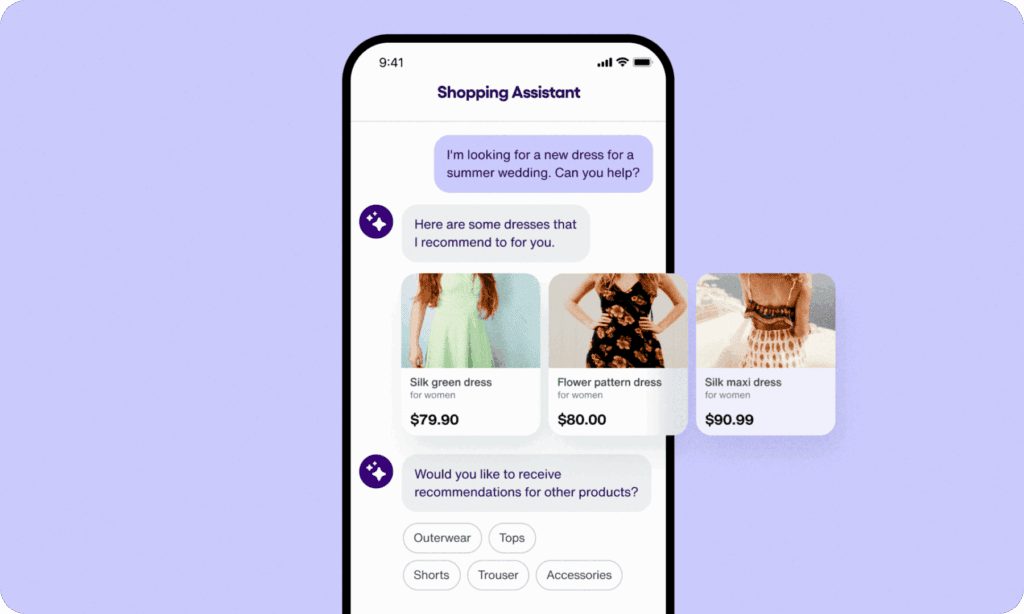
This is the genuinely new development. When you type “I need a gift for my dad who just retired and likes cooking but hates gadgets” into ChatGPT Shopping or Amazon’s Rufus, the system isn’t pattern-matching keywords. It’s parsing the meaning of your request — the constraints, the tone, the implicit price range — and generating recommendations that fit the actual situation. That’s a fundamentally different capability than any previous recommendation system.
“The shift from behavioral prediction to natural-language intent understanding is the real inflection point. It’s not just a better algorithm — it’s a different category of tool.”
3. The Platforms Doing This Right Now in 2026
The landscape has consolidated quickly. There are now four major AI shopping surfaces, each with a different approach, different data access, and different strengths for consumers.
| Platform | Key Strength | Data They Use | Buyer Profile | Notable Metric |
|---|---|---|---|---|
| Amazon Rufus / Alexa for Shopping | Deepest purchase history; best for repeat categories | Your Amazon orders, browsing, Alexa queries | High purchase intent; already in buy mode | 300M customers served in 2025; $12B incremental sales est. |
| ChatGPT Shopping | Natural-language research; 900M weekly users | Conversation history; Shopify catalog (automatic) | Research-first; open-minded; higher AOV | Shoppers arrive 70–80% decided; 31% higher conversion vs. other sources |
| Perplexity Shopping | Real-time web data; PayPal instant checkout | Search history; PayPal account for checkout | Leans premium; researched buyers | 57% higher average order value than typical e-commerce |
| Google AI Mode / Gemini | Integrated with Google Shopping; shoppable image grids | Search history, Gmail (opt-in), Chrome behavior | Broad demographic; price-conscious | Still dominant at 60%+ of product search starts (Datos, Q1 2026) |
A few things worth noting about this table: Amazon’s data advantage is enormous, but it only works for products you’ve already bought or categories you’ve already explored on Amazon. ChatGPT is genuinely useful for gift-buying and exploratory research, but merchants have limited visibility into how it selected their product. And Google, despite all the AI overlays, still handles the majority of actual shopping-related searches — the shift to other AI tools is real but shouldn’t be overstated.
Amazon launched its combined “Alexa for Shopping” on May 13, 2026, merging the Rufus AI assistant with Alexa+’s personalization layer into a single interface across its app, website, and Echo Show devices. This is Amazon’s most significant personalization product move in years — it brings conversational AI into every stage of the purchase journey, from discovery through post-purchase support.
4. The Numbers That Actually Matter
There’s a lot of data floating around about AI shopping. Much of it is marketing. These are the figures that hold up to scrutiny, with their sources.
The conversion data from Adobe is particularly worth dwelling on. AI-referred shoppers converting 31% higher isn’t just a nice number — it suggests these shoppers arrive with their decision largely made. They’ve already had the research conversation with an AI; the retailer’s job is not to persuade them but to not get in the way. That shifts what good retail UX means.
The Gartner figure about negative personalization outcomes is equally important to understand. Personalization done poorly — wrong segment assumptions, creepy over-targeting, irrelevant suggestions based on stale data — generates measurable regret. Gartner’s survey found that customers who had bad personalization experiences were 3.2 times more likely to regret their purchase than those who received no personalization. That’s a cost, and it’s real.
5. Verified Case Studies: What the Data Shows
Amazon Rufus: From Chatbot to Revenue Engine
Amazon launched Rufus as an AI shopping assistant embedded in its mobile app in early 2024, expanding to the full US in mid-2024. Rufus can answer natural-language questions like “what kind of tent is good for rainy weather camping?” and pull through relevant product listings with contextual reasoning.
By end of 2025, Rufus had 300M customers engage with it, and independent analysts estimated it generated approximately $12B in incremental sales. Amazon’s own figures show Rufus-driven sessions have a 60% higher conversion rate among active users compared to standard search sessions. On Prime Day 2025, traffic from AI shopping assistants increased 3,300% year-over-year — a figure that reflects both Rufus’s growth and the broader shift in how shoppers research on Amazon’s platform.
Source: Opascope AI Shopping Assistant Guide 2026; Capital One Shopping Research; Amazon public statements.
Spotify’s Discover Weekly: The Personalization Gold Standard
Spotify’s Discover Weekly, launched in 2015, remains the most-studied consumer personalization success in the subscription economy. The system uses a combination of collaborative filtering (what users with similar taste histories like) and natural language processing of editorial playlists to generate a 30-track personalized playlist each Monday.
Spotify reported in its 2024 annual report that users who engage with AI-personalized features (Discover Weekly, Daily Mixes, AI DJ) have significantly higher retention rates than those who don’t. MAUs reached 713 million in Q3 2025, growing 11% year-over-year. Premium subscriber growth of 12% YoY to 281M is partly attributable to the stickiness of its recommendation products. The AI DJ feature — which provides contextual commentary alongside personalized song selections — has since been expanded to 18+ markets in Spanish and represents Spotify’s most advanced personalization deployment.
Source: Spotify Form 6-K, Q3 2025 (SEC filing); Spotify investor reports 2024–2025.
AI-Referred vs. Standard Shoppers: Adobe’s 2025 Holiday Data
Adobe Analytics tracked shopping traffic across hundreds of US retail sites during the 2025 holiday season, comparing behavior of visitors arriving via AI platforms (ChatGPT, Perplexity, Gemini) vs. traditional sources (organic search, social, email, direct).
AI-referred shoppers were 33% less likely to bounce immediately from product pages. They converted at rates 31% higher than average. The total traffic from AI sources grew 693% year-over-year — an absolute number still small relative to Google and direct traffic, but growing at a pace that justifies retailer attention. The data also showed AI shoppers had higher average order values, consistent with the Perplexity data showing 57% higher AOV for its shopping users.
Source: Adobe Analytics, reported by Shopify (April 2026); Adobe Holiday Shopping Report 2025.
6. What This Means for You as a Consumer
The honest answer is: it depends on how you use these tools and how much you think about the trade-offs. There are genuine benefits. There are also real costs. Let’s take them in turn.
✓ Real Benefits
- Faster path from need to the right product — AI shoppers make decisions 47% faster (Shopify, 2026)
- Genuinely useful for gift-buying, where knowing another person’s taste is the hard problem
- Better price discovery — AI assistants surface price histories and alternatives that basic search misses
- Natural language queries eliminate the need to know the “right” search terms for a product category you’re new to
- Reduced regret when recommendations are good — accurate suggestions reduce post-purchase doubt
✗ Real Costs
- Filter bubbles: recommendations can narrow your awareness of categories and brands you haven’t tried
- Data accumulation you can’t easily undo — behavioral signals are retained by default in most platforms
- Manipulation risk: recommendations aren’t always neutral; sponsored products can surface in “AI-selected” results
- Regret when personalization goes wrong — 3.2× more likely if system has wrong assumptions about you
- Reduced price sensitivity: when AI pre-selects premium products, you may spend more than you intended
Practical Decisions Worth Making
A few things I’d suggest thinking about, not as mandatory rules but as worth your consideration:
Distinguish research tools from purchase tools. ChatGPT and Perplexity are genuinely good for research — asking open-ended questions, comparing options, understanding what you actually need. But buying through these platforms (especially those with instant checkout) compresses the decision-making time that sometimes saves you from a bad purchase. There’s value in a cooling-off period.
Check whether “AI-recommended” means sponsored. Google AI Mode explicitly serves ads in its AI shopping responses. ChatGPT’s current model does not, though OpenAI has announced intentions to add advertising. Perplexity runs sponsored product placements within its shopping results. Knowing which is which matters for how much weight you give the recommendation.
Periodically reset your signals. On Amazon, you can manage your browsing history and purchase-based recommendations in your account settings. Clearing or correcting your history — marking items you bought as gifts, for instance — genuinely improves future recommendations. Most platforms have this functionality; few people use it.
Don’t mistake familiarity for quality. AI systems optimize for what they predict you’ll buy, not necessarily for what’s objectively best. For high-stakes purchases — furniture, electronics, anything you’ll live with for years — spending twenty minutes on a specialist forum or review site is still worth it.
7. The Privacy Problem Nobody Talks About Honestly
Here’s the uncomfortable reality: 82% of consumers say they’ll share personal data in exchange for a more personalized experience (Demandsage, 2026). And 43% of UK businesses suffered a data breach or cyberattack in 2024 (UK Cyber Security Breaches Survey). These two facts exist simultaneously, and most coverage addresses one without the other.
The research from the 2026 CHI Conference (Wageningen University / TU Delft) is one of the more rigorous recent examinations of this trade-off. Their paper on “Privacy Harms vs. Economic Risk in Personalized AI Adoption” found that 76% of new generative AI products carry privacy or data risks, citing a joint IBM and AWS study. The same paper identified the “privacy paradox” — people say they care about privacy, but consistently reveal more information than their stated preferences would suggest.
The reasons are understandable. The benefit of sharing (a better recommendation right now) is immediate and concrete. The cost of sharing (potential data breach or misuse, sometime in the future, by someone you’ll never know) is diffuse and abstract. Behavioral economists call this hyperbolic discounting, and AI shopping experiences are very well designed to exploit it.
The Regulatory Picture in 2026
144 countries now have data protection or consumer privacy laws on the books (Usercentrics, 2026). In the US, more than 20 states have enacted comprehensive consumer privacy legislation as of early 2025, and 42% of states now have some form of data privacy law. GDPR in Europe remains the most stringent framework, and enforcement has been meaningful — British Airways’ £20 million fine for a 2018 breach and Meta’s various GDPR penalties are genuinely consequential.
What this means practically: if you’re in the EU, you have opt-out rights and data subject access rights that are worth using. If you’re in the US, your rights vary significantly by state, but California’s CCPA gives residents meaningful control. Understanding what you’re entitled to is worth twenty minutes of reading.
Many platforms describe their data practices as “anonymized” or “aggregated.” These terms are technically meaningful but can mislead. Research consistently shows that shopping behavior patterns are highly individuating — your purchase sequence across categories is often unique enough to re-identify you from an “anonymized” dataset. McKinsey’s research (2022) found that AI-based data anonymization techniques improve personalization accuracy by 30% while maintaining privacy — which also means the anonymization is imperfect and privacy is only “maintained” in a qualified sense.
8. When AI Personalization Goes Wrong
The failure modes of AI personalization are worth understanding because they’re not obvious, and they’re not rare. They fall into roughly three categories.
Wrong Signal, Wrong Person
A classic example: you buy a baby shower gift on Amazon for a colleague. For the next three months, you’re served baby products. The system doesn’t know this purchase was out of character — it just knows you bought it. This is the “gift problem,” and it’s still largely unsolved even in 2026. Most platforms offer ways to mark purchases as gifts, but default settings don’t assume this.
The Gartner survey (June 2025) found that 53% of consumers have experienced a negative outcome from personalization. The most common complaints: irrelevant recommendations based on outdated signals, recommendations that felt intrusive or “creepy,” and suggestions that clearly reflected incorrect assumptions about the user’s identity or preferences.
Personalization as Pricing Signal
There’s an under-reported practice called dynamic pricing personalization, where the price you see for a product is influenced by signals about your affluence, device type, location, and purchase history. If you’ve previously bought expensive items, you may be shown higher-priced options by default — not because they’re more relevant, but because the system has categorized you as a high-value customer. This is legal in most jurisdictions, often disclosed in terms of service, and rarely understood by consumers.
The Narrowing Effect
Long-term recommendation exposure creates a real filter bubble effect in shopping. If you’ve bought outdoor gear on REI, you’ll keep seeing outdoor gear — and your awareness of what else REI sells may genuinely narrow over time. The same happens with brand discovery: AI recommendation systems strongly favor brands with existing engagement data, which disadvantages smaller or newer entrants. A study from the McKinsey Global Institute found that fast-growing companies derive 40% more of their revenue from personalization than slower-growing counterparts — a dynamic that partly reflects incumbent advantage in recommendation systems.
9. Where This Is Going: 2027 and Beyond
The trajectory is reasonably clear on some dimensions and genuinely uncertain on others. A few things that are already in motion:
Agentic Shopping: AI That Buys for You
The next significant shift isn’t better recommendations — it’s AI systems that complete purchases autonomously on your behalf. Amazon’s new Alexa for Shopping (launched May 2026) moves in this direction: you can ask it to “reorder the coffee pods when we’re running low” and it handles the rest. AI-powered shopping agents acting on behalf of consumers are projected to drive up to $1 trillion in US retail revenue by 2026–2027 (Demandsage). This figure should be treated with appropriate skepticism — projections at this scale often don’t land on schedule — but the direction is clearly established.
Synthetic Data and Privacy-Preserving Personalization
One of the more interesting technical developments is the use of synthetic data — artificially generated datasets that statistically resemble real user behavior — to train personalization models. By 2026, an estimated 75% of businesses will use generative AI to create synthetic customer data, reducing the need to train on actual personal information (Gartner, 2025). This could substantially improve the privacy math of personalization — though it introduces its own complexities around whether synthetic data faithfully represents real diversity of experience.
The Recommendation Engine Market
The commercial stakes are substantial. The recommendation engine market was valued at $8.2 billion in 2025 and is projected to reach over $82.8 billion by 2034, at a CAGR of 28.4% (Demandsage, 2026). AI in e-commerce broadly is projected to hit $51 billion by 2033 (Shopify, 2026). These are large numbers, but they reflect something real: recommendation technology is now core infrastructure for any retailer of meaningful scale, not an optional enhancement.
“The question isn’t whether AI will personalize your shopping. It already does. The question is whether you understand how, and whether the trade-offs are ones you’ve consciously chosen.”
What Might Go Differently Than Expected
It’s worth being honest about what could slow or redirect this trajectory. Regulation is the biggest variable. If the EU pushes through stricter rules on behavioral targeting — something that’s been under discussion — it could force platforms to rely more heavily on contextual signals and first-party data, potentially improving privacy outcomes but reducing personalization quality. Consumer backlash is another real factor; trust, once lost, is expensive to rebuild, and the platforms that experience high-profile data incidents or manipulative recommendation practices will pay for it in churn.
There’s also a genuine open question about whether AI recommendations will keep improving as they scale, or whether they’ll hit a ceiling of “good enough” beyond which more data and more compute don’t meaningfully improve the experience. The history of recommendation systems suggests diminishing returns do eventually set in.
Frequently Asked Questions
Is AI personalization actually accurate, or does it just feel accurate?
Both, honestly. Systems like Amazon’s and Spotify’s have real predictive power — Amazon’s 35% revenue attribution and Spotify’s retention data both reflect genuine behavioral impact. But research from Gartner (2025) found that 53% of consumers have experienced a negative outcome from personalization, suggesting the accuracy is uneven and context-dependent. The feeling of accuracy is partly constructed by exposure: you notice the hits and forget the misses.
Does AI shopping mean I’ll pay more?
Not necessarily more in price, but potentially more in total spend — AI-assisted shoppers make decisions faster and convert at higher rates, which suggests they exercise less deliberate caution. Perplexity Shopping users have a 57% higher average order value than typical e-commerce shoppers. Whether that’s because they’re buying better things or just more expensive things is harder to parse from the data alone.
How do I opt out of AI personalization?
Each platform is different. On Amazon, go to Account → Browsing History → Manage History to pause or clear tracking, and to Recommendations → Improve Your Recommendations to provide corrections. Google’s Ad Settings and My Activity pages give control over behavioral targeting. Most platforms have similar settings; they’re just not prominently surfaced. If you’re in the EU, GDPR gives you the right to request deletion of your behavioral data.
Are AI shopping recommendations neutral, or do they favor certain brands or sellers?
They are not neutral. Amazon’s Buy Box algorithm, Google AI Mode’s ad placements, and Perplexity’s sponsored product listings all mean commercial relationships influence what you see. ChatGPT Shopping currently doesn’t run sponsored placements, though OpenAI has signaled this may change. The distinction matters: a recommendation from a model with no commercial stake in the outcome is different from one that surfaces paying advertisers.
Is AI personalization better for some types of purchases than others?
Yes, substantially. It works best for replenishment (things you buy regularly), gift-buying in unfamiliar categories, and research-heavy purchases where you need to understand trade-offs. It works least well for highly personal aesthetic choices (furniture, art, fashion), purchases that require physical try-on, and categories where you’re building knowledge for the first time and don’t yet know what “good” looks like.
How does AI know what to recommend without me explicitly telling it my preferences?
Mostly through behavioral inference: what you click, how long you spend on a page, what you add to a cart and then remove, your purchase history, and signals shared across the platform’s broader user base. More recent systems also use contextual signals like your location, device, time of day, and the content of your search queries. You don’t need to tell it your preferences — your behavior reveals them, often more accurately than you’d self-report.
Will AI eventually shop for me automatically, without my involvement?
That’s the direction the industry is moving. Amazon’s Alexa for Shopping (launched May 2026) and similar agentic systems are designed to handle replenishment and low-stakes purchases autonomously. For higher-consideration purchases, full autonomy is further off — the failure cost of getting it wrong is too high, and consumer trust in autonomous purchasing is still limited. Most people want a confirmation step even if the AI does all the research.
Does using AI shopping tools compromise my privacy more than regular online shopping?
In some ways, yes — conversational AI assistants collect richer intent data than search queries do. A search for “running shoes” reveals less about you than a conversation about training for your first marathon at 52 with a bad knee. That richer data enables better personalization but also creates more granular profiles. Whether that’s an acceptable trade-off is a personal judgment, but it’s one worth making consciously.
Is AI personalization changing what products get made, not just what gets recommended?
Increasingly, yes. Retailers are using aggregated AI personalization data to inform product development — what features are frequently searched for but not found, what price points consistently see abandoned carts, what combinations of attributes drive repeat purchase. This feedback loop between consumer behavior and product development is real and growing, though its effects play out over years rather than months.
How should small and independent retailers think about competing with AI-powered giants?
The competitive disadvantage is real but not insurmountable. Large platforms have behavioral data at scale; independent retailers rarely do. But they have things AI struggles to replicate at scale: deep category expertise, genuine curation, and the ability to build actual relationships with customers who value those things. For many categories — specialist outdoor gear, local food, artisan goods — the human recommendation from a knowledgeable person still beats the algorithmic one. The key is not to try to out-Amazon Amazon.
What happens if an AI makes a wrong recommendation and I regret a purchase?
Practically, the usual returns process applies — the AI’s involvement doesn’t affect your consumer rights. But Gartner’s data showing that bad personalization makes customers 3.2× more likely to regret purchases suggests there’s a real psychological cost beyond the inconvenience of returning an item. Retailers that rely heavily on AI recommendations and generate high return rates face a business problem; the ones doing it well invest in return rate monitoring as a check on recommendation quality.
Is it true that 60% of consumers will make shopping decisions based on personalized offers?
That figure (Demandsage, 2026) refers specifically to personalized promotional offers — discounts and deals tailored to the individual. It’s plausible, though “will make decisions based on” covers everything from “it tipped me over the line” to “it was the main reason I bought.” The underlying finding — that personalized offers outperform generic ones significantly — is consistently supported across multiple research bodies.
Final Thoughts
AI personalization in shopping is real, it works, and it’s getting significantly more capable. The speed improvement, the accuracy in the right contexts, and the genuine usefulness for gift-buying and research-heavy decisions are all documented and meaningful. Dismissing it as hype would be wrong.
But the story told by the industry — that AI personalization is straightforwardly good for consumers — is incomplete. The privacy trade-offs are real. The manipulation risks (sponsored placements labeled as recommendations, dynamic pricing tuned to your apparent wealth) are real. The narrowing effect on discovery is real. And the failure rate — more than half of consumers having had a negative experience — is too high to ignore.
The consumer who navigates this well isn’t the one who avoids AI shopping tools or the one who delegates everything to them. It’s the one who understands roughly how they work, knows what data they’re sharing and why, uses AI for the tasks it’s genuinely good at (research, comparison, gift-buying in unfamiliar territory), and retains their own judgment for the decisions that matter. That combination — informed use, not avoidance or uncritical adoption — is what the evidence points toward.
The tools will keep getting better. Whether they stay trustworthy as they do is a question for regulators, for platform builders, and — perhaps more than we usually acknowledge — for consumers who choose which tools they use and on what terms.
Explore More on AI Personalization Cloud
- How AI Recommendation Engines Actually Work — A Plain-English Guide
- Amazon’s Personalization Stack: From Collaborative Filtering to Rufus AI
- Your Data, Your Choice: A Practical Privacy Guide for AI Shopping
- ChatGPT vs. Perplexity vs. Google AI Mode: Which AI Shopping Tool Is Right for You?
- AI Personalization for E-commerce Retailers: What Actually Works in 2026
- 2026 Personalization Statistics: The Most Important Data, Sourced and Verified
- How Spotify Built the World’s Most-Loved Personalization Product
- Agentic Commerce: What Happens When AI Shops Autonomously on Your Behalf
- Personalization vs. Hyper-Personalization: Where Is the Line?
- The Future of Retail AI: What 2027–2030 Is Likely to Look Like
Sources & Further Reading
Primary research and verified reporting referenced in this analysis. We link to original sources where possible; some figures derive from vendor research reports cited in industry coverage.
Market Data & Analytics
- Adobe Analytics — Holiday Shopping Reports & Digital Economy Index
- McKinsey — The Value of Getting Personalization Right (or Wrong)
- Gartner — Consumer & Marketing Research (2025)
- Spotify Investor Relations — SEC Filings & Quarterly Reports
Platform & Product Sources
- Amazon Newsroom — Rufus AI & Alexa Announcements
- OpenAI — ChatGPT Product Updates & Shopping Features
- Google Shopping Blog — AI Mode & Gemini Integration
- Perplexity — Shopping Feature Announcements
Privacy & Regulatory
- UK ICO — GDPR & Data Protection Guidance
- California Attorney General — CCPA Consumer Rights
- UK Gov — Cyber Security Breaches Survey 2024
Academic & Technical
- ACM CHI 2026 — Privacy Harms in Personalized AI (Wageningen/TU Delft)
- IEEE — Amazon’s Item-to-Item Collaborative Filtering (2003)
- Netflix Prize — Recommendation Algorithm Competition Archive
ML SEO: The Next Big Leap in Intelligent Website Optimization
Personalized Shopping Trends Taking Over Right Now
Personalized Shopping Experiences Are Driving More Sales — Here’s Why
AI Product Recommendation Case Studies That Increased Conversions by 200%: Boosting Sales with Precision
The Secret to Higher Sales? Personalized Shopping Experiences That Actually Work
How Personalization Encourages Customers to Spend More